

Unclaimed: Are you working at Bar Codes Talk?
Bar Codes Talk Reviews — Pricing, Features & The Honest Take
Bar Codes Talk is a reseller of authentic UPC, EAN and SCC (GTIN) barcode numbers and related digital deliverables (EPS/JPEG images, Excel/PDF spreadsheets and a certificate of assignment). They sell one-time barcode purchases with instant digital delivery, lifetime ownership of the codes they resell, volume discounts and support content aimed at e-commerce sellers (Amazon, eBay, Shopify, etc.). Not a barcode-printing or inventory management system and they do not issue new GS1 company prefixes.
| Company | Bar Codes Talk, LLC |
|---|---|
| Year founded | 1996 |
| Company size | 1-10 employees |
| Headquarters | Brooksville, Florida, USA |

| Segment |
Small Business
Mid Market
Freelancer
|
|---|---|
| Deployment | Cloud / SaaS / Web-Based |
| Support | Email/Help Desk, FAQs/Forum, Knowledge Base, Phone Support |
| Training | Documentation, Videos |
| Languages | English |
Bar Codes Talk Pros and Cons
- Low upfront cost per barcode at scale compared to GS1 direct
- One-time fee with no renewal or subscription
- Instant delivery of codes, graphics and certificate
- Generally works for Amazon and many marketplaces
- Support content and help articles for sellers
- Does not issue a GS1 company prefix under your company name; uses reseller prefixes
- Some retailers and regulated industries may reject reseller codes
- No formal API or deep integrations; tools are web utilities/downloads
- No refunds/returns after digital download in most cases
Bar Codes Talk sells 1,000 UPC barcodes for $180 once. GS1 US charges $2,500 up front plus $500 every year for the same count. Over five years that is $180 against $4,500 — twenty-five times cheaper — and at 100 barcodes the gap widens to thirty times ($45 against $1,350). There is no subscription here at all: you pay once and own the numbers, with UPC and EAN versions, EPS and JPEG artwork, a Certificate of GTIN Assignment and spreadsheets included. The whole price ladder is published, all eighteen tiers of it, and the arithmetic on every row checks out. The question this review has to answer is not whether it is cheaper. It is what you give up for the difference.
- What it is: A reseller of GS1-originated UPC and EAN barcode numbers, sold outright with no renewals.
- Best for: Amazon and ecommerce sellers, and small brands who need GTINs without an annual licence.
- Pricing: $5 for one, $45 for 100, $180 for 1,000, $3,500 for 100,000. One-time. Verified August 2026.
- The honest catch: The numbers originate from a GS1 prefix issued to the reseller, not one issued in your name.
What Is Bar Codes Talk?
Bar Codes Talk sells the numbers behind barcodes — GTINs, delivered as UPC and EAN — to businesses that need to put products on a shelf or in a marketplace listing. It is based in Brooksville, Florida, and claims over 200,000,000 barcodes sold.
Every purchase includes, at no extra cost:
- Both UPC and EAN versions of each number
- EPS and JPEG high-resolution images
- A Certificate of GTIN Assignment
- Excel and PDF spreadsheets of the assigned numbers
- Instant digital delivery, with a free sample package available first
- No renewal fees — the site’s phrasing is “Why rent? Pay once and own for life!”
There are free tools alongside — a quantity calculator, barcode generator, barcode scanner and FNSKU label tool — and the site links GEPIR, GS1’s public registry lookup, directly in its navigation. A reseller that invites you to look its numbers up in GS1’s own database is being reasonably confident about them.
The Findstack listing carries no user reviews and no assigned category.
Bar Codes Talk Pricing
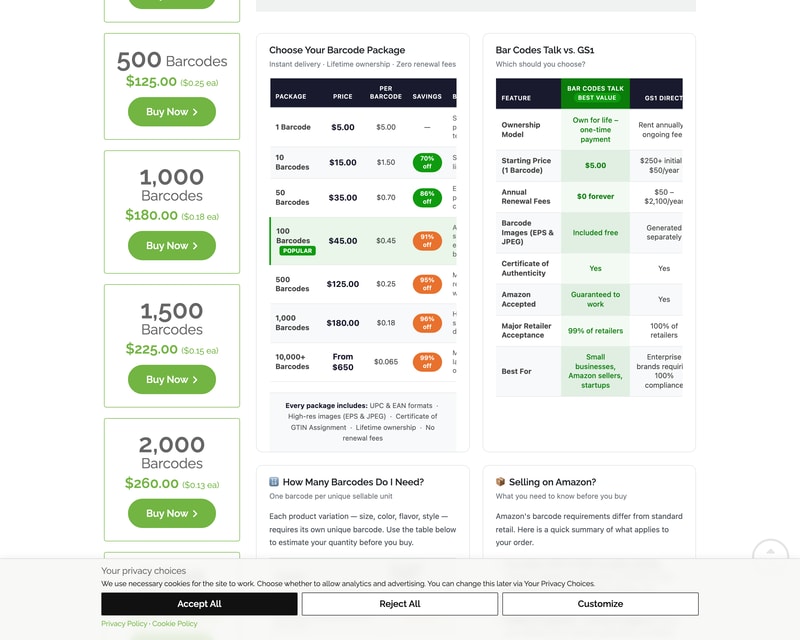
Eighteen published tiers, one-time payment, no subscription:
| Quantity | Price | Per barcode |
|---|---|---|
| 1 | $5.00 | $5.000 |
| 5 | $10.00 | $2.000 |
| 10 | $15.00 | $1.500 |
| 25 | $25.00 | $1.000 |
| 50 | $35.00 | $0.700 |
| 100 | $45.00 | $0.450 |
| 200 | $80.00 | $0.400 |
| 500 | $125.00 | $0.250 |
| 1,000 | $180.00 | $0.180 |
| 1,500 | $225.00 | $0.150 |
| 2,000 | $260.00 | $0.130 |
| 2,500 | $300.00 | $0.120 |
| 5,000 | $500.00 | $0.100 |
| 10,000 | $650.00 | $0.065 |
| 25,000 | $1,200.00 | $0.048 |
| 50,000 | $2,300.00 | $0.046 |
| 75,000 | $3,225.00 | $0.043 |
| 100,000 | $3,500.00 | $0.035 |
Every per-unit figure on that page is arithmetically correct — we checked all eighteen.
Against GS1 US, the gap is enormous
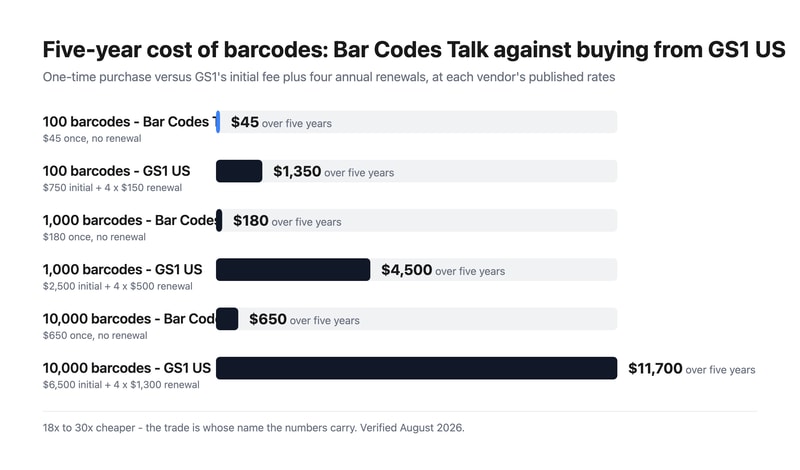
GS1 US, the official issuer, publishes its own rates — an initial fee plus an annual renewal:
| Items | GS1 initial | GS1 annual renewal | 5-year GS1 total | Bar Codes Talk |
|---|---|---|---|---|
| 1 | $30 | $0 | $30 | $5 |
| 10 | $250 | $50 | $450 | $15 |
| 100 | $750 | $150 | $1,350 | $45 |
| 1,000 | $2,500 | $500 | $4,500 | $180 |
| 10,000 | $6,500 | $1,300 | $11,700 | $650 |
| 100,000 | $10,500 | $2,100 | $18,900 | $3,500 |
Across the middle of that table Bar Codes Talk is 18 to 30 times cheaper over five years, and the recurring fee is the reason: GS1’s cost never stops, while Bar Codes Talk’s is a single transaction.
One row is worth pausing on. A single GS1 US GTIN costs $30 with no annual renewal, and includes a free lifetime subscription to GS1 US Data Hub. Against Bar Codes Talk’s $5, GS1 is six times more — but that is $25, not $2,500, and it buys a number issued directly to your company. If you genuinely need one barcode for one product, going direct to GS1 is a defensible $25 decision. Above that, the economics diverge fast.
What you are actually trading
Bar Codes Talk’s numbers are described on its own site as “GS1US originated barcodes that you own.” That phrasing is precise and worth reading closely: the numbers came from a GS1-issued prefix, and you own the individual GTINs — but the prefix was issued to the reseller, not to you.
Practically, that means the company of record behind the prefix in GS1’s registry is not your business. Bar Codes Talk addresses this head-on: it supplies a Certificate of GTIN Assignment as proof of ownership, links GEPIR for lookups, and states its barcodes are “Accepted by 99% of retailers” and work for Amazon.
This is a real and long-standing split in the barcode market, and the honest advice is the boring one: check with the specific retailer you are selling into before you buy. Amazon and most ecommerce channels have historically been fine with reseller GTINs; some large grocery and big-box chains ask for a prefix registered in the brand’s own name. If your route to market is Amazon, Etsy, Shopify or your own store, the saving is close to free money. If you are pitching a national retail chain, ask them first — a $180 mistake is cheap, a rejected listing three months into a launch is not.
The ladder has some genuinely odd steps
Because there are eighteen tiers, the marginal cost of the next barcode is not smooth. Three steps are unusually good value:
- 50 → 100 barcodes: +$10 for 50 more, or 20¢ each
- 5,000 → 10,000: +$150 for 5,000 more, or 3¢ each
- 75,000 → 100,000: +$275 for 25,000 more, or 1.1¢ each — the cheapest barcodes on the entire page
Nobody should buy 75,000. For $275 more you get 25,000 additional numbers, which is a quarter of a cent above what you were already paying and the single best marginal rate Bar Codes Talk offers.
And three steps where the marginal cost actually rises:
- 100 → 200: marginal cost goes from 20¢ to 35¢ each
- 2,000 → 2,500: from 7¢ to 8¢
- 25,000 → 50,000: per-unit improves by only 4% (4.8¢ → 4.6¢) while your spend doubles
None of this is hidden — every price and per-unit figure is on the page. But the ladder rewards checking the tier above yours rather than buying the number you first thought of.
Also: never buy one barcode. At $5 for one and $10 for five, the four extra numbers cost $1.25 each. If there is any chance of a second product, take the five.
What actually decides your cost
- How many barcodes you buy, which is the only variable — the price is a single one-time payment.
- Which tier you land in, since several steps up cost very little more.
- Nothing else. No renewals, no per-product fees, no subscription, no hidden charges.
- Not the format — UPC and EAN, EPS and JPEG, spreadsheets and the certificate are all included.
Who Should Use Bar Codes Talk
Bar Codes Talk fits an Amazon seller, Shopify merchant, Etsy shop or small brand that needs GTINs to list products and does not want an annual licence fee attached to that need forever. For a seller launching 40 SKUs, $35 once against GS1’s $250 plus $50 a year is not a close call, and the instant delivery means you are listing the same day.
It also fits anyone buying in bulk for private label or dropshipping, where the per-unit rate falls to 3.5 cents and the numbers never expire.
It fits badly for a brand whose route to market runs through large national retailers with strict GS1 requirements, or one that expects to be acquired or audited on its supply-chain data. It also fits badly, marginally, for someone who needs exactly one barcode — GS1’s own single GTIN is $30 with no renewal and carries your company’s name.
Honest Pros and Cons
What works well:
- 18 to 30 times cheaper than GS1 US over five years at typical volumes.
- No renewal fees, ever — a single payment against GS1’s recurring annual licence.
- The complete price ladder is published, all eighteen tiers, with per-unit figures that are all correct.
- UPC and EAN both included at no extra cost, plus EPS and JPEG artwork.
- Certificate of GTIN Assignment supplied as proof of ownership.
- GEPIR linked in the site navigation, inviting registry lookups rather than avoiding them.
- Instant digital delivery and a free sample package before you buy.
- Free tools — quantity calculator, barcode generator, scanner and FNSKU labels.
- 200,000,000+ barcodes sold, so this is an established operation rather than a new one.
What to watch:
- The GS1 prefix behind the numbers was issued to the reseller, not to your company.
- Some large retailers require a prefix in the brand’s own name — check yours before buying.
- “Accepted by 99% of retailers” is the vendor’s own figure, unsourced.
- Marginal cost rises at three points in the ladder — 100→200, 2,000→2,500 and 25,000→50,000.
- Buying 75,000 makes no sense when 100,000 costs $275 more.
- A single barcode at $5 is poor value against five for $10 — and against GS1’s own $30 no-renewal GTIN.
- No Findstack user reviews, and no category assigned to the listing.
Bar Codes Talk Alternatives and How It Compares
- GS1 US directly is the official route: $30 for a single GTIN with no renewal, rising to $750 plus $150 a year for 100 and $2,500 plus $500 for 1,000. More expensive by a wide margin, and the numbers are registered to you.
- Other barcode resellers — Nationwide Barcode, Speedy Barcodes and similar — operate the same model at broadly similar prices; compare on inclusions and refund terms rather than headline rate.
- Shopify does not require GTINs for your own storefront at all, which is worth knowing before you buy any.
- Jungle Scout and similar Amazon tools help with the listing work that follows once you have the numbers.
- Zoho Inventory and other inventory systems consume the GTINs you buy; none of them issue them.
The honest comparison is really just two options: buy from GS1 and pay annually for numbers in your own name, or buy once from a reseller and accept that the prefix is not yours. Bar Codes Talk is a good example of the second option — transparent pricing, everything included, and a registry link in its own navigation.
The Verdict
On price and packaging, Bar Codes Talk is hard to fault. Eighteen published tiers, correct arithmetic on every one, no subscription, no renewal, UPC and EAN together, artwork and certificates included, and instant delivery. Against GS1’s own published rates it is 18 to 30 times cheaper across five years at the volumes most sellers actually need.
The one thing to be clear-eyed about is what the low price reflects. These are GS1-originated numbers resold from a prefix that belongs to Bar Codes Talk, and the company says so in its own product description. For Amazon, Shopify, Etsy and the large majority of online retail that is entirely fine and the saving is real. For a national grocery or big-box listing it may not be, and that is a question for your buyer rather than for a review.
So: ask your target retailer first, then buy the tier above the one you need. Several steps up the ladder cost almost nothing — 50 to 100 barcodes is $10, 5,000 to 10,000 is $150, and 75,000 to 100,000 is $275 for 25,000 extra numbers. Since the numbers never expire and there is no renewal, unused barcodes cost you nothing to hold.
And if you need exactly one barcode, look at GS1 first. A single GS1 US GTIN is $30 with no annual fee and comes with a lifetime Data Hub subscription. That is the one place on the whole comparison where paying the official issuer is a $25 decision rather than a $4,000 one.
FAQ
How much do barcodes cost at Bar Codes Talk?
It is a one-time purchase with no renewal fees, across eighteen published tiers: $5 for one barcode, $10 for five, $15 for ten, $25 for 25, $35 for 50, $45 for 100, $125 for 500, $180 for 1,000, $500 for 5,000, $650 for 10,000, $2,300 for 50,000 and $3,500 for 100,000. Per-barcode cost falls from $5.00 to 3.5 cents. Every purchase includes UPC and EAN versions, EPS and JPEG images, a Certificate of GTIN Assignment and Excel and PDF spreadsheets.
Is it cheaper than buying barcodes from GS1?
Dramatically, because GS1 charges an annual renewal and Bar Codes Talk does not. GS1 US lists $750 plus $150 a year for 100 barcodes, $2,500 plus $500 a year for 1,000, and $6,500 plus $1,300 a year for 10,000. Over five years those come to $1,350, $4,500 and $11,700 against Bar Codes Talk’s $45, $180 and $650 — between 18 and 30 times cheaper. The exception is a single barcode: GS1 US charges $30 with no annual renewal, which is only $25 more than Bar Codes Talk’s $5.
Are reseller barcodes accepted by retailers?
Mostly, but confirm before you buy. Bar Codes Talk states its barcodes are “Accepted by 99% of retailers” and work for Amazon, supplies a Certificate of GTIN Assignment as proof of ownership, and links GS1’s GEPIR registry lookup in its own navigation. The structural point is that the GS1 prefix behind the numbers was issued to the reseller rather than to your company. For Amazon, Shopify, Etsy and most online retail that is not an obstacle; some large national grocery and big-box chains require a prefix registered in the brand’s own name. Ask your specific retailer first.
Which quantity should I buy?
The tier above the one you think you need, because several steps cost very little. 50 to 100 barcodes is only $10 more (20¢ each for 50 extra), 5,000 to 10,000 is $150 more (3¢ each), and 75,000 to 100,000 is $275 more for 25,000 additional numbers — 1.1 cents each, the cheapest rate on the page. Since the barcodes never expire and carry no renewal fee, unused ones cost nothing to hold. The one tier to avoid entirely is 75,000, which is poor value against 100,000, and buying a single barcode at $5 when five cost $10.
Do Bar Codes Talk barcodes expire or need renewing?
No. This is the core difference from buying direct: the purchase is one-time, with no renewal fees or ongoing charges — the site’s own framing is “Why rent? Pay once and own for life!” GS1 US, by contrast, charges an annual renewal on everything except a single GTIN: $50 a year for 10 barcodes, $150 for 100, $500 for 1,000, $1,300 for 10,000 and $2,100 for 100,000. Over any multi-year horizon that recurring fee is what produces the large cost gap between the two routes.

Sorry, no reviews are available for this product yet.
Be the first one to review Bar Codes Talk !