

Unclaimed: Are you working at Datapeople?
Datapeople Reviews: 4.4/5 — Solid Choice
Datapeople.io is a powerful data management platform that utilizes artificial intelligence and machine learning to streamline the process of data collection, analysis, and visualization for organizations. Its user-friendly interface and customizable features make it easy for businesses of all sizes to organize and make sense of their data, helping to improve decision-making and drive growth.

| Capabilities |
AI
API
|
|---|---|
| Segment |
Small Business
Mid Market
Enterprise
|
| Deployment | Cloud / SaaS / Web-Based |
| Support | 24/7 (Live rep), Chat, Email/Help Desk, FAQs/Forum, Knowledge Base, Phone Support |
| Training | Documentation |
| Languages | English |
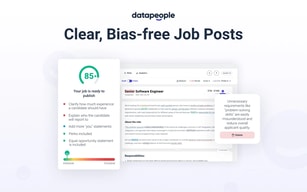
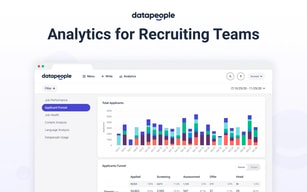

easy to use helpful explanations and examples
the update time/lack of visibility of JD on the page when the datapeople extension is on and it's not updated
working towards inclusivity, eliminating unnecessary vocabulary, corporate jargon etc
Datapeople's language suggestions for my job posts made them easier to read and more inclusive, which led to higher interest levels from candidates. The suggestions also helped me focus on the creating clear criteria to help candidates determine their fit based on their skills and experience.
It is an added step into the process, which makes posting jobs a little longer, but it is worth it based on the results. The integration between Datapeople and Workday takes time, which means I can't create my job posts as soon as a new search is assigned to me.
Datapeople is helping us create more inclusive and concise job descriptions that provide a clear overview of our expectations for the role and the necessary skills required.

User friendly, and provides many options for me to choose from.
The template sometimes has to be readjusted.
DEI issues, helps with diversity and to attract more diverse candidates.

Help us come across as less generic in our job postings as well as detailing why certain words or phrases come across as exclusionary and therefore prohibit us from appealing to a wider audience.
Sometimes the AI suggests removing crucial detail specific to the role and provides alternative synonyms that don't fit within the context of the post.
The main benefit is helping us acknowledge the unconscious biases in our language and giving us the reasons why these words don't appeal to the broadest possible audience.
I like that the suggestions are clear and actionable. No room for vaguely written advice.
It's not as user friendly as I was initially told, though that may be more of an internal problem, admittedly.
It's giving me the data I needed to convince my clients that we needed to reduce our post lengths drastically.
I've used Datapeople to create JDs, and am amazed at how easy it is to create a great JD that will draw in just the right candidates! Getting advice on JD length, and suggestions on what phrases to use, and which ones not to use, was incredibly helpful and made the process quick.
There were a few instances where I tried to address a flag that Datapeople raised about my JD - for example, suggesting I provide information about location of the job, but it didn't recognize that I had done so. It would be nice if you could somehow respond to or override a suggestion in such cases.
Datapeople helps me ensure the JDs that I write are going to attract the right candidates with the skillsets and experience I need. It's going to help me hire better people.
able to tell whether the JD is an inclusive one and make suggestions on how we can make it more appealing to candidates
not much at this point. perhaps could provide some reference templates for different jobs/ functions
rewriting JD in a inclusive way
Really easy to use - It gives great suggestions as to what is more inclusive (language) in job descriptions as well as telling you when the JD is too lengthy, or needs more adding to it.
In some instances you are asked to delete certain words or even technology names that are vital for the job description. That can mean not achieving the score without being able to do anything to change
It helps with making our job descriptions a lot more inclusive, which in turn will reach and appeal to more of the job market and ultimately give us a bigger, better pool of candidates
The logic that underpins the platform is sound, with the majority of recommendations making sense and genuinely improving JDs.
I hate the red error messages and the experience of filling placeholders with actual content.
Stops me from writing unnecessarily long JDs; helps me avoid empty or jargon-y language.
Functionality and recommendations for changing job ads
Nothing but if I had to choose it would be some recommendations don't make sense in the context of the sentence.
Its helps drive more diverse applications and I've already noticed an uptick in some of my ads.
It integrates well with our ATS; I don't have to navigate to a different platform to get help ensuring my job description is well-written and inclusive. The feedback is usually really sensible and helps make sure my job posting is attractive to the widest pool of talent.
So far, I don't have any negative feedback.
Better and more inclusive job postings!
They suggestions that are provided to make it easier to edit.
It predetermines how many years of experience is needed for specific titles and will hurt the grade if your system doesn't agree with our metrics for a role
Wording to avoid scaring away candidates
Datapeople made it extremely easy to update and modify some stale job descriptions. They helped edit the content in a way that was easy to use and understand while making it approachable to a wider audience. They kept me updated on edits progress to get to a score that was an appropriate measure for publishing.
There were some lines that seemed to auto-correct as I put in specific criteria in some areas. I don't know if that was a feature or a glitch but even after going back a retyping it the same lines seemed to auto-correct out on multiple job posts.
We are looking to hire more diversely, so language that sometimes feels natural to use like corporate jargon and team-specific names is highlighted as non-essential. Hopefully, we will see results from the refreshed JDs soon.
Being guided on how best to word and phrase the job description so as to attract more candidates
It does not take into consideration cultural context and usage of words and terms in certain cultures
Saves time building job descriptions and it helps build a job description that candidates are drawn to
I started using Datappl when it first launched, and it has improved by leaps and bounds. The collaboration possibility and the automation is the best when creating and reviewing job descriptions.
I dislike that there are still sections that you can't bypass. For example, branded content that can't be edited but still gets highlighted and underscoring words that must be included, such as Analyst.
It's contributing to our DEI goals in making sure that we have inclusive job descriptions, and the automation with Greenhouse is beneficial for efficiency of our recruiters and HMs.
Helpful to collaborate with hiring managers on their job description - enabling to go through the process of testing different things/learning about language that will work well from a DEI perspective.
Our integration between DataPeople and Lever doesn't allow direct upload of a JD from the draft by the HM to the recruiter. Meaning I have to copy/paste it which takes time and effort. There's also a disconnect with the spacing that can make JDs look sloppy and lots of editing/back and forth.
Datapeople helps our jobs be more equitable in our searches therefore assisting with our DEI efforts. More inclusive language makes our roles more appealing to diverse candidate pools.
I like the rating system, which gives a clear indication about where to improve a job description. It's a clear UI which is simple to use making it accessible to those who aren't necessarily in HR as well.
I've found it difficult to create custom templates, because it's unclear what sections can be modified or not which tends to be restrictive. However, maybe this is part of my org's setup/settings.
Datapeople solves the problem of writing job descriptions that aren't inclusive or aren't of a high quality. This benefits me because I can get instant feedback without needing a human review each time.
Checking the language we use and helping us write succinct adverts.
The need for years of experience - we don't use years in our adverts and this affects the score.
Ensuring managers write inclusive adverts.
Makes our job ads more inclusive and cuts down on unnecessary verbiage
Extra step in our job ad creation process, can slow us down a little bit.
Helping to creat better job ads for us.
The suggestions the tool makes and how it gives you a detail of what needs to be changed
Permissions are sort of complicated for hiring managers. I end up having to ping them and ask for permission or else I can't copy and paste it into our job posting tool. My suggestion would be to create a notification that says "give your recruiter permission to edit and post" so they know to do that.
Datapeople is helping the hiring managers that I work with write more fruitful job descriptions and putting the ownest on them to be precise and in exact in what they are looking for.
The ability to optimize our job postings
Sometimes needing to troubleshoot issues.
Increases our pool of diverse candidates and makes our listings more relatable.
DataPeople is a very intuitive solution to optimizing your job posts. You can make edits fairly quickly and revert back to the original description at any point
DataPeople is currently integrated with our ATS (Lever). When setting up the job, sometimes the formatting doesn't always show up consistently from DataPeople to Lever and vice versa
Writing inclusive job posts, optimizing length, build diverse pipelines, store job descriptions in one place
Easy to use, efficient and reduces manual tasks. The interface is also very intuitive and I love the way it makes my language more intriguing while writing job descriptions.
I like Data People a lot and can't think of anything which I dislike in particular. A little more customized templates would be helpful.
I think Data People makes sure that we are inclusive in our recruitment and helps create JDs which are catering to all types of people.
At our company, we love that this eliminates corporate cliques and makes the job descriptions clear and concise. We are getting more candidates that are best for our role due to Datapeople!
Although we love Data people we arent too fond of retitling some of our jobs. It confuses the candidate when we list one title and then internally they are another title.
It gives us more qualified candidates in our pipeline which is wonderful. It also gives our candidates a full look at our benefits and why they should come to be a part of our team.
I really enjoy that it tells you which words or phrases aren't inclusive. I think that's probably the most helpful piece of it!
I wish it included more suggestions of what else to use. I love when it tells me I could add something like a specifically required skill and/or wording.
It's helping me differentiate my job descriptions but being the usual boilerplate ones that don't help candidates find what they're looking for.

The word correction part is the best part
Not all features included in basic plans
My company's job posts are not very consistent over all departments, datapeople is helping me bring that consistency
DataPeople is easy to use and very insightful. It provides helpful recommendations that really make you think about how you should be approaching the way you write JDs.
There are phrases that we use that are inclusive but when input into DataPeople, it brings down our score. Also, some of the alternative language suggested isn't quite right.
DataPeople is helping hiring managers with different levels of experience write job descriptions. It gives them a great understanding of how to be inclusive and where we can improve.
I really appreciate the recommendations that makes the job postings more DEI friendly.
I can't think of anything I dislike. The job posting format could possibly use a face lift.
It's helping us to attract a more diverse group of people and is reflective on the diversity of our applicants.
The responsiveness and support from the reps through onboarding thus far.
Timeliness of implementation. We are still undergoing implementation and awaiting training for our recruiting team.
debiasing our job postings and embedding a template within our ats for easing our posting process.

I like that it helps us write the JD, keeping inclusive in consideration
Sometimes it suggests words that don't go well with the job
It makes the life of the TA team easy by helping us create the JD, keeping imp things in consideration