

Unclaimed: Are you working at Runable?
Runable Reviews — Pricing, Features & The Honest Take
Runable is a general-purpose AI agent platform that turns natural-language tasks into finished deliverables — websites, slide decks, reports, images, video, documents and more — handling research, build, deployment, design, editing and integrations without requiring users to code. It offers plan-first workflows, reusable skills/templates, a visual canvas for media editing, branding memory, multi-modal chat and broad connector support to automate multi-step tasks and deliver production-ready assets via a cloud-hosted SaaS.
| Company | Runable, LLC |
|---|---|
| Year founded | 2025 |
| Company size | 11-50 employees |
| Headquarters | Dover, Delaware, USA |

| Capabilities |
AI
|
|---|---|
| Segment |
Small Business
Mid Market
Freelancer
|
| Ease of use |
Beginner
|
| Deployment | Cloud / SaaS / Web-Based |
| Support | Email/Help Desk, FAQs/Forum, Knowledge Base |
| Training | Documentation |
| Languages | English |
Runable Pros and Cons
- Broad output capability (websites, reports, images, video, slides) from one agent
- Plan-first workflow that clarifies scope before build
- Extensive integrations/connectors (3,000+), plus reusable skills/templates
- Memory/brand consistency features to reduce repetitive instructions
- Generous free tier; Pro is relatively affordable
- Credit usage can be hard to predict for heavy or media-rich outputs
- Limited public information on team collaboration, seat roles, and enterprise pricing
- No evidence of an open-source release or on-premise deployment
- Outputs still require human review for design and accuracy
- Language support beyond English is uncertain



Runable takes one prompt and hands back a finished thing — a deployed website, a slide deck, a spreadsheet, a video, a research report. It is sold as a replacement for a stack of separate subscriptions rather than another chat window, and the breadth is real: ten distinct output types from one workspace. The pricing detail worth knowing before you subscribe is that the free tier’s 1,500 daily credits work out at roughly 45,000 a month — about two-thirds of what the $20 Pro plan delivers. For a lot of people, free is not a trial here.
- What it is: A general-purpose AI agent platform producing multi-format deliverables.
- Best for: Solo operators and small teams consolidating several creative subscriptions.
- Pricing: Free, Pro $20/month, Max $100/month. 25% off annual. Verified August 2026.
- The honest catch: Credits are the real unit, and the free daily allowance is generous enough to blur the upgrade case.
What Is Runable?
Runable is a prompt-to-deliverable agent platform, run by Runable, LLC — a young company, founded 2025 and registered in Dover, Delaware, with a team of 11–50.
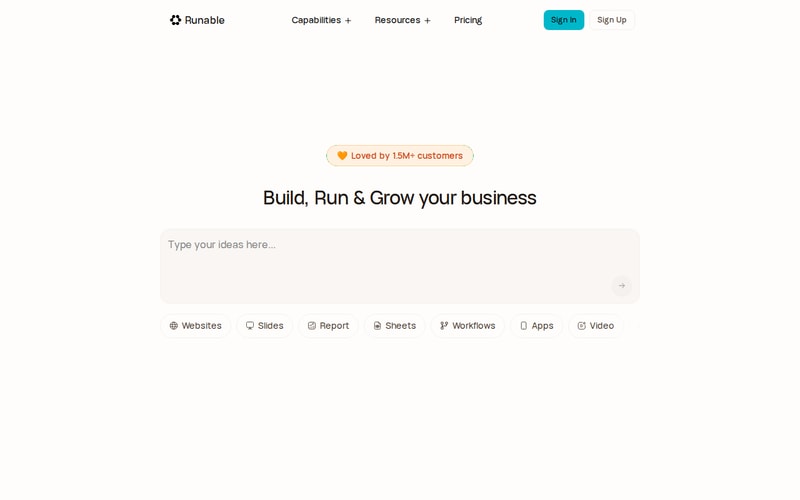
The homepage lists what it makes rather than what it is: websites, slides, reports, sheets, workflows, apps, video, image, audio and carousels. That framing is accurate to how the product works — you describe an outcome and it runs the research, build and design steps to produce it, rather than returning instructions for you to follow.
It reaches you through the web app, iPhone, Android and Mac, and connects to Slack, Teams, Telegram, iMessage and Discord so work can be handed off from wherever it is being discussed. There are 3,000+ plugins and a library of prebuilt workflows.
How Runable Works
- Plan-first: it drafts an approach before executing multi-step work.
- Ten output types from one workspace, no per-format tool.
- Visual canvas for editing generated media rather than re-prompting blindly.
- Branding memory so outputs stay consistent across jobs.
- Reusable skills and templates, plus 100+ curated workflows.
- Reachable from chat: Slack, Teams, Telegram, iMessage, Discord.
- Credit-metered, with a daily allowance that runs on every plan.
Runable Pricing
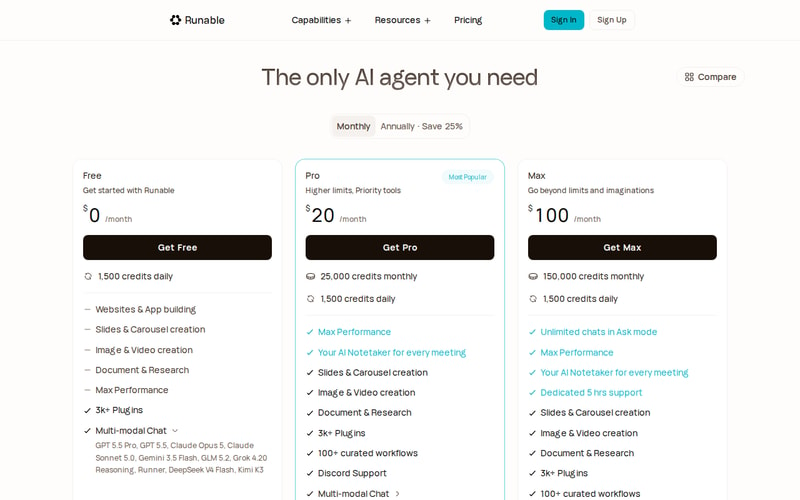
| Plan | Monthly | Credits |
|---|---|---|
| Free | $0 | 1,500 daily |
| Pro | $20 | 25,000 monthly + 1,500 daily |
| Max | $100 | 150,000 monthly + 1,500 daily |
Annual billing takes 25% off the paid tiers. The important thing the table hides is that the daily allowance keeps running on paid plans, so the tiers are additive rather than replacements:
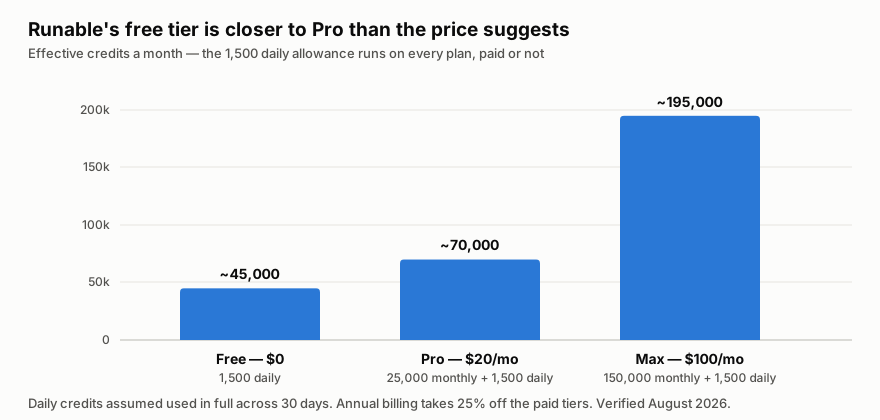
Used in full, the free plan’s daily credits come to around 45,000 a month against Pro’s ~70,000. Pro adds about 56% more monthly capacity for $20 — worth it if you are running work most days, and hard to justify if your usage is occasional. That is an unusually honest free tier, and it is the single most useful fact for deciding what to pay.
The catch is the shape of the allowance rather than the size. Daily credits do not roll over. A burst of heavy work in one afternoon will exhaust the day’s 1,500 while the rest of the week goes unused, which is exactly when Pro’s monthly pool earns its money. If your usage is spiky rather than steady, upgrade sooner than the totals suggest.
Pro also adds the things that make it a working tool rather than a sandbox: an AI notetaker, a personal assistant across the chat platforms, a hosted database, analytics and Stripe integration.
Who Should Use Runable
Runable’s clearest case is the solo operator or small team currently paying for several narrow tools — a site builder, a design subscription, a video generator, a research assistant. At $20 a month Pro undercuts almost any two of those individually, and the consolidation argument holds if you genuinely use several of the output types.
It also suits bursty creative work: a founder producing a pitch deck one week and a landing page the next, where no single tool would be used enough to justify its own subscription.
Two groups should be cautious. If you need one output type done to a professional standard — a production website, a broadcast video — a specialist tool will beat a generalist, and Runable’s breadth works against depth. And if you need enterprise governance, note that this is a 2025-founded company with no listed API access, no SSO story in our data and a small team; the risk profile is different from an established vendor.
Honest Pros and Cons
Strengths
- Genuine breadth — ten output types that would otherwise be several subscriptions.
- The free tier is properly usable, at roughly two-thirds of Pro’s monthly capacity.
- Prompt-to-deliverable, not prompt-to-instructions: it produces the artefact.
- Reachable from the chat tools you already use, across five platforms.
- Visual canvas and branding memory make iteration practical rather than re-rolling the dice.
- Cheap for what it covers — $20 a month against a stack of narrow tools.
Limitations
- Daily credits do not roll over, which punishes spiky usage patterns.
- A generalist beats no specialist on depth — production-grade single-format work is better served elsewhere.
- Very young company (founded 2025), which carries the usual continuity risk.
- No API access listed in our data, limiting programmatic use.
- Credit burn is opaque until you run your own workloads — the plan tables tell you the allowance, not what a task costs.
- No self-hosted option, so everything runs in their cloud.
Runable Alternatives and How It Compares
The closest comparison is Viktor, which shares the artifact-first agent model and credit metering. The differences are decisive rather than marginal: Viktor lives in Slack and Teams and starts at $50 a month with no volume discount at any tier, while Runable is a standalone workspace reaching five chat platforms and starts at $20. Runable is the cheaper entry; Viktor is the better fit if all your work already happens in Slack.
Against general assistants like ChatGPT or Claude, the case is the deliverable and the deployment — Runable ships a live site rather than describing how to build one. Against specialist tools, the case is purely economic: one $20 subscription instead of four.
The Verdict
Runable is a good-value generalist with an unusually honest free tier. The breadth is real, the consolidation argument stands up for anyone paying for several narrow creative tools, and $20 a month is genuinely cheap for what it covers.
Start free and mean it — 45,000 effective credits a month is enough to establish whether the outputs meet your bar, which is the only question that matters with a generalist. Upgrade when you hit the daily ceiling rather than the monthly one, because that is the signal your usage shape needs Pro’s pooled credits. And keep the company’s age in view: this is a 2025 startup, so avoid making it the single point of failure for anything you cannot rebuild.
FAQ
How much does Runable cost?
Free gives 1,500 credits a day. Pro is $20 a month for 25,000 monthly credits plus the daily allowance, and Max is $100 a month for 150,000 plus the daily allowance. Annual billing takes 25% off the paid tiers. Verified August 2026.
Is Runable’s free plan actually usable?
Unusually so. Used in full, 1,500 daily credits come to roughly 45,000 a month — about two-thirds of what Pro delivers. The real limitation is shape rather than size: daily credits do not roll over, so heavy bursts hit a ceiling that Pro’s monthly pool would absorb.
What can Runable actually produce?
Websites and apps, slide decks and carousels, reports and documents, spreadsheets, images, video and audio, plus automated workflows. It runs the research and build steps itself rather than returning instructions.
When should I upgrade from Free to Pro?
When you start hitting the 1,500-credit daily ceiling, not when you approach a monthly total. Pro’s pooled monthly credits are what absorb bursty work, and it also adds the AI notetaker, hosted database, analytics and Stripe integration.
How does Runable compare with Viktor?
Both are artifact-producing AI agents billed by credits. Runable is a standalone workspace starting at $20 a month and reaches five chat platforms; Viktor lives specifically in Slack and Teams and starts at $50 with a flat rate at every tier. Choose Viktor if your work happens entirely in Slack, Runable if you want the cheaper entry point and broader output types.

Compare Runable with other popular tools in the same category.
Sorry, no reviews are available for this product yet.
Be the first one to review Runable !