

( 92 )
Unclaimed: Are are working at Sentry ?
Sentry Reviews: 4.5/5 — Highly Rated
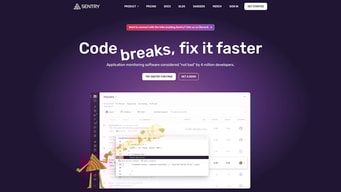
Sentry is an open-source error tracking tool that helps developers monitor and fix crashes in real time. It streamlines the process of identifying, diagnosing, and fixing bugs in software applications across various programming languages. Sentry's capabilities include providing detailed error reports, context on what caused each error, and tools for team collaboration to efficiently address issues.
Sentry is also often used as Application Performance Monitoring (APM) Tools of choice in Indie Hacker and Web Development tech stacks.


| Capabilities |
API
CLI
OSS
|
|---|---|
| Segment |
Small Business
Mid Market
Enterprise
|
| Deployment | Cloud / SaaS / Web-Based, On-Premise Linux |
| Support | Chat, Email/Help Desk, FAQs/Forum, Knowledge Base |
| Training | Documentation |
| Languages | English |

Compare Sentry with other popular tools in the same category.

quicker intigration is the best when i thought of seting it up
repeated notification but it is a valuable feature
quicker integration, website and app crash monitoring
- Detailed Error Reporting - Session Replay feature is awesome gives proper error reporting with user session recording - User Management is better - Multi Project support is good - Alert feature is good
- Give less session replay in the first plan. - some times UI un-responsive while using session replay
- Error reporting and Alerting. We will get the issue and fix it before the user reporting to us - Session replay allow us to get proper error reporting

What I like about Sentry is that it is easy to install in your project so you can start getting the errors immediately. It has a lot of metrics, and helpful information to help you debug better.
I have nothing to say about this. Sentry is very lovely, it has a generous free tier, and as a student, you can use it for many projects and a lot of reports without any cost.
Sentry benefits me by collecting the failures in the system I've built independently so I can debug errors and fix them with insightful information stored in their nice UI.
There are many softwares available for web analytics but I've found sentry to be the best. Very easy to setup and dashboard is also very easy to use. Many other softwares are lacking the features that sentry provides.
The dashboard looks a little cluttered. It can be improved. I really like the UX of Firebase Crashlytics, so something similar can be done here as well.
Sentry helps finding the bug on the website. It tells you exactly where things went wrong with the help of mentioning the line number of the source code.

The ability to trace errors and get the complete stack trace when an error is thrown in the backend application of my company. Easy monitoring and filtering through to debug and make changes in code. Near-real time uploading of logs is a must when production grade apps are deployed
Probably a more enhanced UI can help with better dashboards, web components to perform macros on the web app. Better customer service response should make this a must-recommend product
Error logging, debugging javascript errors, making changes in code, sharing a monitoring space with multiple developers, one source of truth for logging errors and understanding issues in the app
I like the versatility of Sentry, which provides different dimensions of application observability, including metrics, tracing, and error tracking.
The UI is a little too complicated and disorganized for a first-time user.
Sentry helps boost software development experience and efficiency with its versatile observability coverage and rich support for different programming languages.

One of the best things about Sentry is its ability to provide detailed information about errors and exceptions in real-time. This allows developers to quickly identify and diagnose issues, which can save them a lot of time and effort in the long run.
Some users may find that Sentry has a relatively steep learning curve, especially if they are new to error tracking and monitoring tools. Additionally, while Sentry is an open-source tool, some of its advanced features and integrations are only available in the paid plans.
Sentry solves several problems for developers and organizations, which can ultimately benefit their users and customers. Some of the key problems that Sentry addresses include: 1. Error tracking and monitoring: Sentry allows developers to track errors, exceptions, and other issues in real-time, which helps them identify and diagnose problems quickly. 2. Performance monitoring: Sentry also provides insights into the performance of applications, which can help developers optimize their code and improve the user experience. 3. Collaboration and communication: Sentry integrates with various tools and platforms, such as GitHub and Slack, which can help teams collaborate more effectively and resolve issues faster. 4. Debugging: Sentry provides detailed information about the source and context of each error, which can help developers debug their code more efficiently.
What I like most about Sentry is its ability to detect and capture errors in real-time, the detailed information it provides about the root cause of errors, the ability to customize and configure alerts, and the flexibility to adapt to specific monitoring needs.
I don't like that certain features of Sentry are not available in the plan you are using, or that the price is a bit high for the budget, or that the integration with other development tools is not as seamless as I would like.
Sentry has allowed me and my team to monitor the logs in real-time and quickly detect any problems that may arise. This has helped me to identify the root cause of errors and fix them, thus improving our systems and applications.
Group of the logs and showing up the spikes
sometimes the loading of the logs take much time
It helps in monitoring the logs and the unknown sentries

The ease of setting it up in a React Native project.
Sentry can slow your app in the dev environment
It helps us identify CRASHES and Application Performance in a better way when compared to Firebase.