


Best Web Hosting for Small Business: Pick by Failure Mode




“Small business” describes the size of your company, not the job of your website. And the hosting decision is almost entirely determined by the job.
Three small-business sites, three different things that break:
| Site type | What it does | What actually goes wrong |
|---|---|---|
| Brochure | Says who you are, once | You forget about it and the renewal price triples |
| Booking-driven | Takes appointments or payment | The confirmation email lands in spam |
| Local-SEO-driven | Ranks for “near me” searches | It’s slow, and it’s slow in the wrong country |
Ranking nine hosts on one axis can’t answer three different questions. So here’s the cost floor, and then the three answers.
The cost floor
Promotional rates are all roughly the same. What separates these hosts over three years is how long the promotional term runs before the renewal arrives.
| Host | Plan | Promo | Term | Renewal | 3-year effective |
|---|---|---|---|---|---|
| Hostinger | Premium | $2.99 | 48mo | $10.99 | $2.99 |
| HostGator | Hatchling | $3.75 | 36mo | $10.99 | $3.75 |
| Bluehost | Starter | $3.99 | 36mo | $9.99 | $3.99 |
| IONOS | Essential | $4.00 | 12mo | $8.00 | $6.67 |
| DreamHost | Launch | $2.89 | 12mo | $9.99 | $7.62 |
| IONOS | Plus | $1.00 | 12mo | $14.00 | $9.67 |
| GreenGeeks | Lite | $2.95 | 12mo | $13.95 | $10.28 |
| SiteGround | StartUp | $2.99 | 12mo | $17.99 | $12.99 |
Three-year effective = the promo rate for as long as the term runs, then the renewal rate, averaged over 36 months.
Two things fall out of this that the promotional prices actively hide.
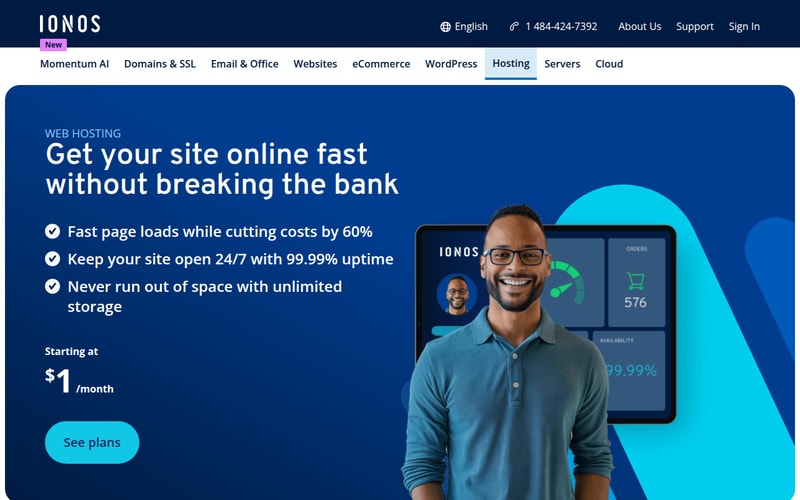
The cheapest advertised plan on the table is the sixth cheapest to own. IONOS advertises $1/month — the headline on its hosting page. That $1 is the Plus plan, normally $16, and it runs for 12 months before renewing at $14. Over three years it costs more than three times what Hostinger’s $2.99 does. It’s the steepest increase in this entire comparison and it’s attached to the most prominent number on the page.
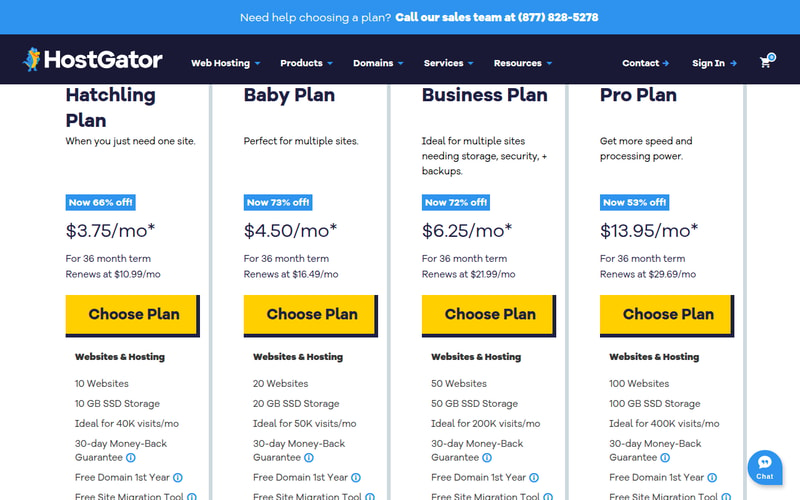
HostGator has a worse renewal than Bluehost and costs less to own. $10.99 against $9.99 at renewal — but HostGator’s promo runs the full 36 months, so inside a three-year window you never reach it. To its credit, HostGator states the term and the renewal rate on the plan card itself, which most of this list does not:
The percentage increase tells you almost nothing. The term length tells you the bill. We worked through why that inverts the rankings in our renewal pricing analysis — and the checkout extras that sit on top are itemised in what web hosting actually costs, including which two are worth keeping.
If it’s a brochure site
You have a homepage, an about page, a contact form, and no plans to touch it again. This is the majority of small business websites and the honest advice is boring: buy on three-year cost and stop thinking about it.
Buy Hostinger Premium. $2.99/month with the promotional rate covering 48 months, so the renewal doesn’t arrive inside your planning horizon at all. Nothing else on the table is cheaper to own.
The one thing worth doing beyond that: set a calendar reminder for two months before your term ends. The renewal-price problem is not really a pricing problem, it’s an attention problem — these increases work because the invoice arrives on a card you set up three years ago and nobody reads it. A reminder converts a 268% increase into a negotiation or a migration.
What you can safely ignore: every performance claim in the marketing. A brochure site with a handful of pages and no database queries will be fast on any of these hosts. Speed differences between shared plans are real and irrelevant at this scale.
If it takes bookings or payments
Now the site earns money, and the failure mode changes completely. The thing that breaks is not the website — it’s the email.
When a customer books an appointment, two emails have to arrive: their confirmation, and your notification. On shared hosting, both are sent from an IP address you share with hundreds of strangers, and your deliverability is a function of their behaviour. One spammer on your IP range and your booking confirmations start landing in spam folders.
The failure is silent and it costs you customers who think they booked. Nobody emails to say “your confirmation went to junk” — they just don’t turn up, or they book with someone else.
The fix is to stop sending transactional email from your web host. Use a dedicated transactional email service with its own authenticated sending domain, and point your booking plugin at it over SMTP. Then set up SPF, DKIM and DMARC records for your domain. This is an afternoon’s work, it’s usually free at small-business volumes, and it matters more than every hosting feature on this page.
Two hosting-side things that also matter here:
Real backups you have tested restoring. Not “the host says it does backups” — an actual restore you have performed once. A booking site holds data that exists nowhere else. This is one of the two checkout upsells we’d tell you to pay for rather than decline.
Uptime you’d notice. A brochure site being down for an hour costs nothing. A booking site down on a Monday morning costs a morning of bookings. This is the case for SiteGround despite it being the most expensive option on the table at $12.99 over three years — its support and infrastructure are genuinely better, and if the site is taking money, $10/month more is not the variable to optimise.
If the payments side is central rather than incidental, our ecommerce hosting comparison is the more relevant guide.
And if you take card payments, the decision that matters isn’t the host. Using your processor’s own hosted or embedded checkout keeps you on the shortest PCI questionnaire; letting card data reach your own server moves you to the longest one. We worked through what actually applies, including two requirements that were removed from the easy path in March 2025 and which a lot of current advice still tells small merchants they must meet.
If it lives on local search
A plumber, a dentist, a restaurant. Traffic comes from “near me” searches, and two hosting properties genuinely affect it.
Server location, which is the one people get wrong. If your customers are in Manchester and your host put you in Arizona, every page load carries an avoidable round trip. This isn’t a ranking-factor argument so much as a load-time one — and load time is a ranking factor. Check that your host offers a datacentre in your country and that you actually selected it, because the default is usually the host’s home region. Most of these hosts will not move you afterwards without a migration.
Core Web Vitals, where the host sets the ceiling and your site sets the result. Shared hosting can produce good scores for a small site. What it can’t do is rescue a page carrying six plugins, a slider and four tracking scripts. The order of operations matters: fix the site first, then the host. Upgrading hosting to fix a bloated page is the most common wasted spend in this category.
Where hosting genuinely helps: server-side caching that’s on by default, a CDN included rather than sold separately, and a current PHP version. All three are table stakes at this price now, which is why we wouldn’t pay a premium for them.
For UK-specific hosting with local datacentres, see our UK WordPress hosting guide.
The nine hosts
Hostinger — the default recommendation and the cheapest to own by a clear margin. $2.99/month with a 48-month promotional term, so the $10.99 renewal sits outside a three-year window. Multiple datacentre regions to choose from at signup, which matters for the local-search case. The catch is the one that applies to every host here: that rate requires a long prepaid term, and the renewal is a 268% increase whenever you do reach it.
Bluehost — $3.99 on a 36-month term renewing at $9.99, the gentlest renewal increase among the major shared hosts at 150%. If you dislike the idea of a 268% jump on principle, this is the one that jumps least, and it costs a dollar a month more to own.
SiteGround — the most expensive on this table over three years at $12.99, because a $2.99 promo runs only 12 months before renewing at $17.99. Worth it specifically for the booking-and-payments case, where support quality and uptime have a revenue consequence. Not worth it for a brochure site, where you’d be paying four times Hostinger’s price for capability you won’t use.
DreamHost — $2.89 promotional but only for 12 months, landing at $7.62 over three years. Its distinguishing feature is a genuinely strong privacy and no-upsell posture; its distinguishing weakness is the short term.
GreenGeeks — $10.28 over three years, and the reason to choose it is the carbon offsetting rather than the arithmetic. Price the migrations if you have more than one site: one is free, then it’s $15 per additional site.
InMotion Hosting — a long-standing host with a strong reputation for support and 90-day money-back terms that are unusually generous. We could not read its current pricing — its plan pages didn’t render for our automated checks — so we’re recommending it on reputation rather than on a verified figure, and you should price it yourself.
IONOS — the one to be careful with. Its $1/month headline is a 12-month promotion on the $16 Plus plan that renews at $14, which is the steepest increase in this comparison. Its cheapest tier, Essential at $4 renewing to $8, is the better-value product and it’s the one the page doesn’t lead with. Good European datacentre coverage.
HostGator — better than its reputation suggests, purely because of term length: $3.75 across a full 36 months makes it the second-cheapest to own here, and it discloses term and renewal on the plan card. The Hatchling plan covers 10 websites and 10GB, which is more than a brochure site will ever use.
Hosting.com, formerly A2 Hosting — positions on speed, with a 30-day money-back guarantee spanning shared, WordPress, email and reseller plans. Note the rebrand, because you’ll find reviews under both names and the older ones describe a different company. As with InMotion, we could not verify its current hosting rates — the figures its page exposed to us were domain pricing rather than plan pricing, which is exactly the confusion to avoid — so treat it as a shortlist candidate to price yourself.
Running client sites rather than your own? Our freelancer and agency economics covers the reselling-versus-retainer question, which changes the answer entirely.
How we checked this
Pricing we read ourselves. HostGator’s plan card — Hatchling at $3.75/mo for a 36-month term renewing at $10.99, and the Baby, Business and Pro tiers at $4.50/$16.49, $6.25/$21.99 and $13.95/$29.69 — is from its live pricing page captured on 17 August 2026, shown above. IONOS’s four tiers ($4, $6, $1 and $10 promotional against list prices of $10, $12, $16 and $20, renewing at $8, $10, $14 and $18) are from its rendered plan cards on the same date, with the 12-month term stated repeatedly on that page.
Pricing carried over from our own earlier verification: Hostinger, Bluehost, DreamHost, SiteGround and GreenGeeks are the figures established in our renewal pricing analysis, where the GreenGeeks numbers came from secondary sources rather than the vendor’s own page and are flagged as such there.
Two hosts we could not price, and we’ve said so in place of guessing. InMotion Hosting’s and Hosting.com’s (formerly A2 Hosting) plan pages did not expose current rates to our automated reads — InMotion’s returned no pricing text at all, and Hosting.com’s returned domain registration prices that would have been easy to mistake for hosting rates. Both are in the list on reputation and policy, not on a verified figure. A costed comparison with two invented rows would look more complete and be worth less.
The three-year effective figures are our arithmetic, applying each promotional rate for its stated term and the renewal rate thereafter across 36 months. They exclude domain registration, which most of these hosts give free for the first year and charge for afterwards, and they exclude the checkout extras covered in our hidden fees breakdown. Prices change often and promotional terms change more often — re-read them before buying.
What we did not measure. No uptime monitoring, no load testing, no Core Web Vitals scores, and no support response times across these nine hosts. So the recommendation of SiteGround for booking-driven sites rests on its reputation and its pricing structure, not on uptime data we hold — and if that’s the deciding factor for you, it’s the claim in this article you should trust least.
On the email deliverability section: that shared hosting means a shared sending IP, and that sending reputation is therefore partly determined by other tenants, is a property of how shared hosting works rather than something we tested. We have not measured inbox placement rates for these hosts and we’re not aware of anyone who has done it credibly. The recommendation to move transactional email to a dedicated authenticated sender is standard practice and it’s the advice we’d give regardless of host.
On server location and local search: we’ve argued from load time rather than claiming datacentre location is itself a ranking signal, because we can’t demonstrate the latter. We have not run before-and-after tests of moving a site between regions.
The host links above are affiliate links. The cheapest recommendation in this article is also the one we’ve placed first, which is a coincidence worth being explicit about — and the section telling you to fix your page weight before upgrading your hosting argues against the upgrade we’d earn from.
FAQ
What is the best web hosting for a small business?
For most small businesses — a brochure site you rarely touch — Hostinger Premium at $2.99/month, because its promotional rate runs 48 months and it’s the cheapest to own over three years. If your site takes bookings or payments, the calculation changes and support quality is worth paying for.
How much should a small business pay for web hosting?
Between about $3 and $13 per month depending on the host, once you average the promotional and renewal rates over three years. Advertised prices of $1–4 are promotional and most of them expire after 12 months.
Why did my hosting bill triple?
Your promotional term ended. Increases of 150–500% at renewal are standard across this industry. What determines your real cost is how long the promotional term runs — a 268% increase arriving in month 49 costs less than a 373% increase arriving in month 13.
Is the $1 per month hosting deal worth it?
IONOS’s $1/month is a 12-month promotion on a plan that renews at $14, making it one of the more expensive options over three years. Its own $4 Essential tier is better value. Always check the term length and the renewal rate together.
Why do my booking confirmation emails go to spam?
Usually because they’re sent from your web host’s shared IP address, whose sending reputation depends on every other site on it. Send transactional email through a dedicated authenticated service instead, with SPF, DKIM and DMARC configured for your domain.
Does server location matter for local SEO?
It matters for load time, and load time affects rankings. Choose a datacentre in your customers’ country at signup — the default is usually your host’s home region, and most hosts won’t move you later without a migration.
Will better hosting make my site faster?
Only if hosting is the bottleneck, and for a small business site it usually isn’t. Plugin count, image sizes and tracking scripts dominate. Fix the page first; upgrading hosting to compensate for a bloated page is the most common wasted spend in this category.