

Unclaimed: Are you working at Bitbucket?
Bitbucket Reviews: 4.4/5 — Solid Choice
Bitbucket is a cloud-based version control platform for developers who want to collaborate on code as well as manage software projects. The software supports tools that focus on team collaboration through review tools, issue tracking, and continuous integration.

| Capabilities |
API
CLI
|
|---|---|
| Segment |
Small Business
Mid Market
Enterprise
|
| Deployment | Cloud / SaaS / Web-Based, Desktop Mac, Desktop Windows, On-Premise Linux, On-Premise Windows |
| Training | Documentation |
| Languages | English |

Compare Bitbucket with other popular tools in the same category.
As a non-programmer, I like how intuitive it is to create a pull request. I often make non-technical edits for our website and using Bitbucket allows me to interface with our development team in a way that is meaningful to them.
It would be nice if there was some kind of tutorial for those with little to no programming experience. Even though I know how to make a pull request, sometimes I make "merge conflict" mistakes. This requires our development team to take time and fix it. If I knew how to fix it myself I would, but I have not found any simple tutorials to help me do this.
Our office was trying to find a common "holding" area that we could all submit changes to and have team collaboration on. Also, version control was a big concern for us. Bitbucket allows us to do each of these items with relative ease. To my knowledge, none of our development team has expressed any concerns with using this product. And that is an unusual thing for us. :-)
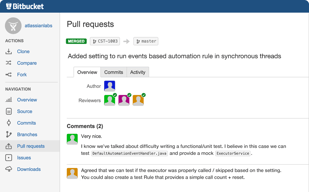
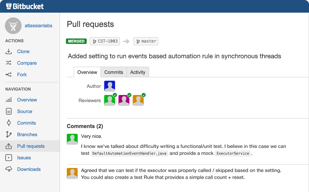
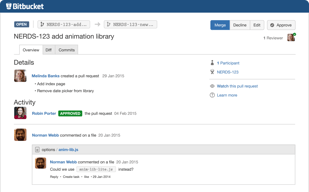
BitBucket framework helps us manage multiple projects easily. Bitbucket allows us to add one or more reviewers to a pull request who can then approve or reject the request based on code quality.
Nothing that I dislike about bitbucket. its a great tool
Helps us create pull request for the feature implemented. once approved we can further merge with the main brach such develop, master etc which can be used further deployments

* I believe it achieves the right balance for the Freemium model in the git SaaS world. * Integrates well with Jira, allowing tracking of bug/fix commits within Jira issues * They are the developers of SourceTree which is one of the most capable git desktop clients (at least on the mac) * The ability to review and comment on commits in the web interface
* Even after a recent redesign, the UI is cluttered and confused
We found Bitbucket very capable and when we first started out, it was important to us that their pricing was startup friendly while still allowing us to create private repositories right off the bat without paying (unlike github) We needed a capable git SaaS that allowed us to create private repositories without having to pay a lot because source code repositories are fundamental infrastructure that you want to stress test for a while before committing to it. Paying up front (like for github) creates a powerful disincentive to leave even if the service doesn't turn out to be optimal. I also feel that Bitbucket seems to charge for the right features. As an example, they started charging as soon as we exceeded 5 users. This is very startup friendly - we were strapped for cash early on but a bigger team is a good indicator of financial health and is a good time to start charging for access.
the flexibility and the simply way to handle development
mostly nothing. may be the possibility to be better integrate with atlas sian product
develop in cloud from everywhere

It offers a great repository and a good system of continuous integration
In some phases the interface is quite complicated and not really linear.
Free private git repository
The capability of this application exceeded my expectation. The overall GUI and Repositories make a great TFS for personal or business use. I would suggest combining Bitbucket with SourceTree for uploading and pushing changes. I personally also use Beyond compare for an overall check and balance.
It takes a little to get used to it but overall I like it.
My team is using this to fill a TFS need.
Right now I use the free version and the amount of features is amazing.
There are no down sides I can find right now.
Version control
Private repos for projects, a robust notification system and every feature you find on competing systems plus more. Bitbucket provides a complete version control, ticketing and wiki platform for your company projects.
The user interface has changed a few times in significant ways making navigation awkward until one gets the handle on the new interface.
Tracking code changes and deploying private projects while working with multiple developers.

- clean and simple UI - focused features. the platform don't have lots of features so it is easy to get started and work with it. - ecosystem for integrations and plugins that helps me to compensate the missed features
Even if there is a support for plugins and integrations, I don't see lots of them. And it's mostly hard to get my integrations works.
I use bitbucket as my default version control for all projects I'm working on.
Private repositories are allowed without upgrading to a paid subscription.
Information about repos is not as detailed as GitHub.
I needed version control in a small startup - proprietary code with not a lot of money. Therefore, paying GitHub for a private repo was not appealing. BitBucket serves its purpose well for small teams.
The best thing is it provides private repository for free upto 5 members.It also has functionalities of peer code review,version control.
After crossing limit of 2gb repository size the repository becomes ready only.I think this thing should not happen
With bitbucket we solve both version control problem and code review problem.It has highly benefited us

I like that if you just use a personal account you can create private repo's. This was something that GitHub lacked requiring you to have some sort of plan. I like that it integrates with Atlassians other products nicely.
It's a little too basic after using a service like GitHub. It adds features, but still lacks functionality that you can get with other services.
We used this to host a ton of our old sites that would build with Bamboo. It was very useful and ties in to Atlassian products greatly.

I think the main Bitbucket feature is to offer private Git repositories for free. You can store your non-open source software projects free of charge.
The way teams and project are organised, it's not clear what project belongs to each team. I am not sure if this is related to user experience design of administration website or the way teams and projects are structured.
Bitbucket offers all Git integration need to manage and store software projects.
It's open source and can work with many platforms
Security does not integrate with Microsoft stack. Would be very cool if it did.
We use it to store all of our code. It's made it very easy to share projects across teams and organizations.
Fully integrated with JIRA Easy to use and very powerful Very intuitive
For me is perfect. Just to say anything: Not free.
manage in a easy way all the code from our projects
Bitbucket is hands-down the best service that allows the use of teams/groups for projects and repositories on their free plan. The service is professional, UI is easy-to-use and intuitive, and affordable.
Because most of the small things that you can add to a project, like Slack notifications, issue tracking, and other add-ons are added and customized manually, they get tedious and difficult to use as the number of projects/repositories increases.
Bitbucket was the only service my team could use to collaborate on a large project. Services like GitHub required payment to setup an organization, which would allow to collaborate on a project.
Unlimited private repository Many tool for pull request, issue, branch Integrate native continuous integration: Bitbucket pipeline API document for webhook Tool for access management
Support team less than 5 people. Tester, QA and BA can't join in almost case.
Private repository Native Continuous integration and continuous delivery
A very good tool for code repository, using it in our client application , very easy to configure
The traversing through links could be made more user friendly and lively
We use it as our code repository
Pull requests is the feature we use most
Lack of apps to integrate to jenkins to tie pull requests closer to build artifacts.
We are working to integrate bitbucket with our jenkins pipeline to further enhance our integration and delivery processes.
it's push and pull concept is the best
when it's merge conflict occur during pulling data from bitbucket
storing code and branches that it had and code backup using brances
it allowed to create and maintein private projects, the documentation to use the platform its very usefull, and the integration with JIRA make a powerfull tool!
I'm a big fan of gitlab, personali i dislike bitbucket, but its a great tool, maybe i don't like the UI.
i worked with it in a project with a client, its very powerfull, ideal for all size projects, and has a great integation with JIRA
Free private repos. The ability to have private repos is essential since i need time to also consider licenses but still develop.
Create repo from site not cmd line. It can be frustrating since there is no command line options to create or upload New local repo to bitbucket
Private repositories
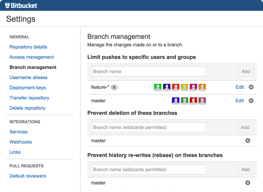
Private repository and easily control access
Forks don't inherit permissions of parent
Version control, code review
To be honest, I began using Bitbucket because github was charging me too much.
It's a little difficult to browse code. The sources are hidden and I'm not always sure what branch I'm looking at.
Working with distributed teams.
user friendly interface, great documentation great plugins
pricing, should have a community like github, code review process could have been better
we are using bitbucket for code review and also integrated with jenkins for code deployment
The value of Bitbucket can't be beat. Github might be pretty, but, being able to host private repositories for free is an amazing value to small teams. It's extremely developer-friendly in that regard.
The UI/UX, while being improved, isn't at the level of Github (or Gitlab for that matter). When dealing with it day-to-day, this generally doesn't matter. It's all the same from the commandline. However, when needing to log in and track down commits, or browse the repository at a certain period in time, this can be really frustrating.
Version control is absolutely essential for developers. Tracking users issues is also a must. With Bitbucket, our small team has a free way to track, version, and deploy code, as well as handle user issues, bugs, etc. We're better able to ensure that quality code is being written, to address real user concerns.
I like how simple and easy to use it is. We have a hosted solution sitting on a VM that functions smoothly without needing any maintenance.
That perhaps it is a little too simple. This is in part because Atlassian has diversified their product suite into multiple solutions so if I wanted a project management system I would have to get Jira as well as opposed to just using something like TFS which has both.
Code repository and version control. Although currently we use other solutions in addition to this one.
We use the full atlassian suite and the tie-in between the different products is really great and really does help the work flow more smoothly than using separate products
There is some duplication across different products leading to many ways to do the same thing. For example, you can create pull requests from Sourcetree, Agile-Jira, or Bitbucket. For certain team members this has lead to some confusion. Generally, the product is well liked, however.
We were moving from SVN which was hosted on a server, however bitbucket gives a much nicer interface to viewing the repos, branches, merges, etc.
Free and unlimited amount of private repository hosting for small development teams of up to 5 people/developers per repository. It seamlessly integrates into other Atlassian tools and services with little hassle, enabling a fluid experience across all their platforms and services. This allows development teams to easily track issues, reference those issues in commits, and deploy based on those references in a centralized and familiar environment. It includes many of the features you would find in many other repository hosting providers such as wiki's, issue/bug tracking, etc. with the added bonus of being the only one that provides free private repos on this sort of scale. Easy repository management, nice code view, fair & balanced licensing terms, and cloud-based deployment possibilities.
I would say there are two main things that stand out to me when it comes to where Bitbucket falls a bit short compared to it's competition... I have a bit of a love/hate relationship with it's user experience. Some aspects of it are perfect. Like in terms of general aesthetics, the design elements are wonderful. But when it comes to presentation and organization of information, it's a bit convoluted. Much more than is should or needs to be. My second main issue is the complexity behind setting up auto-deployments for web-based projects. It's much more complicated than it should be. Coming from Beanstalk as my main service for private repositories, where setting up auto-deployments was soooo simple, switching over to Bitbucket had me a bit frustrated. Not because it was a necessarily a big struggle to set it up, but because it simply didn't make any sense why it would have these layers complexities when competitors who fail in every other way can do this one thing so much better.
Being that we work exclusively in small development teams or solo, this provides the perfect solution for all our code repository needs and any personal projects that aren't open source. Almost everything that I'm developing which isn't open source, goes into the Bitbucket. Adding the fact that we use other Atlassian products, the development cycle is faster when integrating those products with Bitbucket.
Can't beat their pricing for private repos. Their interface is easy enough to navigate. It gets out of the way and lets you manage your code.
There isn't a social network on Bitbucket and therefore it doesn't really feel like a place for open source code. While the UI is clean it isn't polished. It leaves some room to be desired.
Bitbucket allows me to host private repos and make sure we have backups of our code.