

Unclaimed: Are are working at Salesforce Heroku ?





Salesforce Heroku Reviews & Product Details
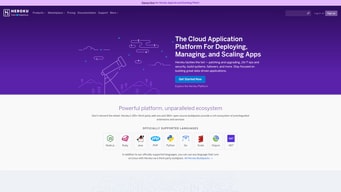
Salesforce Heroku is a cloud platform as a service (PaaS) that enables developers to build, run, and scale applications in various programming languages and frameworks in the cloud. It simplifies the deployment process, auto-manages the infrastructure, and provides integrated data services, making it easier for developers to focus on writing code without worrying about the underlying hardware or software layers. Heroku supports a wide range of development languages, including Ruby, Java, Node.js, Python, and PHP, offering a highly flexible environment for application development and deployment.
| Company | Salesforce |
|---|---|
| Year founded | 1999 |
| Company size | 10,001+ employees |
| Headquarters | San Francisco, California |
| Social Media |

| Capabilities |
|
|---|---|
| Segment |
|
| Deployment | Cloud / SaaS / Web-Based |
| Training | Documentation |
| Languages | English |

Compare Salesforce Heroku with other popular tools in the same category.
Firstly, and this cannot be overlooked, it's free to get started with Heroku and you probably won't have to pay them for a long long time (and by then you're probably making enough money anyway). Secondly, their documentation is awesome and it's really easy to get started. I wasn't a linux pro by any stretch of the imagination when I started with Heroku but if you can use Git then you can deploy to Heroku. Thirdly, they have a bunch of plugins and third party services to add support for any weird or wonderful data storage mechanisms you want to use, message queue services etc. so you basically don't have to touch infrastructure at all (something you generally would have to fiddle with if you were using AWS or Digital Ocean or the like).
Herokus is essentially Linux only... not a huge problem for many people (and certainly not for Heroku users).
I needed a place to host my public websites. Heroku is a good pick for personal/hobby projects or prototypes as well though.

Quite possibly the greatest aspect of using Heroku is the shear simplicity of working with the system. Whether you're building a Ruby, Node or PHP app, its as simple as running a command from your source directory. Heroku just gets out of your way and lets you work your own magic.
One of the only things I dislike about Heroku is the pricing model compared to some of the other PaaS solutions that are competitors. Based on the size of your app though, this may not be an issue as the cost comes with using, arguably, the leader in the space.
The largest problem I solve using Heroku is reducing the time-frame for putting out POC's. It's DEAD simple to get something live and in front of users with very minimal effort and management on your part. Being able to do this in pretty much every popular language is a really huge benefit as you don't have to jump from solution to solution.
Installation with a Mac is flawless, and accessing the server is easy. The documentation available online is also phenomenal. You can always find something that will lead you in the right direction if you are unsure about something.
I wish Heroku was not only a read-only file system. This would allow users to deploy scripts. For example, I am building a mobile application that requires me to POST to a server with a list of variables and then run a script that calls an external API with these variables.
Integration with Amazon EC2 has solved the read-only problem, and it has allowed my mobile application to send and receive data to and from the database.
Fast integration with NodeJS, mongoDB, and other new technologies and also with git. Great documentation. Any app in heroku runs smooth and fast.
Bad error log, I had some troubles building my app, and the errors those heroku give me to understand what is happening were REALLY bad, I spend a lot of time researching about issues, and many time there were package problem, or errors in the package.json. Debugging in heroku is almost imposible.
I use heroku to build mobile app backends, as API services. And also same pages or prototyping.
I love how Heroku does all the deployments and how he is able to breake all the limits
Sometimes the way it fails is really random.
Prototype fast.
How easy the application is for users to use and the flexibility and stability it provides a organization. You can host Heroku in the cloud and don't have to worry about having the overhead of any equipment on sight. This is a pretty cool application to have and use.
There isn't much that I dislike, if I had to say it would be pricing depending on what you need. Depending how much you need to scale or how fast your business grows it could get pretty expensive pretty fast. So depending on financial resources would determine if scaling is feasible.
Customer mobile application and tracking of user data. A mobile app that allows our customers to login and track their progress for the Immunotheraphy they are on. Allow the user to stay compliance.
I love the heroku tools for your terminal and how easy it is to integrate with your GIT workflow. If you're not afraid of the terminal, heroku is amazing simple and fast. Very reliable (or at least as reliable as the S3 architecture it's built on.
If amazon goes down, we all go down.
Not provided
It is easy to deploy application on heroku and config the setting , frendly UI/UX
it is not free to use. We cannot try it first.
It is easy for developer to deploy application. so far, we don't have any problem.
The ease of usage which enables fast deployment
There is nothing to dislike about the product.
Heroku's deployment process is a breeze. This benefits in deploying demos with ease. With its support for various programming languages, buildpacks, and continuous integration tools, you can deploy your application quickly and effortlessly
Heroku provides tools that enable us to deploy our application more easily and with less configuration. We get to focus our effort on product development and rapid improvement instead of spending it tinkering with server configuration.
The price is the biggest downside. We've used Heroku for 10+ years now. I had thought that over time pricing would decrease, however it appears that hasn't happened. While we'd undoubtedly save money using another service, the polished tools and convenience factor are keeping us with Heroku for now.
We use Heroku to run Ruby on Rails applications, both web/worker servers and database. Easy rollbacks, backups, and scaling options all us to worry less about the unexpected.