

Unclaimed: Are are working at Segment ?
Segment Reviews & Product Details
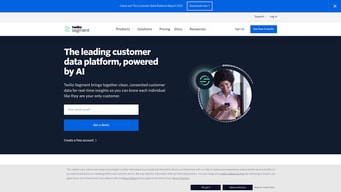
Segment is a customer data platform that consolidates data from multiple sources to provide real-time insights and enhanced customer profiles. It enables businesses to personalize customer interactions by using AI-driven predictions and recommendations. Segment offers tools and integrations that help streamline data collection, management, and activation for targeted marketing campaigns and customer relationship management.

| Capabilities |
AI
API
CLI
|
|---|---|
| Segment |
Mid Market
Enterprise
|
| Ease of use |
Advanced
|
| Deployment | Cloud / SaaS / Web-Based |
| Support | 24/7 (Live rep), Email/Help Desk, FAQs/Forum, Knowledge Base |
| Training | Documentation |
| Languages | English |

Segment makes it super simple to instrument their too and ensure that you are seeing consistent data in all of your down-stream visualization tools. The fact that you can spin up a new tool (like hotJar) with no code, in a few minutes, makes it the perfect product management weapon.
I really wish that Segment had some basic visualizations. They are ONLY a CDP, and they do it fantastically, but putting together some cookie-cutter visuals could help get it instrumented on more clients.
Segment allows us to not have tool-lock. We can instrument our tracking in Segment and have confidence that we can visualize the data in whatever the best downstream tool is for the job. Additionally, with all of the data privacy concerns that are emerging, Segment offers us a convenient one-stop-shop to offer any data requests that come through GDPR or others.
Great support staff and good response time.
How I have to email support every time a new field comes into our SFDC objects.
Piping data from Salesforce and our production app databases to visualize in Data Studio and work with in BigQuery
Simple interface, easy setup and incredibly powerful features to capture, govern and protect data and empower the business to self-sufficiently generate actionable insights and audiences, and activate them to any channel - all automatically and in real-time.
My only desire would be to have a more visual experience - highlighting a summary of details and behaviours for each profile, and perhaps some actionable insights that may be of interest to assist in building audiences. This isn't it's primary purpose, but it would be nice to have this feature built in.
I can provide sales, digital, product, marketing, customer service, customer experience, legal and compliance, and data and analytics teams access to a single view of all customer behaviour to create custom and highly targeted audiences for executing interventions to deliver highly personalised experiences to customers.
Title says it all, the tool allows us to a pass and control data flows on a level outside of code, and is extremely valuable to our core business, but the team that we have been able to work with to this point have been phenomenal. Our CSMs, AMs, and Solution Engineers have all been extremely knowledgeable and incredibly responsive.
The only thing that I would say here is that if you set this tool up incorrectly, it has the potential to be difficult to fix. Make sure that you are documenting everything and have an idea and plan before implementation on what you need and want.
It is our CDP. All of our event streaming data flows through it and it is working so well for our product that we are expanding it to our marketing. It really allows visibility and customization on a level that is outside of code, which is incredibly useful for our non technical team.

Very easy to configure and add new sources and destinations. The integrations Catalog is impressive, many options.
The pricing model especially for anonymous users. They will also count on your MTU usage, if you add the JS on landing and marketing pages, this number can go up pretty easily.
We're solving the classic marketing stack problem. Marketing team wants to use and explore many tools and now they can do that easily through segment, since my dev team only needs to add the Segment JS to the website and from there it's pretty much self-service for the marketing team.
The Segment dashboard has the nice debugger that is a web-based tool, very helpful in my case. Simple API that is documented pretty well, at least there are no issues to work with Segment from Drupal 8 application.
Actually, there are no cons to write about. Probably would be great to have a tool to copy tracking data between sources.
Basically, I'm a developer and I worked on Segment integration for the Drupal 8 site that we are developing for the client. They use Segment data to make some analytics investigations. We use many destinations like Vero, Google Analytics, BigQuery, Amplitude, and other.

The various speakers especially from IBM. A strong panel explaining exactly the process to implement, and why CDP are so important moving forward and scaling.
I'm absolutely gutted I didn't win a pelaton. jk. Fabulous event .
scaling a startup doesn't happen without strong analytics, segmentation and a CDP like Segment.

It's one of the most important, but least sexy tools in the stack. If you've ever had to manage ETL in a large organization where there are constant demands for new downstream tools getting Segment instrumented is a lifesaver. They have a huge library of sources and destinations. The documentation is very good. Their customer success teams are highly responsive and often willing to set up dedicated slack channels.
Instrumentation is not a straight forward thing. It's a mix of data, product, and engineering expertise and typically organizations don't have those all in one place (or even more rarely one person). So for start-ups and the tech world, it's a no brainer, but for enterprise, Segment really needs a strong professional services team. Also, Segment could really use a better solution for the on-prem legacy systems that bottleneck big companies. If they're already a redshift/snowflake/react shop - awesome - but most big old companies aren't.
Helps solve the data teams need for a consistent approach to user behavioral data (product data). Helps solve the need to quickly warehouse and use the data. Helps solve the evolving ETL headaches of downstream tooling. If the marketing team wants Google Analytics, the engineers want DataDog, the product team wants Mixpanel, and the data team wants Looker? No problem.

Segment provides one API that allows you to plug in with hundreds of different services, greatly increasing the amount of data and the ease at which you are able to collect data. Without having to spend hundreds of developer hours learning and implementing different APIs for each data, tracking, or marketing software, you can still integrate with so many services. Additionally, the payload of the JS loaded on the client is greatly reduced. Segment gives you the ability to playback data to a new service you want to integrate with as though you've been already sending that service data for 6 months. I think Segment is an invaluable part of a modern data and marketing stack.
The cost of Segment makes it hard to use as a startup.
Segment makes it way easier to integrate and consistently track data.
The ability clearly map, collect, and transform data in near realtime has been game changing. The fact we could slowly migrate our old marketing data flows has been helpful and productive. Having clean data among our sites that we can just combine in the same Schema has increased productivity.
The documentation for some connectors is lacking. We have a few third part vendors who we've struggled to migrate because there is almost no documentation other than making a connector.
We have heavily reduced development costs related to data ETL and measurement events. Less outages. The largest unexpected benefit was have seen is that we can test changes to third parties much faster than previous. Having a single set of semantic events has improved implementations times.


