


Best VPS Hosting in India: Start With UPI and GST, Not Specs




International hosting comparisons rank Indian VPS plans on RAM and price. For an Indian buyer, two things decide the purchase before specs come into it: can you pay without an international card, and what happens to the 18% GST.
Both turn out to be more interesting than expected, and one of them saves you real money.
The INR price is lower than the dollar price
Buyers often assume a local storefront means local markup. We checked, and it’s the reverse.
Hostinger’s Indian VPS renewals against its US dollar renewals, converted at 95.61 INR/USD:
| Tier | RAM | India renewal | US renewal | USD converted | Local vs converted |
|---|---|---|---|---|---|
| KVM 1 | 4GB | ₹999 | $11.99 | ₹1,146 | −12.9% |
| KVM 2 | 8GB | ₹1,199 | $14.99 | ₹1,433 | −16.3% |
| KVM 4 | 16GB | ₹2,399 | $28.99 | ₹2,772 | −13.4% |
| KVM 8 | 32GB | ₹4,399 | $49.99 | ₹4,780 | −8.0% |
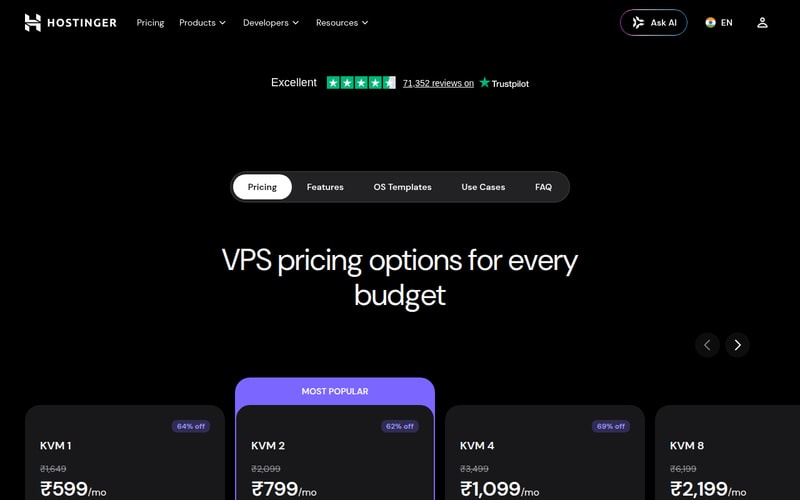
The Indian list price is 8–16% below the converted dollar price at every tier. That’s genuine local pricing rather than a currency conversion, and it’s the single most concrete reason to buy from the Indian storefront rather than the .com.
Promotional first-term rates are lower again — ₹599 for 4GB, ₹799 for 8GB, ₹1,099 for 16GB and ₹2,199 for 32GB — though as everywhere in hosting, the renewal is the number to plan around.
The GST question, answered properly
Hostinger’s Indian pricing page states plainly that “prices are listed without GST.” At the standard 18% rate for cloud and hosting services, ₹999 becomes about ₹1,179.
Here’s the part that matters, and it’s where we’d refine how this usually gets explained.
If you’re GST-registered, the 18% is recoverable either way. When a foreign provider supplies a registered Indian business, the mechanism is reverse charge: you account for the IGST yourself, raise a self-invoice, report it in GSTR-3B and claim input tax credit if it’s used for business. So the 18% is a cash-flow and paperwork item, not a cost — whether or not the provider issues you an Indian tax invoice.
That’s a genuine correction to the common advice. The provider’s invoice is not what unlocks the credit for a registered business; the reverse-charge process is.
What buying locally actually saves you is different, and still worth having:
- The compliance work. A domestic supply from a provider with an Indian GSTIN is ordinary input tax credit. No self-invoicing, no reverse-charge entries, no GSTR-3B line you have to remember every month.
- The FX markup. Paying a dollar invoice on an Indian card typically adds 2–3.5% in foreign transaction fees on top of the exchange rate. That’s not recoverable.
- The 8–16% local discount in the table above.
If you’re not GST-registered — an individual, a hobby project, a pre-registration startup — the 18% is a real 18% with nothing to claim it back against. In that case the local discount matters most, and the arithmetic is straightforward.
Payment rails
This is the practical blocker international lists never mention, and we could only confirm it for one provider.
Hostinger’s Indian payment page lists Visa, Mastercard, Amex, Discover, Diners Club, and — the ones that matter here — RuPay, UPI and GPay. So you can pay from an Indian bank account without an international card at all.
For the other five providers we could not confirm UPI support, and we want to be precise about why: payment options normally appear at checkout rather than on public pricing pages, so our checks produced weak negatives rather than evidence of absence. Assume USD-and-card unless you verify otherwise, and if UPI is a requirement, take a plan through to the payment step before committing.
What we can say structurally: of these six providers, only Hostinger operates an Indian storefront with INR pricing and an explicit GST line. The rest bill in dollars.
One thing to watch when searching
cloudways.in is not Cloudways. It’s a separate Indian telecom and cloud services company using the same name, with its own site and contact form. The managed hosting platform is at cloudways.com. Nothing improper is happening — two businesses share a name — but it’s an easy wrong turn for an Indian buyer, and worth knowing before you hand over details.
Why we won’t rank Indian nodes by latency
The brief for this article asked for latency measured from four Indian cities. We don’t have an Indian vantage point, and our data shows why that disqualifies us rather than being a minor caveat.
We timed six real Asian region endpoints from Germany and from Virginia:
| Endpoint | From Nuremberg | From Ashburn |
|---|---|---|
| AWS ap-south-1 (Mumbai) | 129.6ms — fastest | 260.1ms — slowest |
| DO blr1 (Bangalore) | 143.6ms | 219.2ms |
| Vultr Bangalore | 149.9ms | 244.6ms |
| Vultr Singapore | 164.7ms | 235.7ms |
| AWS ap-southeast-1 (Singapore) | 165.9ms | 242.0ms |
| DO sgp1 (Singapore) | 243.2ms | 235.4ms |
AWS Mumbai is first from Europe and last from the US. The ranking doesn’t just shift between vantage points, it inverts. A latency table measured from the wrong continent is worse than no table, because it looks authoritative — and any article ranking Indian nodes without saying where it measured from is publishing exactly that.
The one thing this data does establish is the peering point. Look at the two Singapore rows from Nuremberg: DO’s Singapore endpoint answered in 243ms and AWS’s in 166ms — a 77ms gap between two facilities in the same city, measured from the same machine at the same time. Distance didn’t cause that; routing did.
So the brief’s claim that a well-peered Singapore node can beat a badly-peered Mumbai one is structurally sound — we’ve demonstrated the mechanism, just not the specific Indian case. The practical instruction is to test it yourself: spin up the cheapest instance in each candidate region, and time it from your own connection and your users’. Most providers bill hourly, so that experiment costs a few rupees and answers the question properly for your traffic.
Which localisation rule actually binds
Two rules get discussed together and only one of them forces your hand.
The RBI payment data directive does. Its April 2018 circular requires payment system operators to store the entire payment data — full end-to-end transaction details — only on servers in India. The foreign leg of a transaction may also be stored abroad where required. This is a genuine, hard localisation mandate, and the DPDP Act does not override it. If you’re a fintech, payment aggregator or anyone routing card or UPI transaction data, offshore processing breaches it even with user consent.
The DPDP Act 2023 currently doesn’t. Section 16(1) takes a negative-list approach: personal data may be transferred to any country unless the Central Government notifies a restriction — and no restricted-country list has been published. So as things stand, DPDP permits hosting personal data outside India.
The practical split:
- Touching payment data? Indian servers, no discussion. This is the one that has teeth today.
- Ordinary personal data? DPDP doesn’t currently require localisation, so choose on latency and price — and note the negative list could appear, which is a reason to prefer a provider with an Indian region even if you don’t use it yet.
- Regulated sector? Insurance, securities and telecom carry their own rules on top. A company can be subject to several regimes at once.
This is the opposite shape to what we found in Canada, where most of the residency law people cite doesn’t exist. India has less localisation than assumed in one area and an absolutely firm rule in another. None of this is legal advice.
The providers
Hostinger — the clear answer for most Indian buyers, and for reasons that have nothing to do with specs. INR pricing 8–16% below the dollar equivalent, UPI, RuPay and GPay accepted, and GST stated openly. Renewals are ₹999 for 4GB, ₹1,199 for 8GB, ₹2,399 for 16GB and ₹4,399 for 32GB, on generous core counts. It’s the only provider here you can buy without an international card, which for a lot of buyers ends the comparison.
DigitalOcean — the pick if documentation and API predictability matter more than payment convenience. It has a genuine Bangalore region (BLR1), published in its own regional availability docs, and we measured that endpoint live. Billing is in dollars and we could not confirm UPI. Pricing is the highest per gigabyte here at $6 for 1GB and $24 for 4GB.
Cloudways — managed hosting deployed onto DigitalOcean, Vultr, AWS or Google Cloud, so it can place you in Bangalore or Mumbai and inherits those regions’ latency. Billed monthly in dollars with no term, $11 for 2GB to $88 for 8GB. It’s a DigitalOcean company. And do check you’re on cloudways.com — see the note above.
UltaHost — more cores per plan than most at this price, and unusually its two-year discounted rate is also its renewal rate, which removes the year-three cliff entirely. It serves a Hindi-language site, though we found no INR pricing on it.
ScalaHosting — runs its own SPanel rather than licensing cPanel and includes it, which genuinely helps margins if you’re reselling to Indian clients, since per-account panel licensing comes straight out of your unit economics. We found nothing India-specific on its VPS pages.
Hosting.com, formerly A2 Hosting — positions on speed with a 30-day money-back guarantee. Note the rebrand: a2hosting.in now redirects to hosting.com, and older reviews describe a different company.
For the normalised price view across the market, see price per gigabyte of RAM, and the cheapest VPS index if budget is the binding constraint.
How we checked this
Pricing. Hostinger’s Indian tiers — KVM 1 at ₹599 promotional and ₹999 renewal for 4GB, KVM 2 at ₹799 and ₹1,199 for 8GB, KVM 4 at ₹1,099 and ₹2,399 for 16GB, KVM 8 at ₹2,199 and ₹4,399 for 32GB, all stated as renewing “for 2 years” — were read from its Indian VPS page on 17 August 2026 with an Indian locale set, as was the “prices are listed without GST” line. Its US dollar renewals were read from its international VPS page the same day. The comparison is our arithmetic, using a USD/INR rate of 95.61 from a public exchange rate API on 17 August 2026. Rates move daily; the direction of the finding is robust to that, the exact percentages are not.
Payment methods come from the payment logos published on Hostinger’s Indian payment methods page. We did not complete a checkout, so we haven’t confirmed that every listed method is available for every product or term.
The latency figures are ours and reproducible. We resolved regional storage and ping endpoints for DigitalOcean, AWS and Vultr, checked for wildcard DNS first, and timed TCP connections to port 443 — seven per target, median reported — from a machine in Nuremberg and our production server in Ashburn. All six answered in 129–260ms from both vantage points, which is consistent with real Asian infrastructure rather than CDN edges.
Their central limitation is the point of that section: we have no Indian vantage point, so we cannot tell you which Indian node is fastest for Indian users, and we’ve declined to imply otherwise. The 77ms same-city spread between two Singapore endpoints is solid evidence that routing quality varies independently of distance; it is not a measurement of Indian peering. We also have not measured Chennai or Delhi-NCR regions at all.
The tax and legal material is from published Indian tax and law commentary read on 17 August 2026: the 18% GST rate on cloud services; the reverse-charge mechanism under which a GST-registered Indian recipient of foreign OIDAR services self-invoices, reports in GSTR-3B and claims input tax credit; the RBI circular of 6 April 2018 requiring payment system data to be stored only in India; and DPDP Act section 16(1)’s negative-list approach with no restricted-country list yet notified. We are not tax advisers or lawyers, we have read secondary commentary rather than the underlying circulars and statute in full, and GST treatment in particular depends on your registration status and how you use the service. Verify with your accountant before relying on the input credit point.
What we did not do: hold accounts with any of these providers, deploy a server in an Indian region, complete a purchase with UPI, test support, or verify any provider’s GST registration status. Five of the six providers’ Indian payment support is unconfirmed rather than absent, and we’ve labelled it that way throughout.
The host links above are affiliate links. The provider we’ve recommended first is also the cheapest here, and the section explaining that GST is recoverable regardless of who invoices you removes one of the standard reasons for steering Indian buyers toward local storefronts.
FAQ
Which VPS providers accept UPI in India?
We confirmed Hostinger’s Indian payment page lists UPI, RuPay and GPay alongside cards. For the other providers we looked at we could not confirm UPI from public pages — payment options usually appear only at checkout, so verify before committing.
Is Indian VPS pricing higher than dollar pricing?
No — we found the opposite. Hostinger’s Indian renewals run 8–16% below its dollar renewals converted at the current rate, at every tier. GST at 18% is added on top and is stated separately.
Can I claim GST back on foreign hosting?
If you’re GST-registered and using it for business, generally yes — via reverse charge, where you self-invoice, report it in GSTR-3B and claim input tax credit. That works whether or not the provider issues an Indian tax invoice. Confirm the specifics with your accountant.
Do Indian data localisation laws require hosting in India?
Only for payment data. The RBI’s 2018 directive requires payment system data to be stored only on servers in India and is not overridden by the DPDP Act. DPDP itself takes a negative-list approach and no restricted countries have been notified, so it doesn’t currently require localisation.
Is a Singapore server faster than a Mumbai one for Indian users?
It can be, because peering quality varies independently of distance — we measured two datacentres in Singapore 77ms apart from the same vantage point. We can’t tell you which is faster from India because we didn’t measure from India. Test both from your own connection; hourly billing makes that cheap.
Which VPS providers have an Indian data centre?
DigitalOcean publishes a Bangalore region (BLR1) in its own documentation, and AWS and Vultr have Indian regions that Cloudways can deploy onto. We verified those endpoints are real; check the region selector for any provider before buying.
Why does cloudways.in show a different company?
Because it is one — a separate Indian telecom and cloud services business using the same name. The managed hosting platform is cloudways.com.