
Unclaimed: Are you working at Miro?
Miro Reviews: 4.8/5 — Highly Rated
Miro is a whiteboarding platform online that facilitates collaboration in real-time. The platform allows teams to work together seamlessly and gives them access to customizable templates and supports integrations with tools such as Slack.

| Capabilities |
API
|
|---|---|
| Segment |
Small Business
Mid Market
Enterprise
|
| Deployment | Cloud / SaaS / Web-Based, Desktop Mac, Desktop Windows, Mobile Android, Mobile iPad, Mobile iPhone |
| Training | Documentation |
| Languages | English |
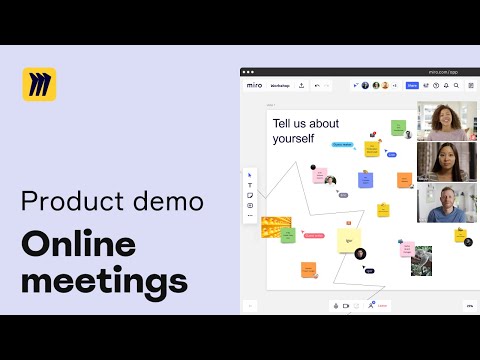


Miro is the default online whiteboard, and its free plan gives you three boards. Not three per month, three in total, permanently. That single number is what converts most Miro users into paying ones, and it is worth understanding before you build a workshop practice around the free tier. The product itself is excellent, with a 4.6 to 4.7 rating across more than 14,000 reviews.
- What it is: An infinite-canvas collaboration tool for team workshops and planning, covering diagrams, sticky-note sessions, roadmaps, and prototypes.
- Best for: Distributed teams running workshops, product discovery, retrospectives, and systems design.
- Pricing: Free for 3 boards. Starter €8 and Business €20 per member per month billed yearly. Enterprise is custom from 30 members. Verified in July 2026.
- The honest catch: The free plan’s three-board cap arrives fast, and performance degrades on very large boards heavy with images and PDFs.
What Is Miro?

Miro is an infinite canvas that a team works on together in real time. In practice that means the digital equivalent of a wall covered in sticky notes, except distributed teams can use it and nothing gets lost when the room is cleared. It has become the default tool for remote workshops, and for many teams it is the only reason anyone still runs a retrospective.
The scope has widened considerably. Alongside freeform canvas work there are diagrams, data tables for roadmapping, interactive prototypes, and, in 2026, AI workflows and agents. Miro also exposes Model Context Protocol endpoints, metered per plan, which lets AI assistants read and act on board content directly. Few tools in this category have gone that far.
The independent ratings are strong on a very large base: roughly 4.7 out of 5 on Capterra across 1,681 reviews and 4.6 on G2 across 12,674. Praise concentrates on the canvas, speed, templates, and integrations; criticism concentrates on price and on performance at scale.
How Miro Works
- The infinite canvas. The core, and what people mean when they say Miro. Sticky notes, shapes, freehand drawing, images, and embeds on an unbounded surface.
- Templates. A very large library covering retrospectives, user story mapping, service blueprints, and most standard workshop formats.
- Structured formats. Docs, tables, slides, and Kanban, so a board can hold structured artefacts as well as freeform thinking.
- Diagramming and prototyping. Technical system visualization and interactive prototypes on Business.
- AI and MCP. AI credits per member per month, plus MCP calls metered daily at 500 on Starter, 2,000 on Business, and 10,000 on Enterprise.
- Integrations. 250+ including Jira, GitHub, and Azure, which reviewers specifically cite as a strength for engineering teams.
Miro Pricing
Four tiers, metered mainly on boards, workspaces, AI credits, and MCP calls. Figures verified on Miro’s pricing page in July 2026, billed yearly. Miro localizes currency, and the euro figures correspond numerically to its dollar pricing.

| Plan | Per member/mo (yearly) | Boards | AI credits | MCP calls/day |
|---|---|---|---|---|
| Free | €0 | 3 editable | Explore AI | — |
| Starter | €8 | Unlimited and private | 25/member/mo | 500 |
| Business | €20 | Unlimited, plus unlimited workspaces and guests | 50/member/mo | 2,000 |
| Enterprise | Custom, from 30 members | Unlimited | From 2,500/month | 10,000 |
What decides your cost:
- Three boards is the free plan’s real limit. Not storage, not members, not time. Three editable boards, and a workshop practice generates boards quickly. This is the single most common reason teams upgrade, and reviewers say so plainly.
- Starter unlocks the thing most people want. Unlimited private boards, visitor editing, and high-resolution exports at €8 per member. For most small teams this is the plan.
- Business is for guests and structure. Unlimited workspaces and unlimited guests, which matters for agencies and consultants running client sessions, plus prototypes and AI workflows.
- Enterprise requires 30 members minimum. Below that headcount, Business is your ceiling regardless of which governance features you want.
- AI and MCP are metered per plan. If you intend to drive Miro from AI assistants, the daily MCP call limits are the number to check, and they differ tenfold between tiers.
Who Should Use Miro
- Distributed teams running workshops. The clearest case and the reason Miro exists. Retrospectives, planning sessions, and discovery work translate to the canvas better than to any document.
- Product and design teams. Story mapping, journey mapping, and prototyping in one surface, with Jira and GitHub connectivity that engineering teams value.
- Consultants and agencies. Unlimited guests on Business makes client workshops practical without buying seats for everyone.
- Anyone whose meetings need a wall. The straightforward test: if your team used to fill a physical wall with sticky notes, Miro is what replaces it.
It fits poorly for teams needing three boards or fewer, who should simply stay free, for very large media-heavy boards, given the performance complaints, and for cost-sensitive individuals, since per-member pricing adds up and reviewers in non-dollar economies specifically flag it as expensive.
Honest Pros and Cons
Strengths
- The best infinite canvas available. Fast, fluid, and the reason it became the category default.
- An enormous template library. Most workshop formats you would want already exist.
- Excellent integrations. 250+ including Jira, GitHub, and Azure, cited by developers as a genuine differentiator.
- Strong ratings on a huge sample. 4.7 on Capterra and 4.6 on G2 across more than 14,000 combined reviews.
- Serious AI investment. AI workflows, agents, and metered MCP access for assistant-driven work, ahead of most competitors.
- Unlimited guests on Business. Genuinely valuable for client-facing work.
Limitations
- Three boards on free. The hard constraint, and the reason most upgrades happen.
- Performance degrades on large boards. Consistently reported across G2 and Capterra for boards heavy with images and PDFs.
- Per-member pricing adds up. Frequently raised by freelancers and small businesses, and particularly by users outside dollar economies.
- Enterprise has a 30-member floor. Governance features are out of reach for smaller organizations.
- MCP and AI limits vary tenfold by tier. Easy to miss, and material if you plan agent-driven workflows.
- It can become a dumping ground. Not a product flaw exactly, but unlimited boards without conventions produces sprawl.
Miro Alternatives and How It Compares
- FigJam is the natural comparison for design teams already in Figma, cheaper and less feature-dense.
- Notion covers documents and databases rather than canvas work, and the two are complements more than substitutes.
- monday.com manages structured work; Miro handles the unstructured thinking that precedes it.
- Mural is the closest direct competitor, similarly workshop-focused, often chosen on procurement rather than features.
- Framer overlaps only on prototyping and is a website builder rather than a whiteboard.
For a broader view, browse our project management directory.
The Verdict
Miro deserves its position. The canvas is fast, the templates cover nearly every workshop format worth running, and the integration depth means it fits into how engineering and product teams already work. A 4.6 to 4.7 rating across more than 14,000 reviews is about as strong a signal as this category produces.
Plan around two numbers. The free plan gives three editable boards, which sounds workable and is not, because any team running regular sessions generates boards faster than that. Treat free as an evaluation tier and budget for Starter at €8 per member, which is where unlimited private boards live and where most teams should be.
The second number is board size. Performance degradation on large, media-heavy boards is the most consistent functional complaint, and it is worth designing around: split big workshops across boards rather than building one enormous canvas. Do that, and Miro is close to the best tool available for distributed collaborative work. Ignore it, and you will eventually be the team waiting for a board to load while everyone watches.
FAQ
How many boards do you get on Miro’s free plan?
Three editable boards, permanently. This is not a monthly allowance or a trial limit, it is the total, and it is the most common reason teams upgrade. Any team running regular workshops or retrospectives will reach it quickly, so treat the free plan as a way to evaluate Miro rather than as a working tier.
How much does Miro cost in 2026?
Billed yearly, Starter is €8 per member per month and Business is €20, with Enterprise custom priced and requiring at least 30 members. Miro localizes currency, so its dollar pricing corresponds numerically. Starter adds unlimited private boards, visitor editing, and high-resolution exports; Business adds unlimited workspaces and guests, prototypes, and AI workflows.
Does Miro slow down on large boards?
Yes, and it is the most consistently reported functional complaint across both G2 and Capterra. Boards heavy with images and PDFs degrade noticeably. The practical mitigation is to split large workshops across several boards rather than building one very large canvas, which is good practice for navigability regardless.
Is Miro worth paying for over FigJam or Mural?
For teams that run workshops as a regular practice, usually yes: the template library, integration depth, and AI capabilities are ahead. FigJam is cheaper and a natural fit if your team already lives in Figma. Mural is the closest direct competitor and is often chosen on procurement terms rather than feature differences.
What is Miro best for?
Distributed teams running collaborative sessions: retrospectives, planning, discovery, journey mapping, and systems design. It is the tool that replaces a wall of sticky notes, and it is strongest when the work is genuinely visual and genuinely collaborative rather than document-shaped.

many template to use. It is really helpful for my project.
uh some templates is not familiar with me.
It is really clear and easy for me to use.
The freedoom of an online whiteboard. Ideas easily come to live!
very very slow to load. Difficult to manipulate multiple objects.
Collaboration and presentation of new ideas to a wide audience.
使用方法は直感的でわかりやすい。リアルタイムで他者のアクティビティが見えるので効率的な共同作業ができる。
日本企業であまり活用されておらず、利用許可の取得などがスムーズにいかない。履歴をデータとして残しにくい。
テレワーク下でも効率的にコミュニケーションを取るための支援になる。
I like the fact you can create quickly boards and see online modifications from collaborator.
I wouldn't say I like much the way to move in the miro board (better to do it with the usual left button on the mouse)
Miro is helping in idea sharing and brainstorming phase of a project
The program is userfriendly and highly adaptable. The templates are powerful. The collaboration potential is fantastic. Visually very attractive.
No customer support. Accidental change in my service led to doubling the subscription amount. This charge went directly to the business credit card, causing us a lot of internal problems. It would have been nice to have better communication from Miro, as well as the possibility of calling to rectify the problem.
Using Miro for a wide-range of educational applications, including meeting facilitation, project design, and evaluation.
* Realtime interactivity. Makes running sessions while working remotely easy.
That I keep dragging bits of the miro board around when I'm trying to pan the canvas - beacuse I keep forgetting to toggle "presentation" mode. 😅
Remote collaboration made easy.
That you can keep adding to it time after time
It can be tricky to navigate sometimes, need to get used to it first
Using one board for several meetings.
The application itself is a great tool for the business, especially with the diverse teams spread across different regions, and remote working.
The support is only available via email and takes an age to get your point across and talk to someone that can actually help. It's even difficult finding the support page! (Buried in the app) The on boarding is terrible, with just a poorly written welcome email. The administration and security controls are poor. The documentation is often poorly written. Often with trial and error being the Only sure way to clarify or reject the documentation. The licensing model is very expensive. Especially for the day passes, which can only be purchased in extra large bundles and only last until the end of the contract, and not from the date of purchase. All of which is based on an Enterprise subscription.
Remote whiteboard collaboration.
Able to tag elements and search across all elements.
Very slow loading time when a storyboard is opened.
View storyboards to understand flow of the project.
I really like the easy-to-use-features that have been mentioned already hundred of times: zoomable space, colored post-its, agile way of working, realtime
For me, whiteboarding and posting colored post-its is often not enough - even in workshops. I miss integrated documents, multipage documents (like PPTX, PDF etc.) that can be edited and exportet keeping the original format. Exporting a powerpoint image with lots of post-its on it requires a lot of rework when it comes to post-production after the workshop.
Realtime Collaboration in distributed teams; agile way of working; brainstormings, trainings;
Easy to use and user friendly, you can use it to present complex flows in a seamless manner.
No way to save custom templates, the option to save my own custom template should be provided to the creator.
Collaboration with teh team has become quite easy and cross functional work with other teams is simplified.
Clean user interface that is very responsive on web.
Really dislike the way team seats are billed. Feels like anytime a miro doc was shared with a collaboratorer they were added as another $25 monthly bill on our plan. There was no warning about these additional charges and my team kept adding more people on tiny little brainstorming docs. Our billl climbed to $500+ before we realized it. We were expecting $75 a month. Ooof
Communicating complex strutures that are better drawn than written
Simplicity after a very short learning curve and visual freedom it offers to do unlimited work.
I have not found anything yet. It seems that Miro is continuously evolving.
Visual thinking, collaboration, learning, organizing, planning, and strategizing.
Nothing at all. It is faster than Visio, but there are many other options if this was the only criterion
Miro does not follow well-known WYSIWYG architecture, making it very difficult to use and difficult to learn how to use it. Miro does not integrate well with SharePoint. Our charts are saved in Miro when they should be in our corporate content storage (which is SharePoint/OneDrive-based), and making use of the standard access control and RBAC sharing rules we have in SharePoint. There is no easy way to audit and manage inappropriate access controls in Miro. Miro does not enable us to save our boards/diagrams in an open and revisable format, such as the vsdx file format. You could only save your diagrams in final forms, such as PNG, or PDF. Even the export of mind maps as CSV is not working correctly. This means that the more you draw, the more you are beholden to Miro. If you ever need to move your drawings elsewhere, as you inevitably will eventually, you either have them in a final, non-revisable form that you can never update, or you stay with Miro. Miro's customer support is horrible. I can't take my complains to them
It is seeking to provide a more productive whiteboarding and collaborating tool that is easier to use, but it is failing miserably at this and it is focusing on all the wrong things. It is not really benefitting me much at all. I am looking into alternatives such as draw.io or Lucid
Used it during college for school, my dad also used it for his education business at first before switching to a better product, good ability to whiteboard digitally but that was all.
No free version and stopped short of abilities after whiteboarding. Other products can do more and support product better, so not worth the price in my mind.
I was using it for digital whiteboarding, but whenever I had an issue seemed to take forever for response for support.
It's a pathetic platform with no customer support.
I created a board with a free profile and I was still exploring the system by creating a board. I left some team and without realizing I lost my own board, a board I created with so much effort and work. No one is able to help me internally or from the Miro team and I gave to redo the whole efforts on my own. It's pathetic! I will never make the mistake of using Miro again
Nothing, worst software
AWW app is easy to use. It offers all the basic features it should, but their support is really bad. Even after getting a paid account, I did not get proper support.
As mentioned, I dislike their support services. They need to improve on post sales support a lot.
I have discontinued using it. It could have solved plenty of problems like collaborating with remote colleagues in real time. But because of bad support, I had to switch to alternatives.