


Best VPS Hosting in Germany: German Host or German Server?




There are exactly two reasons to buy German hosting: latency and jurisdiction. They’re usually discussed together and they point at different products.
We measured the first from inside Germany and read the paperwork on the second. Both produced something the marketing doesn’t say.
First, a price correction
The figure that circulates for this market is Hetzner at around €4.15–4.49 a month for 4GB. You cannot buy that today.
Hetzner repriced its shared CPX line upward in June 2026, and its cheaper cost-optimized tier — the one those figures came from — currently shows as unavailable on its own page:
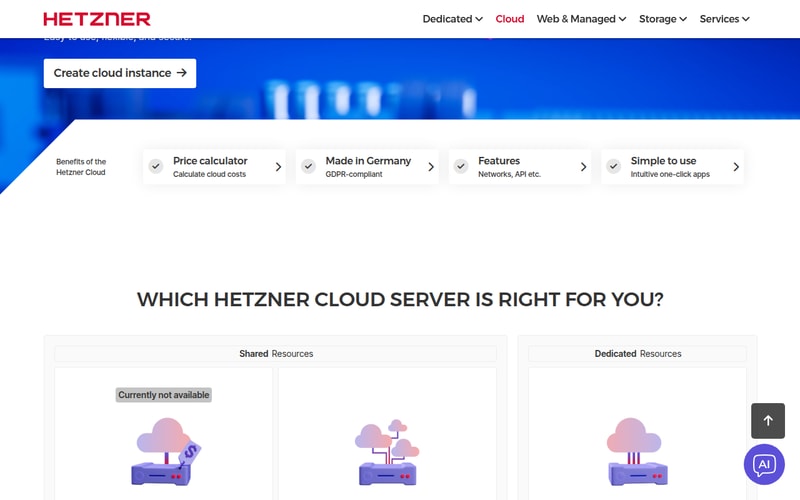
The line you’d actually fall back to is €19.99 for 4GB and €11.99 for 2GB. Hetzner is still excellent value — it just isn’t four times cheaper than everyone else any more, and any article still quoting €4 is quoting a plan you can’t put in a basket.
One cost that isn’t in the headline number: Hetzner charges €0.50/month excluding VAT for an IPv4 address. Small, but it’s per server and it’s easy to miss.
Latency, measured from inside Germany
Hetzner publishes per-datacentre speed-test endpoints, which makes this reproducible by anyone. We timed TCP connections from a machine in Nuremberg and from our production server in Ashburn, Virginia:
| Endpoint | From Nuremberg | From Ashburn |
|---|---|---|
| Hetzner nbg1 (Nuremberg) | 0.60ms | 96.49ms |
| Hetzner fsn1 (Falkenstein) | 2.94ms | 106.45ms |
IONOS (ionos.de) |
3.64ms | 89.62ms |
| Hetzner hel1 (Helsinki) | 24.05ms | 107.88ms |
| Hetzner ash (Ashburn) | 98.74ms | 0.43ms |
The symmetry is the quality check. Each provider’s home datacentre answers its own city in under a millisecond, and the transatlantic hop costs 96–99ms in both directions. That’s what real single-origin infrastructure looks like — a content delivery network would have answered both probes quickly, and none of these did.
Every German endpoint came in under 4ms from a German vantage point. So the “sub-10ms anywhere in Germany” claim holds comfortably — the country is small and densely interconnected, and Frankfurt’s exchange is why.
The number that decides anything: 98.74ms against 0.60ms. Serving German users from a US region costs about 98ms on every round trip, and no amount of caching fixes the first byte. That’s the entire latency argument, and it’s about the continent rather than the provider — the three German endpoints sit within about 3ms of each other, which for a web application is nothing.
Jurisdiction, where it gets interesting
The second reason people buy German hosting is legal, and here the usual framing — “my data is in Germany, therefore German law protects it” — is the wrong test.
The US CLOUD Act reaches data in the possession, custody or control of a US provider regardless of where it’s stored. A US-owned company operating a Frankfurt datacentre is a US provider with a German building. The server’s location is not the question. The company’s is.
That’s the short version. The fuller picture is that a CLOUD Act order needs US judicial approval, providers can challenge it, and GDPR Article 48 pulls the other way — so the provider sits between conflicting obligations rather than simply handing data over. We mapped which providers sit where, and what each position means for a transfer assessment.
And that distinction is sharper than we expected, because we found a provider that is both.
The same brand, two jurisdictions
IONOS is a German company with German datacentres. But look at which entity you actually contract with:
| You buy from | Imprint names |
|---|---|
| ionos.de | IONOS SE — the German entity |
| ionos.com | IONOS INC. — a US entity |
Same brand, same German datacentres, two different corporate jurisdictions depending on the domain you happened to land on. If you’re buying German hosting for jurisdictional reasons and you bought it from the .com, it’s worth checking which entity is on your invoice.
We’re not claiming IONOS conceals this — an imprint is a legal disclosure and both are published. The point is that the thing that matters is on the invoice, not the map, and almost nobody checks.
Who is actually German
| Provider | Legal entity | Home jurisdiction |
|---|---|---|
| Hetzner | Hetzner Online GmbH (Ansbach register, HRB 6089) | Germany |
| IONOS | IONOS SE (.de) / IONOS INC. (.com) | Germany or US — check your invoice |
| Cloudways | A DigitalOcean company | United States |
| Cloudzy | Cloudzy AI Information Technology L.L.C., Dubai | UAE |
| Hostinger | Hostinger International Ltd (stated in its privacy policy) | Cyprus — an EU member state |
| UltaHost | Not stated on its legal pages we could read | Unconfirmed |
Hetzner is the unambiguous answer if the legal entity is the point: a German GmbH with a German commercial register entry and German datacentres, with no US parent in the chain.
Cloudways is worth flagging because it’s easy to buy German-located hosting from it without noticing the ownership. It’s a DigitalOcean company, and it deploys onto DigitalOcean, Vultr, AWS and Google Cloud — all US providers. A Cloudways server in Frankfurt is a German server, not a German host.
None of this is legal advice, and if a real compliance obligation turns on it, that’s a question for a lawyer rather than a hosting comparison.
German host or German server?
The decision tree, which is the whole article:
You need a German server — location only — if:
- Your users are in Germany or nearby and you want the sub-4ms figures above
- You want GDPR to be uncomplicated by an international transfer
- This is most people, and any provider with a genuine German region satisfies it
You need a German host — a German legal entity — if:
- A customer contract, public-sector procurement rule or sector regulation names the supplier’s jurisdiction
- Your threat model includes foreign government access requests, in which case the CLOUD Act reasoning above is the relevant one
- You’ve been asked for a data processing agreement under German law specifically
If it’s the first, buy on price and latency. If it’s the second, the shortlist is much shorter than the market looks — and it starts with a company whose imprint names a German register.
The providers
Hetzner — the answer to both questions at once, which nothing else here manages: German GmbH, German datacentres, and still the best hardware per euro. €19.99 for 4GB, €11.99 for 2GB, plus €0.50/month for an IPv4 address. Nuremberg answered our probe in 0.60ms. Two caveats to go in with: the June 2026 repricing means older figures overstate the value, and its cheap tier has been unavailable — check before you plan around it. Its own pricing also sits behind a calculator rather than a readable table, which is an odd choice for a company whose reputation is price. If you’re coming from AWS, we costed that move.
IONOS — the other genuinely German option, with strong European coverage and the best price per vCPU we’ve found: four vCPU on a 4GB plan at $11. Its Frankfurt endpoint measured 3.64ms from Nuremberg. Check which entity your invoice names — IONOS SE if you buy from the German site, IONOS INC. if you buy from the .com — because that’s the variable that matters for the jurisdictional case. Its promotional pricing also runs a short term before renewing, which we unpicked in our small business hosting comparison.
Hostinger — the value pick, at $11.99/month renewal for 4GB rising to $14.99 for 8GB and $28.99 for 16GB, with European datacentres and one-click templates that remove the install step. We could not establish its legal entity from its own legal pages, so if jurisdiction is your requirement, ask before buying. If it’s latency and price, this is the cheapest capable option here. We compared it head to head with Hetzner in Hostinger vs Hetzner.
Cloudways — managed hosting on top of other people’s infrastructure, billed monthly with no term at $11 for 2GB up to $88 for 8GB. It can place you in Frankfurt via DigitalOcean or AWS, so the latency case is satisfied. The ownership is the thing to know: it’s a DigitalOcean company, so this is a German server from a US host. Fine for most buyers, disqualifying for a few.
UltaHost — more cores per plan than most at this price, and unusually its two-year discounted rate is also its renewal rate, so there’s no year-three cliff. That’s rare enough to be worth the mention on its own. Legal entity unconfirmed by us.
Cloudzy — the one to pick if you want no commitment: month-to-month billing with no term, $8.97 for 2GB and $17.37 for 4GB, across 13 regions including Amsterdam and London. Its entity is Cloudzy AI Information Technology L.L.C. in Dubai, which is neither German nor US — worth knowing either way, since a UAE company sits outside both GDPR’s home jurisdiction and the CLOUD Act’s.
For the normalised price view across the whole market, see price per gigabyte of RAM. If your question is the same one for a different country, we did the Canadian version — and found most of the residency law people cite there doesn’t exist.
How we checked this
The latency figures are ours and anyone can reproduce them. On 17 August 2026 we resolved Hetzner’s published per-datacentre speed-test hostnames (nbg1-speed, fsn1-speed, hel1-speed and ash-speed.hetzner.com) plus www.ionos.de, forced IPv4 resolution, and timed TCP connections to port 443 — eight per target, median reported — running the identical script from a machine in Nuremberg, Germany and from our production server in Ashburn, Virginia. We confirmed none of these domains has wildcard DNS by querying a nonsense subdomain first, which is a check that has previously saved us from publishing fabricated rows.
The strongest evidence that these are real datacentre endpoints is the symmetry: nbg1 answered Nuremberg in 0.60ms and Ashburn in 96.49ms, while ash answered Ashburn in 0.43ms and Nuremberg in 98.74ms. Both directions of the transatlantic path agree, and no CDN behaves that way.
Their limits. One German vantage point, not several — we have not measured from Berlin, Hamburg or Munich, so the “under 10ms anywhere in Germany” claim rests on our sub-4ms readings plus the country’s size rather than direct measurement of those cities. And TCP connect time is not application performance: it measures the network path, not disk, CPU or how the provider’s servers behave under load, none of which we tested.
The entity findings come from each company’s own published imprint, read on 17 August 2026: Hetzner Online GmbH with the Ansbach registration office and HRB 6089; IONOS SE on the German imprint and IONOS INC. on the .com imprint; and Cloudzy AI Information Technology L.L.C. in Dubai on its terms page. Hostinger’s and UltaHost’s legal pages did not yield an entity name for us, so those rows say unconfirmed rather than guessing — Hostinger is widely described as Lithuanian and we’re not treating that as verified. That Cloudways is a DigitalOcean company is stated on DigitalOcean’s own product listing.
On the CLOUD Act: that it reaches data in the possession, custody or control of a US provider regardless of storage location is the statute’s well-documented central mechanism. We are not lawyers, we have not analysed how it interacts with a German subsidiary of a US parent — which is genuinely contested ground — and this article does not tell you whether any specific arrangement satisfies any specific obligation.
On Hetzner’s pricing: the €19.99 for 4GB and €11.99 for 2GB figures are the post-June-2026 CPX rates established across this series, not read fresh today — Hetzner’s page does not render a price table our tooling can read, which is why. What we did verify live today is that the cost-optimized tier shows “Currently not available” and that IPv4 addresses carry a €0.50/month excluding VAT charge, from Hetzner’s own documentation.
What we did not do: hold accounts with any of these providers, deploy a server, test support, or run a throughput benchmark. Other providers’ pricing is drawn from our earlier reads across this series rather than re-verified today.
The host links above are affiliate links. The provider we’ve recommended most strongly is also the cheapest, and the section explaining that most readers only need a German server rather than a German host points away from the premium end of this category.
FAQ
Is Hetzner still the cheapest German VPS?
It’s still the best hardware per euro, but the widely-quoted €4 figures are stale — Hetzner repriced its shared line upward in June 2026 and the cheap cost-optimized tier shows as currently unavailable. Budget €19.99 for 4GB, plus €0.50/month for an IPv4 address.
How much latency do German users lose on a US server?
About 98ms per round trip. We measured 0.60ms from Nuremberg to Hetzner’s Nuremberg datacentre against 98.74ms to its Ashburn site — and caching doesn’t fix time to first byte.
Does a German data centre mean German jurisdiction?
No, and this is the most common mistake. The US CLOUD Act reaches data in the possession, custody or control of a US provider regardless of where it’s stored, so a US-owned host with a Frankfurt facility is still a US provider. The company’s jurisdiction is the test, not the building’s.
Which VPS providers are actually German companies?
Hetzner Online GmbH is unambiguously German. IONOS depends on where you buy — the German site’s imprint names IONOS SE and the .com site’s names IONOS INC. Cloudways is a DigitalOcean company, and Cloudzy is registered in Dubai.
Is Cloudways German hosting?
It can put your server in Frankfurt, so it satisfies the latency and data-location case. But it’s a DigitalOcean company, so it’s a German server from a US host — which matters only if your requirement is about the supplier’s jurisdiction.
Do I need a German host or just a German server?
Just a server, for most people — that covers latency and keeps GDPR simple. You need a German legal entity only when a contract, procurement rule or sector regulation names the supplier’s jurisdiction, or when foreign government access is in your threat model.
How fast is hosting within Germany?
Every German endpoint we tested answered a German probe in under 4ms, and the closest in 0.60ms. The country is small and well interconnected, so the difference between German providers is negligible compared with the difference between Germany and another continent.