


Bluehost vs Hostinger: The Five-Year Cost, Including the Add-Ons




Both of these hosts advertise somewhere around $2 a month, and neither charges it for long. So the only honest way to compare them is over a realistic hold — and when you do, something counterintuitive happens.
Over five years, Bluehost is the cheaper of the two. Roughly $515 against Hostinger’s $551 — a $36 difference on a bill of more than five hundred dollars, which is close enough to call a tie.
Then you add the line item most comparisons omit, and the tie disappears.
Thinking of moving off Bluehost entirely? Bluehost alternatives covers what actually triggers the switch — resource limits rather than price — and the email rehoming step that strands people mid-migration.
The five-year cost
| Hostinger Premium | Bluehost Starter | |
|---|---|---|
| Introductory | ~$2.49–2.69/mo | ~$1.99/mo |
| Renewal | $10.99/mo | $9.99/mo |
| Intro period total | ~$24 | ~$36 |
| Renewal total | ~$527 | ~$479 |
| Five-year total | ~$551 | ~$515 |
Two things worth noting before drawing conclusions. Hostinger’s renewal represents roughly a 340% increase over its introductory rate, which is steep even by this industry’s standards. And Bluehost’s $9.99 renewal is genuinely among the cheapest of the mainstream shared hosts — it is not the outlier people assume.
Introductory pricing varies by promotion and region, so treat the first row as indicative. The renewal rows are what matter, because that’s where 80% of a five-year bill is incurred.
The line item that decides it: daily backups
Here is the detail that reopens the gap.
Bluehost’s standard plans include weekly backups only. Daily backups with one-click restore come from CodeGuard, which is included free for the first year on Choice Plus and above — and is a paid add-on otherwise. CodeGuard Basic runs about $2.99/month, or $35.88 a year, with other tiers listed as high as $47.88 and $59.88 annually depending on sites and storage.
Run that across the same five-year hold:
| Hostinger Premium | Bluehost Starter | |
|---|---|---|
| Five-year hosting | ~$551 | ~$515 |
| Daily backups (5 yrs) | Included on plan tiers | +~$179 |
| Realistic five-year total | ~$551 | ~$694 |
A $36 advantage becomes a $143 disadvantage the moment you decide you want daily backups rather than weekly ones. And you should want daily backups: the gap between losing a day of work and losing a week is the entire reason backups exist.
This is the pattern to watch for generally. The headline price is the part of the bill both companies compete on, so it’s the part that’s been squeezed flat. The difference lives in the add-ons, where nobody is comparing.
What the entry plans actually include
Cost per month is only half the question. The other half is what the money buys, and here the plans are not close:
| Hostinger Premium | Bluehost Starter | |
|---|---|---|
| Websites | 100 | 10 |
| Storage | 100 GB SSD | 10 GB NVMe |
| Backups | Weekly included | Weekly (daily = paid add-on) |
| Control panel | hPanel | cPanel |
| Phone support | ❌ | ✅ |
Hostinger’s entry plan carries ten times the sites and ten times the storage for about a dollar more per month at renewal. If you host more than one site — and most people eventually do — that difference dwarfs the pricing argument entirely.
Bluehost’s 10 GB is NVMe against Hostinger’s SSD, which is a genuine point in Bluehost’s favour on paper. In practice, 10 GB of fast storage runs out sooner than 100 GB of merely-good storage for most people’s use.
Where Bluehost genuinely wins
Two things, and they aren’t trivial — plus one that most comparisons get wrong:
cPanel and phone support — covered below. But first, a correction to something you’ll read in most comparisons of these two.
The WordPress.org endorsement is not a Bluehost-only advantage. Bluehost is long-established as one of WordPress.org’s recommended hosts, and it’s frequently presented as a reason to choose it over Hostinger. That framing doesn’t survive a look at Hostinger’s own homepage, which displays a “Recommended by WordPress.org” badge alongside its Trustpilot score.
Treat the endorsement as a tiebreaker that doesn’t break the tie, and if it genuinely matters to your decision — say you’re justifying a choice to a client — check wordpress.org/hosting directly rather than either vendor’s marketing.
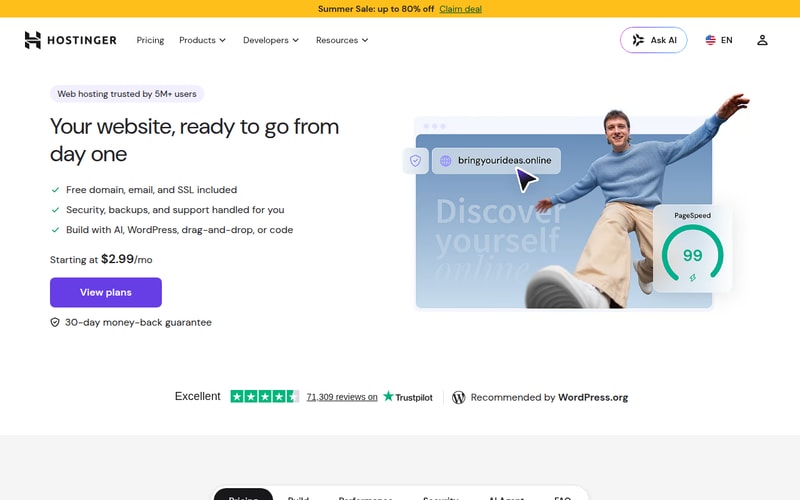
The badge bottom-right is the one to notice: Hostinger carries the WordPress.org recommendation too.
cPanel. The most documented control panel in existence. When you search for how to do something, you’ll find a guide with screenshots matching your screen — which matters more than interface quality when you’re stuck. Hostinger’s hPanel is cleaner and faster, and less documented by third parties.
Phone support. Hostinger doesn’t offer it. If talking to a human on a call is how you want to resolve problems, that’s a decisive difference no feature table captures.
There’s also the cheaper five-year hosting total, provided you genuinely don’t want daily backups.
Where Hostinger wins
Ten times the entry-plan allowance on both sites and storage, which is the single largest difference between them.
Daily-backup economics, as set out above — the add-on Bluehost charges for is roughly $179 over five years.
Modern one-click installs. Hostinger’s catalogue covers agent-era software including OpenClaw and n8n, not just a legacy CMS list. If you intend to self-host anything beyond a website, that’s a genuine advantage for Hostinger. Our one-click apps comparison covers what each marketplace actually carries.
Independent testing tends to favour it on performance and on handling traffic spikes, though results vary by test and by plan, and both are adequate for the traffic an entry shared plan realistically sees.
The verdict
Hostinger, for most people — but not for the reason the price tables suggest.
The pricing argument that dominates every comparison of these two is close to a wash: $36 apart over five years, with Bluehost marginally ahead. If someone tells you one of these is dramatically cheaper than the other, they’re comparing an introductory rate to a renewal rate.
What actually separates them is what the entry plan contains and what it makes you buy separately. Hostinger gives you 100 sites and 100 GB where Bluehost gives you 10 and 10, and includes at plan level the daily-backup capability Bluehost bills at roughly $36–48 a year. Add those together and Hostinger is both more generous and, in realistic use, cheaper.
Choose Bluehost anyway if you need cPanel specifically or phone support matters to you. Those are legitimate reasons and no amount of storage allowance replaces them. Just don’t choose it for the WordPress.org endorsement, which both vendors display.
Check Hostinger pricing → · Read our Hostinger review
Check Bluehost pricing → · Read our Bluehost review
Weighing Hostinger against the premium end instead? SiteGround vs Hostinger finds the two identical in year one and 4.8× apart by year four. Comparing Hostinger against the other name most people arrive from? Hostinger vs GoDaddy prices the whole bundle, including the SSL renewal that dominates it.
Adding a third option? Our Bluehost vs SiteGround vs Hostinger comparison brings in the premium tier and covers the resource limits — visits, CPU, inodes, entry processes — that decide whether a site survives growth.
If you’ve outgrown shared hosting entirely, both sell VPS plans — and the calculus changes, as our VPS hosting comparison and cheapest VPS index set out.
How we picked
We compared entry shared-hosting plans on renewal price rather than introductory price, projected over a five-year hold, and added the cost of daily backups where a provider charges for them separately. Prices and plan contents come from provider pricing pages and published pricing breakdowns read in August 2026.
Introductory rates move constantly with promotions and differ by region, so we’ve given them as ranges and anchored the comparison on renewal figures. Backup add-on pricing is quoted from published CodeGuard tiers; confirm the current rate and which plans include it before buying, since the free-first-year arrangement on Choice Plus and above changes the arithmetic materially.
We have not run performance benchmarks on either host. Where we refer to independent testing favouring one, that’s published third-party work rather than ours.
Both links here are affiliate links. It’s worth stating that the cheaper option on raw five-year hosting cost is Bluehost, and we’ve said so plainly above rather than leading with the total that flatters our conclusion.
FAQ
Is Bluehost or Hostinger cheaper?
On raw hosting over five years, Bluehost — roughly $515 against $551, a $36 difference. Add daily backups, which Bluehost sells separately at about $36–48 a year and Hostinger includes at plan level, and Hostinger becomes cheaper by roughly $143 over the same period.
Why is Hostinger’s renewal price so much higher than its introductory rate?
Because the introductory rate is a customer-acquisition cost. Hostinger Premium goes from about $2.49 to $10.99 at renewal — roughly a 340% increase. Bluehost does the same thing less steeply, moving to $9.99. Neither is unusual for the industry; both are why comparing advertised prices is misleading.
Which is better for WordPress?
Both run WordPress well, and both display the WordPress.org recommendation — so that badge doesn’t separate them, despite being cited constantly as though it does. Bluehost gives you cPanel and phone support; Hostinger gives you ten times the sites and storage on its entry plan and a more modern installer catalogue. For a single personal WordPress site, either is fine.
Does Bluehost include backups?
Standard plans include weekly backups. Daily backups with one-click restore come via CodeGuard, which is free for the first year on Choice Plus and above and a paid add-on otherwise — around $2.99 a month or $35.88 a year for the Basic tier, rising with sites and storage.
How many websites can I host on each entry plan?
Hostinger Premium allows 100 websites with 100 GB of SSD storage. Bluehost’s entry plan allows 10 websites with 10 GB of NVMe storage. That tenfold difference is the largest single gap between the two.
Does Hostinger offer phone support?
No. Support is 24/7 via chat and ticket. Bluehost does offer phone support, which is a genuine reason to choose it if that’s how you prefer to resolve problems.

Related Products