

( 416 )
Unclaimed: Are you working at PostHog?
PostHog Reviews: 4.4/5 — Solid Choice
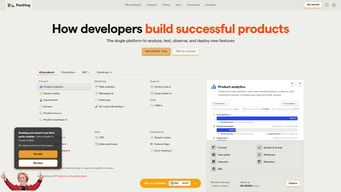
PostHog is an open-source analytics platform designed to help software teams understand user behavior, improve products, and drive growth. It offers a suite of tools for event tracking, heatmaps, session recording, and feature flags, enabling developers and product managers to gain insights into how users interact with their applications.
PostHog is also often used as Product Analytics of choice in Indie Hacker and Product Management tech stacks.


| Capabilities |
API
CLI
OSS
|
|---|---|
| Segment |
Small Business
Enterprise
|
| Deployment | Cloud / SaaS / Web-Based, On-Premise Linux |
| Training | Documentation |
| Languages | English |

Compare PostHog with other popular tools in the same category.
We really like the pricing of Posthog. It is cheaper for our needs than HotJar. It also lets us see more. The analytics also seems more accurate than Google analytics.
I wish that I could pick a user and track exactly what they have done on the platform.
We want to see what users do on our site, especially things that they get stuck on.
Installation was straightforward. Put a javascript snippet into the header of the pages you want to monitor, and you're all set. The admin GUI is easy to use and is not bulky or heavy. The trial/free level account was exactly what I needed to do some debugging on a small client's web form. I will most likely go ahead and install a self-hosted version of the system on my server.
The console logging doesn't seem to be as detailed as FullStory, so it took a bit more digging through the logs to find the problems I was facing. Session recording isn't enabled by default on a project, and it took me a bit of searching through the documentation to find the instructions for that.
I needed a way to record Javascript console logs from users' browsers and see exactly what they entered on the signup form. I needed to know how the system behaved once the user submitted the web forms. I did not have the budget or time to install a system like FullStory. I had everything set up in about 30 minutes.
The potential recordings are quite interesting
Nothing so far, potentially the UI/UX could be superior in other products
Tracking product usage and analytics
I loved that they did not have too many features that were exclusive but rather kept the tool open and if you really needed to extend the functionality, it made sense as to what you might need to pay to upgrade.
I wish that you could export the raw video data from the session recordings so that those could be analyzed separately. With that said, I understand why they cannot export it.
It helps with a lot of things including tracking users and sessions as well as individual user tagging data to understand their behavior over time. I cannot wait to implement it in another project!
PostHog also allows us to export our event data to S3 or even directly into Postgres, a key feature we were looking for. Most of our team members using PostHog are non-technical, and it's been very easy for them to all create custom dashboards and build insights based on what KPIs we are tracking. Auto-capture with the Javascript library makes it easy to collect all activity across our web application. Then as the team has gotten more comfortable with PostHog we've begun to track custom events to better understand our customer behavior (in our web application) within our core workflows.
Event streams are slightly delayed, but that seems to be expected after evaluating a few other analytic platforms. During the initial setup, it would be great to see more feedback regarding events that are streaming in real-time. For non-technical team members, there was a bit of a learning curve to setting up insights can be tricky as you need a bit of an intimate understanding of the incoming event's parameters to build the correct graphs.
We want to figure out a solution that would allow our team and future non-technical PMs (i.e. someone who doesn’t know SQL) to analyze product usage without needing the help of the engineering team. And PostHog offers a great way to do precisely that. Once the snippet is loaded, you also get a few "bonus" benefits as a byproduct, such as the session recording feature, which provides playback of what visitors are doing across our marketing pages. When our team looked at other pure SQL query-based solutions that created graphs, the SQL was a nonstarter, which is understandable. PostHog provides a hybrid scenario where we capture and store the events as a first-party and then use PostHog to do product analytics. For example, PostHog will let you ingest historical events and use their analytic tools.
We have complete access to all our data for no additional fee and can use it for more advanced insights by merging it with transactional data. PostHog's integration experience is at par with its top SaaS competitors.
The UI is a bit clunky. The setup experience is a bit unpolished, especially with a data warehouse. It does not come with fancy data science based insights out of the box. Some features, like the tag system for insights and dashboards, seem incomplete.
PostHogs is helping us better understand how our users interact with our apps and website. It helps us determine what parts need improvement to drive conversions and the UX.
The PostHog data stack is intuitive and easy to work with. The features they offer at the price they offer them are unmatched by our old provider and seem to lead the industry.
We started using PostHog about a month ago, and so far, we haven't run into anything we don't like. We got up and running in a few minutes using the Auto Capture feature for our website. From there, we started dialing in our setup specifically for our organization.
PostHog gives us a ton of insight into what our customers are doing on our website. Also, with the session recording feature, we can troubleshoot issues much easier and faster.
I was impressionnant in how our data can be used with Posthog. I did many things in a short time: cohort analysis and user lifecycle in a simple way. It's not necessary a big know about data to use this platform.
I didn't have time to test all features in posthog app, so I'm not ready to write a dislike commentary, but maybe a visual onboarding process in the platform can be helpful to for beginners.
With Posthog I choose how I want to see my dashboard and follow some events of the product. The greatest benefit for me, was stopping doing a lot of tables in excel and starting to have time to do more intelligent analyses.
Easy to integrate and implement into an application. The JavaScript library works great!
More freedom and varieties of diagrams. Right now you're limited to a basic set, you don't have the tools to create a more advanced graph.
Giving insight into our application. Who is using it and how? We're experimenting with a new UI/UX, and PostHog gives us the information to see if the users are using the new features.
Posthog Service has been great and very scalable for the heavy amount of events we ingest. The recording feature has been huge for our company and developers for troubleshooting customer and internal issues. Technical Support has been pretty great. Shout out to Tiina Turban for all the help troubleshooting and helping our setup run smooth!
The application is complex, and finding the culprit for an outage can sometimes be cumbersome.
event ingestion on a large scale and session recordings to help troubleshoot and collect click data.
- Live recordings - A/B tests (experiments) - The launchpad from which you can select actions no-code - heatmaps - design - it's quite beautiful and a good tool for viewing analytics -> all-in-one solution, without needing to install extras like hotjar Also, the trackers are quite aggressive (sophisticated).
- Setup for more complicated tasks is challenging as the docs are yet incomplete. For example, several config options in the initialisation function are not explained anywhere in the docs (e.g. methods for adjusting GDPR). In any case, the docs should contain more examples through code than written explanations. - No warning panel for experiments and other features before stopping/deleting them. I once thought stop meant pause and killed my entire experiment (wasn't too tragic as it hadn't fully started yet)
Validating design and product hypothesis, measuring out conversion funnel, quantitative and qualitative ways to analyse a customer

PostHog was easy to set up and immediately started tracking events and contact data. We love the new screen recordings feature and how it auto-captures events without us setting up the telemetry - no code changes are needed. It's as simple as point and click - we use the "Inspect element" feature to define an event and then navigate to the "Live feed" to see if the events we just defined are being tracked correctly.
The screen recordings is a fantastic new feature, but we experienced a few bugs. Hoping to see it polished as the rest of the platform in the coming weeks. Apart from that, the reporting feature needs some more types of graphs and features to replace the other tools we use entirely.
Two things we use Posthog for as an early-stage startup: 1. Easy access to feature utilisation data without requiring colossal development effort and time. 2. Observe how our users interact with our app and see where the significant dropoffs are, and improve the flow.
The software is very feature-rich from being able to do A/B tests, to deploying feature flags and doing lots of analysis based on their tracking. We previously used separate tools for tracking and analysis, but with Posthog we can combine all of that into one application. Also, we are actively looking into hosting Posthog on our servers to prevent the blocking of third-party scripts and maintain full control of our data.
The documentation of how to use Posthog sometimes lags a bit of detail. Hence, there is some learning and discovery required. Also, the pricing model based on events doesn't come in as handy as pricing per MTUs (although this is a case-by-case decision).
Analysing user behaviour on our marketing landing pages and in our web-app. Our product team works much more data-driven and informed since deploying Posthog.
Insight reports and Dashboards are easy to create. I like being able to filter recordings for specific events in order to watch users as they attempt to use our product.
I've had a few issues with errors or bugs occurring. I have a few graphs that even though they are set to group Monthly, are showing weekly. When watching recordings, I would like to be able to move to the next video without having to go back to the first Recordings page.
We're using PostHog to track our most important metrics and other data in order to determine friction points in our product and learn how to best optimize the user experience.

PostHog is a powerful cloud-based tool that allows us to index and analyze a large volume of data in real time and query it. It offers great features like session recording, integration with other tools, and allows us to export data to platforms like BigQuery and Hubspot.
PostHog suits my needs. But I have to mention that it is not that effective for running analytic queries on larger datasets.
PostHog is relatively easy to use. And we use it for processing and analysis to give value to the data, with the aim of helping our clients make decisions. It is also a very powerful software with which I can integrate it with other platforms to export data to other platforms such as Hubspot.
Its quite easy to set up a new experiment or ab test and to start testing it. Lot of features and information can be track
License model. Quite expensive when you raise the free limit.
Capacity to ab test new features and to analyse their performance.
PostHog has been essential for bringing our engineers and product teams together. The suite of products works together perfectly. It was fairly straightforward to implement and add to our product.
PostHog provides a variety of products under one roof, which sometimes leads to poor user experience and it is something that can be improved.
PostHog is helping us track and capture product metrics.
It's all in one, it does product analytics and experimentation. I like that it's more of a self-serve tool because I don't need regular meetings with a representative trying to help me learn how to use the tool, I want good documentation so I can use the tool at my own pace, and PostHog does that very well. The documentation is well organized and uses videos and animated screenshots to visually reinforce the concepts. Also, their pricing model is quite simple to understand and easy to get started without a big commitment.
The funnels and journeys aren't very easy to use, but it could be our test data. I found them hard to understand, but once I have a real use case I would dig more into it. The heatmaps were hard to find and only showed clicks, not scroll maps or anything else I'd expect from a heatmap.
We need a product analytics tool to help us understand who are users are and we want to leverage the built-in experimentation tools to run experiments with our hypothesis once we understand our users better.
The recordings part is great and the fact that you can use it to do qualitative research based on events that you can filter out. The in-built automatic filters are extensive and easy to use.
PostHog has a lot of different features compared to other product analytics suites. Most products usually just focus on one part of the features PostHog incorporates, making them easier to use.
Helping us in finding patterns in user activities, allowing us to do user research and A/B testing in one place with good visibility and less technical management.
PostHog is one of many tools out there that let you walk in your users' footsteps and view your website the way they do. It's a great tool for diagnosing problems, polishing UI, or just for understanding how your product is being used in a way that goes deeper than simple usage analytics can.
I found the PostHog filtering for recordings to be a bit more difficult to use than other services I had tested. Perhaps this was because I was hung up on trying to do things the way other services did them. Ultimately, it took me a few tries to be able to retrieve a session recording via IP address, something I do to investigate support tickets.
When a customer emails you blindly that they "got an error" you're in the dark. PostHog is liking turning on the lights. You can discern what error was likely to have been encountered, and even see any other messages or console logs that might have contributed to the problem. It's very powerful and removes a lot of the guesswork out of supporting a frontend tool in public.
Extremely easy to setup. Events work really well. Session replay is amazing. Product analytics are straightforward but very deep and helpfully auto-srtup with basic ones. Feature flags and extra features are also helpful.
Since it's only cloud hosted and does not offer BAAs, it's not a good choice for anything remotely dealing with PHI. The self host version being for hobbyists is something to explore if it's even possible to make it scale properly even with proper DevOps, but probably other self host solutions or cloud solutions with BAAs are preferable.
Understanding user behaviour. Data analysis for events and user journeys is amazing, session replays are also very helpful. Much more helpful to understand product analytics than eg GA that is just conversion tunnels and marketing analytics.
Their whole "by product developers, for product developers" approach gives me reassurance that even if I don't understand everything about their product at first, I feel I am in good hands
It took me a while to not find the dashboard bewildering, and I still have the creeping fear that I am only using 5% of the power that is on offer
I am using PostHog to try find out how sticky my product is with users, which features they seem to be using, and ultimately if I am moving towards, or away from, product market fit
Ease of use and a fact that few essential features are packed into one product so I dont have to use 3 different ones
Not sure how surveys fit into the product. Would be good to have more analytics related features and not something unrelated. Also why is this survey not done via Posthog survey feature?
Finding out what users are doing in the app
The onboarding experience was super smooth. It stepped me through how to integrate posthog into my app and confirmed everything was working which gave me confidence to try more features.
The navigation is quite jam packed. I'd prefer if it was stripped down to only the features I'm actually using.
I'm able to understand how users use my app, where they spend time and what percent complete specific journeys.
We loved to integrate Posthog SDK in our products. It was a very pleasant experience, very easy to achieve and with immediate results seen on Posthog interface.
Documentation lacks of details about using hogql
We can now manage easily AB tests and offer testing features with experiments.
The free tier is generous, and setup was really simple. The SDK is straightforward and it's easy to follow up events in the interface.
The fact that an identify event goes through your quota is a bit misleading as it essentially will cost 1 event per user even if they do not generate any tracked event.
How users interact with certain features, and how many.
Setup is easy, clear pricing, nice to have regular analytics and screen recordings in same tool.
screen recordings are often missing some visual details. Great because we feel like we're getting it for "free" by already having an account, but would be harder to justify paying for individually.
Basic user funnel tracking and being able to see detailed views of how our users interact with the site via session recordings
The analytics platform has helped our businesses track user behavior on our SaaS. It provides features like event tracking, user analytics, and A/B testing, which has been valuable for understanding how our users interact with our digital product and optimizing user experiences.
Setting up and maintaining PostHog may require a certain level of technical expertise and resources, which could be a challenge for smaller businesses or organizations with limited technical capabilities.
User Engagement Understanding: PostHog allows us to track and analyze how users interact with our application. This helps us gain insights into user behavior, such as which features are popular, where users drop off, and what actions lead to conversions. This understanding can lead to improved user engagement strategies and product optimization.

Funnels and custom insights creation from the dashboard
So far I don't have bad feedback about it
Heavy analytics libraries take too much time to load at first while delivering a limited amount of insight.
Intuitive product/interface. Fantastic value. Solid starter product for most people (I'm sure it will improve over time too).
Customizations for reporting are a bit limited for power users. Also custom SQL language that isn't as powerful for heavy SQL users.
Understanding user base and activity, retention, patterns.