


Best VPS Hosting in the UK: The Compliance Reason Just Expired




The standard hook for UK hosting is that Brexit made the UK a third country, so “EU hosting” and “UK hosting” are different compliance answers and you’d better host in Britain.
That argument had a shelf life and it ran out in December.
What actually happened
On 19 December 2025 the European Commission renewed both UK adequacy decisions — the GDPR one and the law enforcement one — for a further six years, to 27 December 2031, after assessing the UK’s Data (Use and Access) Act 2025.
So for transferring personal data from the EU to the UK, there is no transfer mechanism to build, no standard contractual clauses to sign, and no impact assessment to run. Data flows on adequacy, the same as it would to Ireland or Germany. UK hosting and EU hosting are, for this purpose, now the same compliance answer.
Two things from that period do still matter:
The Data (Use and Access) Act’s main data protection provisions came into force on 5 February 2026. Among other changes it replaces the “essential equivalence” test for the UK’s own outbound transfers with a data protection test — whether a destination’s safeguards are “not materially lower than” the UK’s. If you’re sending data out of the UK, that’s the test you now apply.
Adequacy has a sunset clause. It expires on 27 December 2031 unless extended. That’s six years away, which is longer than most hosting decisions, but it’s a real date rather than a permanent settlement.
What this means for buying: the compliance argument for UK hosting is much weaker than the articles ranking for this term suggest. Buy on latency and billing instead — which is where the interesting differences actually are. None of this is legal advice.
How to tell a real London node from a rebadged Amsterdam one
This is the question worth answering, and there’s a method: latency from a fixed point on the continent gives you a distance ladder, because the speed of light doesn’t negotiate.
From a machine in Nuremberg, we timed real regional endpoints whose locations are published, to calibrate:
| Endpoint | From Nuremberg | Implied |
|---|---|---|
| DigitalOcean fra1 (Frankfurt) | 3.97ms | ~200 km |
| Vultr Amsterdam | 9.48ms | ~600 km |
| DigitalOcean ams3 (Amsterdam) | 11.16ms | ~600 km |
| AWS eu-west-2 (London) | 15.35ms | ~1,000 km |
| DigitalOcean lon1 (London) | 16.18ms | ~1,000 km |
| Vultr London | 20.78ms | ~1,000 km |
| AWS eu-west-1 (Ireland) | 23.01ms | ~1,300 km |
The ladder is clean and monotonic: Frankfurt ~4ms, Amsterdam ~10ms, London ~15–21ms, Ireland ~23ms. So a genuine London node answers a German probe in the mid-to-high teens. Something claiming London that answers in 4ms is in Frankfurt, and something at 10ms is in Amsterdam.
Now apply it. We tested the two UK-facing providers’ own web endpoints:
-
20i.com— 17.20ms. Squarely in the London band. Consistent with genuine UK infrastructure. -
ionos.co.uk— 3.63ms. That’s the Frankfurt band. It’s within 0.01ms ofwww.ionos.de(3.64ms) and sits on an adjacent IP address.
Be careful what that second finding means. We measured IONOS’s UK website, not a customer VPS. A company serving its British marketing site from Germany tells you nothing definitive about where it provisions servers — IONOS is a large European operator and may well have UK capacity. What it does mean is that a .co.uk domain is not evidence of a UK server, and the same test applied to your own provider’s node will tell you the truth in about thirty seconds.
Two caveats on the method. It establishes distance, not a city — a node 1,000 km from Nuremberg in some other direction would look like London. And check for wildcard DNS first: 20i.com resolves every subdomain to the same address, so probing invented hostnames there would have produced meaningless numbers. We ran that control before trusting anything.
We didn’t measure from Manchester or Edinburgh, which the brief asked for and which is where northern latency claims would be tested. We have no UK vantage point, so that comparison isn’t ours to make.
GBP billing, and the fee that actually surprises you
Both UK-facing providers here quote in pounds, and both add VAT rather than including it.
IONOS UK is explicit: “All prices exclude VAT charged at 20%.” So a £9 plan is £10.80 to a consumer. A VAT-registered business reclaims it; an individual doesn’t.
The real surprise isn’t foreign exchange — it’s the promotional window.

That headline reads £3/month — for three months. Then £9. Across the series we’ve looked at promotional terms of 12, 36 and even 48 months; three months is the shortest we’ve found anywhere, and it means the advertised price covers a twelfth of a three-year hold.
There’s also a £10 setup fee, waived in the current promotion but real if it isn’t.
Priced honestly over three years, IONOS’s 4GB tier is 3 months at £3 plus 33 at £9 — £8.50/month excluding VAT, or £10.20 including it.
For providers billing in dollars — Hostinger, DigitalOcean, Cloudways — the sterling cost moves with the exchange rate (1.354 USD/GBP as we write), and a UK card typically adds around 2–3% in foreign transaction fees on top. That’s not hidden so much as invisible on a dollar pricing page.
What a gigabyte costs in Britain
| Provider | 4GB | 8GB | 16GB | Per GB | Currency |
|---|---|---|---|---|---|
| IONOS UK | £9 | £18 | £38 | £2.25–2.38 | GBP + VAT |
| Hostinger | ~£8.85 | ~£11.07 | ~£21.41 | ~£1.34–2.21 | USD |
| DigitalOcean | ~£17.72 | ~£35.45 | — | ~£4.43 | USD |
| 20i | £24.99 | £49.99 | £79.99 | £5.00–6.25 | GBP |
20i is roughly 2.8 times IONOS’s price for the same memory. Both give 4 cores at the 4GB tier, so the difference isn’t compute — it’s 120GB of NVMe at IONOS against 75GB of SSD at 20i, for £9 against £24.99. On specs per pound this isn’t close, and we’re saying so plainly because 20i is the provider we list first.
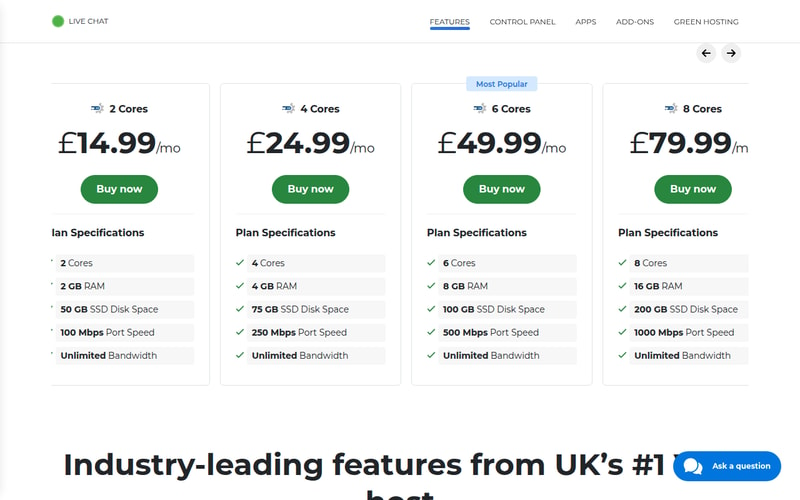
One thing 20i publishes that IONOS doesn’t is a port speed per tier — 100 Mbps at 2GB rising to 1000 Mbps at 16GB — alongside unlimited bandwidth. If sustained throughput matters to you, that’s a specification you can actually check rather than infer.
What 20i is actually selling is a UK company with UK support, its own control panel with no per-account licence fees, and free unlimited migrations and CDN. Whether that’s worth a 2.8× premium depends entirely on whether you’d use it — for a reseller whose margins are eaten by cPanel licences, quite possibly; for one server running your own application, harder to argue.
The providers
20i — the genuinely British option, and verifiably so: its own site states it is registered in England and Wales, company number 09775671, VAT number GB 221 935 815, and its endpoint measured in the London band. Pricing is £9.99 for 1GB, £14.99 for 2GB (2 cores), £24.99 for 4GB (4 cores), £49.99 for 8GB (6 cores) and £79.99 for 16GB (8 cores), unmanaged with full root access, with port speeds from 100 Mbps to 1000 Mbps and unlimited bandwidth. Its StackCP panel carries no per-account licence fee, which genuinely matters if you’re reselling. It is the most expensive per gigabyte here by a wide margin — buy it for the UK entity, the support and the panel, not the specs. We could not confirm whether its listed prices include VAT.
IONOS — the value answer, and by a distance: 4 vCores, 4GB and 120GB NVMe for £9/month excluding VAT, rising to £18 for 8GB, £38 for 16GB and £58 for 24GB, with unlimited traffic. That’s the best price per core we’ve found anywhere in this series. Two things to go in knowing: the promotional rate lasts three months, and there’s a £10 setup fee outside the promotion. Note also that we measured its UK website answering from Germany — confirm the region you’re provisioned into if UK location matters to you.
Hostinger — the cheapest per gigabyte once converted, at renewal rates of about £8.85 for 4GB and £11.07 for 8GB, with European datacentres and one-click templates that remove the install step. Billed in dollars, so budget the card fee and the exchange rate. If UK residency isn’t a requirement — and per the section above, it probably isn’t a legal one — this is the price-led choice.
DigitalOcean — has a documented London region (LON1) and we measured that endpoint live at 16.18ms, so the UK presence is real and published rather than asserted. It’s the dearest of the dollar-billed options at roughly £17.72 for 4GB, and what you’re buying is documentation and API predictability.
Cloudways — managed hosting deployed onto DigitalOcean, AWS or Google Cloud, so it can place you in London and inherits that region’s latency. Billed monthly in dollars with no term, from $11 for 2GB. It’s a DigitalOcean company, which matters only if the supplier’s jurisdiction is part of your requirement.
Namecheap — the budget end, with a long record on domains and low-cost hosting, and the gentlest renewal increases we’ve measured in shared hosting. Its site is served through a CDN, so we could not locate its infrastructure by the method above; check the datacentre selector at signup.
For the wider market view see price per gigabyte of RAM. If you want the same treatment for a different country, we did Germany, Canada and India — and in three of the four the legal premise turned out to be weaker or differently shaped than the received wisdom. For WordPress specifically, our UK WordPress hosting guide covers the shared-hosting end.
How we checked this
The adequacy position is from the European Commission’s December 2025 decisions and the published legal commentary on them: that on 19 December 2025 the Commission renewed both the GDPR-based and Law Enforcement Directive-based UK adequacy decisions for six years to 27 December 2031, subject to a sunset clause, following its assessment of the Data (Use and Access) Act 2025; that the DUAA received Royal Assent on 19 June 2025 and its main data protection provisions commenced on 5 February 2026; and that it introduces a “data protection test” of safeguards “not materially lower than” the UK’s in place of essential equivalence. We have read law firm and institutional commentary rather than the decisions themselves, we are not lawyers, and this is not legal advice.
The latency figures are ours and reproducible. On 17 August 2026 we resolved published regional endpoints for DigitalOcean, AWS and Vultr plus the two UK providers’ web endpoints, checked each domain for wildcard DNS, and timed TCP connections to port 443 — eight per target, median reported — from a machine in Nuremberg, Germany.
What the ladder does and doesn’t prove. It measures round-trip distance, not city. The calibration is sound because Frankfurt, Amsterdam, London and Ireland are published locations and the readings order correctly by distance. But a node 1,000 km from Nuremberg in another direction would read like London, so this identifies inconsistencies rather than confirming addresses. And the two provider figures are websites, not customer VPS nodes — we have not provisioned a server with either, and we’ve been careful not to claim IONOS lacks UK hosting capacity, only that its .co.uk site answered from the German band.
The wildcard control mattered here. 20i.com resolves every subdomain, including invented ones, to a single address. Had we probed guessed hostnames like lon.20i.com we would have produced numbers that looked like data and meant nothing.
We did not measure from Manchester or Edinburgh, which this article’s brief specified. We have no UK vantage point, and the whole point of the section above is that a latency figure is only as good as the place it was taken from — so publishing a “northern UK” table from Germany would contradict the article’s own argument.
Pricing is each provider’s published rates read on 17 August 2026 with a UK locale: 20i’s seven VPS tiers and its company and VAT registration numbers from its own VPS page; IONOS UK’s four tiers with specs, its “all prices exclude VAT charged at 20%” statement, the three-month promotional term and the £10 setup fee from its UK VPS page. The three-year effective figure and all currency conversions are our arithmetic, using 1.354 USD/GBP from a public rate API on the same date — rates move daily, so treat converted columns as indicative. Hostinger’s, DigitalOcean’s and Cloudways’ dollar rates are carried from earlier reads in this series rather than re-verified today.
What we did not do: hold accounts with any of these providers, deploy a server in a UK region, complete a checkout, or test support. 20i’s VAT treatment and Namecheap’s datacentre locations are both unconfirmed, and labelled that way above.
The host links above are affiliate links. We’ve said clearly that the provider we list first is the most expensive per gigabyte here, and that the legal argument for buying British has largely evaporated — both of which point away from the products this page exists to sell.
FAQ
Do I still need UK hosting for GDPR after Brexit?
Generally no. The European Commission renewed UK adequacy in December 2025 for six years to 27 December 2031, so EU-to-UK personal data transfers flow on adequacy without standard contractual clauses or a transfer impact assessment.
Is UK hosting the same as EU hosting for compliance?
For transferring personal data from the EU to the UK, effectively yes, while adequacy holds. The remaining differences are latency, billing currency and VAT — not transfer mechanics.
How can I tell if a “UK” host is really in the UK?
Time a TCP connection to your node from a fixed point on the continent. A genuine London node answers a German probe in the mid-to-high teens of milliseconds; around 4ms means Frankfurt and around 10ms means Amsterdam. Check for wildcard DNS first, or you’ll measure nothing.
Which UK VPS providers bill in pounds?
20i and IONOS UK both quote in sterling. Hostinger, DigitalOcean and Cloudways bill in dollars, so your cost moves with the exchange rate and a UK card typically adds 2–3% in foreign transaction fees.
Is VAT included in UK hosting prices?
Not usually for VPS plans. IONOS UK states explicitly that prices exclude VAT charged at 20%, so £9 becomes £10.80. A VAT-registered business reclaims it; an individual does not.
What’s the cheapest UK VPS?
Of the sterling-quoted options, IONOS at £9/month excluding VAT for 4 vCores, 4GB and 120GB NVMe — about 2.8 times cheaper per gigabyte than 20i. Watch the three-month promotional term and the £10 setup fee.
Why is 20i more expensive?
You’re paying for a UK-registered company with UK support, a control panel with no per-account licence fees, and free unlimited migrations and CDN. On memory and cores per pound it’s the most expensive here, so it’s worth it only if you’d use those things.