
Unclaimed: Are you working at beehiiv?
beehiiv Reviews: 4.8/5 — Highly Rated
beehiiv is an all-in-one newsletter publishing platform for creators and media brands that combines newsletter creation/distribution, web publishing, podcast hosting, audience growth tools, monetization (paid subscriptions, ads, digital products), and built-in analytics to help scale and monetize an audience.

| Capabilities |
AI
API
|
|---|---|
| Segment |
Small Business
Mid Market
Freelancer
Enterprise
|
| Ease of use |
Beginner
|
| Deployment | Cloud / SaaS / Web-Based |
| Support | Email/Help Desk, FAQs/Forum, Knowledge Base |
| Training | Documentation, Videos |
| Languages | English |
beehiiv Pros and Cons
- Comprehensive, newsletter-first feature set including growth tools and monetization
- Transparent pricing with a free plan and published tiers
- 0% platform fee on paid subscriptions (Stripe fees still apply)
- Unlimited email sends on all plans
- Strong developer support (public API, webhooks, Send API on higher tiers)
- Advanced features (dynamic content, Send API, click-triggered automations, branding removal, multiple publications) require higher-cost tiers
- Cannot fully replace beehiiv email template/footer; certain HTML tags and required elements are stripped
- UI localization beyond English is not clearly published
- Some integrations require Zapier or custom engineering via API/webhooks for enterprise use



beehiiv gives you 2,500 subscribers, unlimited email sends, a website, a podcast, custom domains and API access for nothing. That is a genuinely large free tier for a newsletter platform. What is less obvious from the plan cards is how differently the upgrade prices behave depending on your list size: at 1,000 subscribers Max costs 123% more than Scale, but at 100,000 it costs only 40% more. The same upgrade decision has a very different answer at each end.
- What it is: A newsletter platform with content marketing, website, podcast and monetisation tooling.
- Best for: Newsletters under 2,500 subscribers (free) or over 25,000 (where per-subscriber cost collapses).
- Pricing: Free, then $517 to $3,474 a year on Scale by list size. Verified July 2026.
- The honest catch: Several plan features carry asterisks with no legend on the page.
What Is beehiiv?
beehiiv is a newsletter publishing platform that bundles the surrounding infrastructure: a website, podcast hosting, link-in-bio, an AI website builder, custom domains and campaign analytics, all included even on the free tier. Its distinguishing feature is monetisation — an Ad Network, paid recommendations, digital products, a sponsorship storefront and paid subscriptions at a 0% take rate — which is why the platform is usually compared on revenue potential rather than send limits.
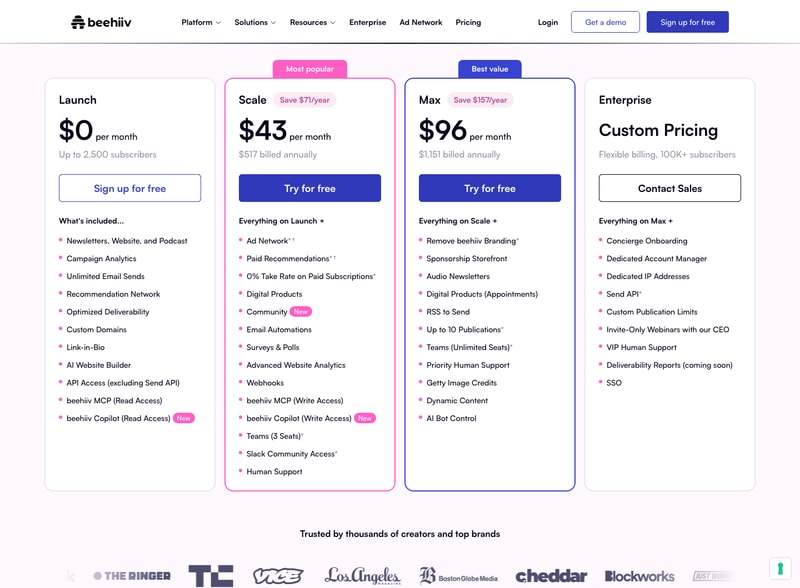
Prices move with the subscriber slider above the cards.
How beehiiv Works
- Priced by subscriber count, in eight bands.
- Free to 2,500 subscribers.
- Unlimited email sends on every plan.
- Annual saves ~12%, exactly as stated.
- 0% take rate on paid subscriptions from Scale.
- Enterprise above 100,000.
beehiiv Pricing
Captured from beehiiv’s pricing page in July 2026 in US dollars, stepping every position of the subscriber slider and both billing toggles.
| Subscribers | Scale/year | Per month | Max/year | Per month | Max premium |
|---|---|---|---|---|---|
| 1,000 | $517 | $43 | $1,151 | $96 | +123% |
| 2,500 | $729 | $61 | $1,573 | $131 | +116% |
| 5,000 | $940 | $78 | $1,785 | $149 | +90% |
| 10,000 | $1,151 | $96 | $2,313 | $193 | +101% |
| 25,000 | $1,785 | $149 | $3,052 | $254 | +71% |
| 50,000 | $2,629 | $219 | $4,002 | $334 | +52% |
| 75,000 | $3,052 | $254 | $4,425 | $369 | +45% |
| 100,000 | $3,474 | $290 | $4,847 | $404 | +40% |
| Annual vs monthly (at 1,000 subs) | Monthly | Annual | Saving |
|---|---|---|---|
| Scale | $49/mo ($588/yr) | $517 | $71 (12.1%) |
| Max | $109/mo ($1,308/yr) | $1,151 | $157 (12.0%) |
| Free Launch plan includes | |
|---|---|
| Up to 2,500 subscribers | ✅ |
| Unlimited email sends | ✅ |
| Newsletter, website and podcast | ✅ |
| Custom domains, link-in-bio, AI website builder | ✅ |
| Campaign analytics, recommendation network | ✅ |
| API access (excluding Send API) | ✅ |
| Monetisation, automations, teams | ❌ |

What actually decides your cost:
- The free plan is unusually complete, and 2,500 subscribers is a real newsletter. Launch includes unlimited email sends, a website, a podcast, custom domains, campaign analytics, the recommendation network, an AI website builder and API access — at $0. Most newsletter platforms meter sends or withhold custom domains at the free tier. Here the only hard ceiling is the subscriber count, so you can run a genuine publication without paying until you cross 2,500.
- What you buy on Scale is money, not capacity. At 1,000 subscribers you are already inside the free limit, so Scale’s $517 a year buys features: the Ad Network, paid recommendations, 0% take rate on paid subscriptions, digital products, email automations, surveys, webhooks and 3 team seats. If you have no intention of monetising yet, staying on Launch until you pass 2,500 subscribers costs you nothing.
- Per-subscriber economics improve about fifteenfold across the range. On Scale with annual billing, 10,000 subscribers costs $430 a month when your list is 1,000 and $29 a month when your list is 100,000. The curve falls steeply and steadily — $430, $244, $156, $96, $59.60, $43.80, $29.00 per 10,000 across the eight bands. Small lists pay a heavy premium per reader; large ones get genuinely cheap distribution.
- The Max upgrade is disproportionately expensive on small lists. Compare the two paid tiers band by band and the premium collapses as you grow: +123% at 1,000 subscribers, +90% at 5,000, +71% at 25,000, +40% at 100,000. In absolute terms Max costs $634 more a year at 1,000 subscribers and $1,373 more at 100,000 — but as a proportion of your bill it becomes far easier to justify at scale. A small newsletter paying double for removed branding, a sponsorship storefront and up to 10 publications is making a much bigger relative bet than a large one.
- The premium is not perfectly smooth, either. The Max gap narrows from +116% at 2,500 to +90% at 5,000, then widens back to +101% at 10,000 before resuming its decline. So there is one band — 10,000 subscribers — where upgrading is relatively worse value than at the band below. Worth checking against your actual list size rather than assuming a straight line.
- The advertised annual savings are exact. “Save $71/year” on Scale and “Save $157/year” on Max both reconcile precisely: monthly rates of $49 and $109 give twelve-month totals of $588 and $1,308 against annual prices of $517 and $1,151. That is 12.1% and 12.0% off. Both figures check out at every band we tested, which is more than several products in this series manage.
- Several features carry asterisks and daggers with no legend anywhere on the page. Ad Network*†, Paid Recommendations*†, 0% Take Rate*, Teams (3 Seats)*, Slack Community Access*, Remove beehiiv Branding*, Up to 10 Publications* and Send API* are all marked. We searched the full rendered page and found no footnote defining either symbol. Given the marked items are precisely the monetisation and seat features people upgrade for, the missing conditions are the ones most worth knowing. Ask before you buy on the strength of any starred line.
- A 20% promotion was running when we captured this. A banner reads “Last call: Save 20% off the new beehiiv — Summer Release savings end July 31.” The prices above are what the page displayed; whether that promotion stacks on the figures shown or is applied at checkout is not stated. If you are reading this later, expect the promotional element to be gone and check the numbers again.
-
The affiliate link works despite returning 403 to automated checks. Fetching
/go/beehiivfrom the command line gives HTTP 403 — a bot challenge, not a dead link. In a real browser it returns 200, lands onbeehiiv.com/?via=findstack, displays “Thank you for considering beehiiv! You’ve been referred by…” and setsattr_firstandattr_lastattribution cookies. Referral tracking is functioning.
Who Should Use beehiiv
- Newsletters under 2,500 subscribers. The clearest case — the free plan is genuinely complete.
- Publishers monetising an audience. Ad Network, paid recommendations and 0% take rate from Scale.
- Large lists. Per-subscriber cost falls roughly fifteenfold from 1,000 to 100,000.
- Anyone wanting a website plus newsletter. Site, podcast, custom domain and link-in-bio included free.
It fits poorly for small paid lists, where Max costs more than double Scale; for buyers who need clarity on the starred features before committing; and for publishers over 100,000 subscribers, where pricing becomes a sales conversation.
Honest Pros and Cons
Strengths
- 2,500 free subscribers with unlimited sends.
- Custom domains and API access on the free plan.
- “Save $71/year” and “$157/year” reconcile exactly.
- 0% take rate on paid subscriptions from Scale.
- Per-subscriber cost falls ~15× across the range.
- Website, podcast and link-in-bio bundled throughout.
Limitations
- Asterisks and daggers with no legend on the pricing page.
- Max costs +123% over Scale on small lists.
- The Max premium is non-monotonic — worse at 10,000 than at 5,000.
- Monetisation is entirely gated behind Scale.
- beehiiv branding stays until the $96 tier.
- Above 100,000 subscribers there is no published price.
beehiiv Alternatives and How It Compares
- Mailchimp is the broader marketing platform, stronger on e-commerce automation.
- MailerLite competes on price with a similar free tier.
- Ghost is the open-source publishing alternative you can self-host.
- Substack takes 10% of subscription revenue instead of charging a platform fee.
- Kit targets creators with commerce and automation tooling.
The Verdict
beehiiv’s free tier is the headline, and it holds up. Launch covers 2,500 subscribers at $0 with unlimited email sends, a website, a podcast, custom domains, link-in-bio, campaign analytics and API access. Most newsletter platforms meter sends or withhold custom domains until you pay; beehiiv’s only hard limit is the subscriber count. If you are below 2,500 and not yet monetising, there is no reason to pay anything — Scale’s $517 a year buys revenue tooling, not capacity: the Ad Network, paid recommendations, a 0% take rate on paid subscriptions, automations and team seats.
Above that line the economics reward scale steeply. Measured per 10,000 subscribers a month on Scale, the cost falls $430, $244, $156, $96, $59.60, $43.80, $29.00 across the eight bands — roughly a fifteenfold improvement from 1,000 to 100,000 subscribers. Small lists pay a lot per reader; large ones get genuinely cheap distribution. The annual discount is straightforward and honest: “Save $71/year” and “Save $157/year” reconcile exactly against monthly rates of $49 and $109, at 12.1% and 12.0% off.
The decision that deserves real thought is Scale versus Max, because its answer changes with your list. Max costs 123% more at 1,000 subscribers and only 40% more at 100,000 — the same features (removed beehiiv branding, a sponsorship storefront, audio newsletters, up to 10 publications, unlimited seats) at wildly different relative prices. There is also one uneven step: the premium narrows to +90% at 5,000 and then widens again to +101% at 10,000, so check your actual band rather than assuming a smooth curve. On a small list, Max is a heavy bet on monetisation you have not yet proven.
One caveat worth resolving before you buy. On the plan cards, Ad Network*†, Paid Recommendations*†, 0% Take Rate*, Teams (3 Seats)*, Remove beehiiv Branding* and Up to 10 Publications* all carry asterisks or daggers — and we could find no footnote anywhere on the page explaining either symbol. Those marked items are precisely the monetisation and seat features that justify upgrading, so whatever conditions attach to them are the conditions that matter most. Ask beehiiv directly rather than assuming.
FAQ
How much does beehiiv cost?
Pricing scales with subscriber count. Launch is free up to 2,500 subscribers. On annual billing, Scale runs from $517 a year at 1,000 subscribers to $3,474 at 100,000, and Max from $1,151 to $4,847 over the same range. Monthly billing costs about 12% more — at 1,000 subscribers, $49 and $109 a month respectively. Above 100,000 subscribers, pricing is custom.
Is beehiiv’s free plan actually usable?
Yes, more than most. Launch includes up to 2,500 subscribers with unlimited email sends, plus a website, podcast, custom domains, link-in-bio, an AI website builder, campaign analytics, the recommendation network and API access (excluding the Send API). What it excludes is monetisation — the Ad Network, paid recommendations, paid subscriptions and digital products all start on Scale.
Should I pick beehiiv Scale or Max?
It depends heavily on list size. Max costs 123% more than Scale at 1,000 subscribers but only 40% more at 100,000. What it adds — removed beehiiv branding, a sponsorship storefront, audio newsletters, up to 10 publications and unlimited team seats — is the same either way, so the upgrade is far easier to justify on a large list. Note one uneven step: the premium is +90% at 5,000 but +101% at 10,000.
Does beehiiv take a cut of subscription revenue?
Not on paid plans. “0% Take Rate on Paid Subscriptions” is listed from the Scale tier upward, which is the main structural difference from platforms that take a percentage of your subscriber revenue instead of charging a fee. Note that this feature carries an asterisk on beehiiv’s pricing page with no accompanying footnote, so confirm the conditions before relying on it.
Is beehiiv’s advertised annual saving accurate?
Yes. “Save $71/year” on Scale and “Save $157/year” on Max both check out exactly: monthly rates of $49 and $109 give annual totals of $588 and $1,308, against annual prices of $517 and $1,151. That is 12.1% and 12.0% off, and the same relationship held at every subscriber band we tested.

Compare beehiiv with other popular tools in the same category.
It has been really easy to use the tool to generate our newsletter for our database.
I wish it was a little easier to add one off email addresses to my list. Importing large lists is easy, but doing one or two that randomly get sent to me are tougher.
Communicating via email with our community.

It helps me get new subscribers without a big lift on my end.
The price is high for the moment, but the new features being released non-stop are making up for that.
Beehiiv helps me to acquire new subscribers while I focus on creating my content.

I reviewed multiple newsletter services before setting on beehiiv. I intend to grow my subscribers and everything else I researched showed that after 10k subscribers you get a steep price increase and for most actually a set limit for how many subscribers you can email. Beehiiv has no limitations in their final pricing tier and for that it is the best. Our website is https://thereach.ai and beehiiv actually had the easiest form setup of everything I tried. Easy to use, set up, adjust to whatever widget I'm using. Everything else is great tood, a lot of features, functionalities, landing pages, AB testing etc etc
Maybe it's a bit pricier? Also I think the team could do weekly Q&A to demo and help people set up their newsletters, answer questions, show tips and tricks. The platform can do a lot, but I'm sure many users need training.
I run my newsletter for https://thereach.ai/ on beehiiv and honestly it's great. It was fast to set up, plenty of features to test the newsletter content and actually a lot of tools that help you grow the followers.
It is easy to understand and it is very user friendly. I use to do my newsletters on MailChimp but recently switched to beehiiv and it is not that complicated to use and navigate.
The only thing i dislike about it so far is the option to ctrl+a. Whenever I do that it just selects all and not just the block or part that I want to select. So yeah still trying to figure it out.
beehiiv made the transition from MailChimp easy. I am happy that it is user friendly and very easy to understand and to adapt to. I can Navigate and edit my newsletter with ease.
user friendly interface for a newsletter
Number limitations for their free plans
It is helping me run my newsletter as part of my content creation and writing journey to reach quite an audience on a free plan It enables me automate and easilty operate the newsletter with basic software operation skills