

Unclaimed: Are you working at Coda?
Coda Reviews: 4.7/5 — Highly Rated
Coda is a document management solution for creating, editing, and viewing text documents and spreadsheets. , It also helps centralize all documents to ensure seamless efficiency between teams and comes with customizable templates that let organizations create personalized documents for meetings, brainstorming sessions, customer feedback, to-do lists, and market research. It features drag-and-drop functionality, which keeps functionality simple, and has numerous tools that offer role-based access.

| Capabilities |
API
|
|---|---|
| Segment |
Small Business
Mid Market
Enterprise
|
| Deployment | Cloud / SaaS / Web-Based, Mobile Android, Mobile iPad, Mobile iPhone |
| Support | 24/7 (Live rep), Chat, Email/Help Desk, FAQs/Forum, Knowledge Base, Phone Support |
| Training | Documentation |
| Languages | English |



Coda bills you for Doc Makers only. Editors and Viewers are free — on every plan, including Enterprise. An Editor can edit content, add tables and views, build formulas and buttons, and configure Packs and automations, and still costs nothing. So a fifty-person workspace where five people create docs pays for five seats. In a category where almost everyone charges per head, that is the most buyer-friendly pricing model reviewed here this month.
- What it is: A document creation platform combining docs, tables, formulas and automations — now sold as Superhuman Docs.
- Best for: Teams where a few people build documents and many people use them.
- Pricing: Free; Pro €12, Business €33 per Doc Maker monthly on annual billing; Enterprise custom. Verified July 2026.
- The honest catch: The product has been rebranded — every button on the pricing page says “Get Superhuman”.
What Is Coda?
Coda merges documents, spreadsheets, databases and applications into one surface: pages that contain connected tables, views, forms, formulas, buttons and automations, extended by integrations it calls Packs. It cites 40 million-plus people and 50,000-plus organisations.
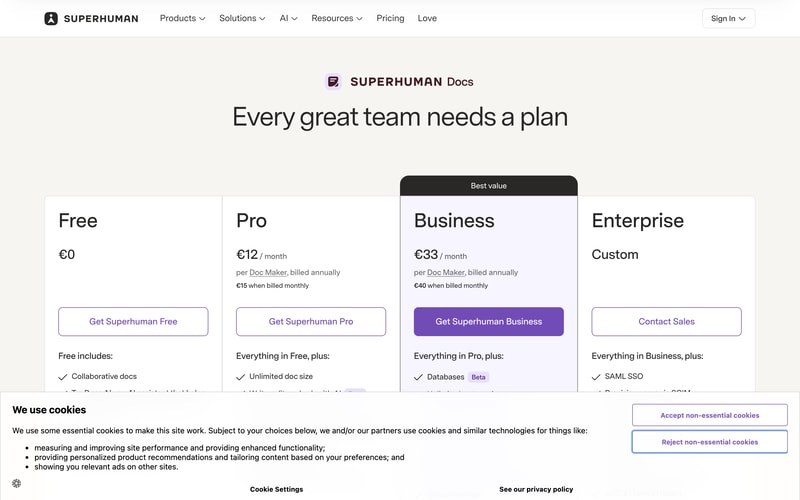
The name has changed. Every call to action on the pricing page reads “Get Superhuman Free”, “Get Superhuman Pro” or “Get Superhuman Business”, and the FAQ refers throughout to “Superhuman Docs”. Coda now sits inside the Superhuman family alongside Grammarly, and the plan cards list Grammarly and Go as included from Pro, with Mail added from Business.
Docs AI is marked Beta and is described as “available during Beta for Doc Makers”.
How Coda Works
- Doc Makers are the only billed role.
- Editors, Viewers and Guest Editors are always free.
- The model holds on Enterprise, per Coda’s own FAQ.
- Two paid tiers plus a free one, and a custom Enterprise.
- Grammarly, Go and Mail are bundled from Pro upward.
- Removals give account credit, not refunds.
Coda Pricing
Captured from Coda’s pricing page in July 2026 on the euro price list.
| Plan | Annual (per Doc Maker/mo) | Monthly | Saving | Key additions |
|---|---|---|---|---|
| Free | €0 | €0 | — | Collaborative docs, connected tables, formulas, automations |
| Pro | €12 | €15 | 20% | Unlimited doc size, 30-day version history, custom branding and domains |
| Business | €33 | €40 | 17.5% | Databases, unlimited automations and version history, private folders, doc locking |
| Enterprise | Custom | — | — | SAML SSO, SCIM, audit events, SOC 2 Type 2, HIPAA |
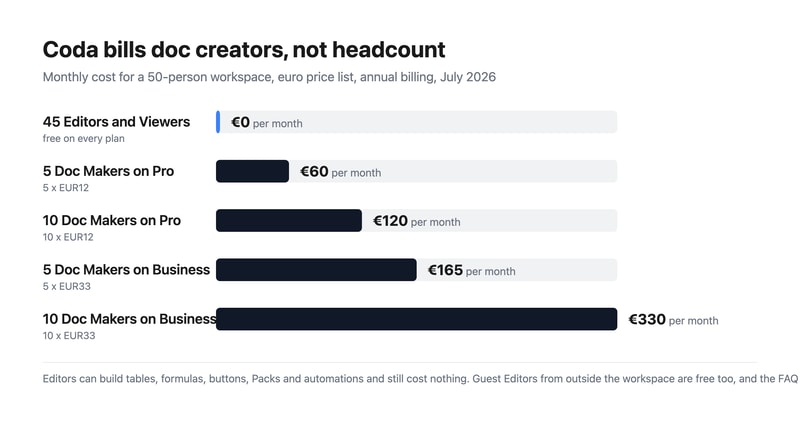
What actually decides your cost:
- Count your doc creators, not your team. Coda’s FAQ is explicit: “Editors and Viewers are always free”, and “at the end of each billing cycle, you will be billed for the workspace based on the number of Doc Makers in it.” A Doc Maker creates docs and templates and manages folders; an Editor does almost everything else — tables, views, formulas, buttons, Packs, automations — for nothing.
- The free roles are unusually capable. This is not a viewer-only tier dressed up. An Editor building a formula-driven tracker with automations is doing the substantive work of the platform and is not billed for it. Compare that with Notion or Airtable, where an editor is a paid seat.
- Outside collaborators are free too. Sharing a doc externally adds the recipient as a Guest Editor, who can edit content in that doc but cannot manage pages or browse the workspace. Guest Editors cost nothing, so client and contractor collaboration does not inflate the bill.
- Enterprise keeps the model. The FAQ states plainly: “Even on Enterprise, you pay only for Doc Makers.” Enterprise adds SAML SSO, SCIM provisioning, audit events, a SOC 2 Type 2 report and HIPAA compliance rather than changing how you are counted.
- Business is a 175% step up from Pro. €33 against €12 buys databases, unlimited automations and version history, private team folders, page locking and cross-doc actions. Pro’s automations are not stated as unlimited, so heavy automation users should establish the Pro limit before assuming they can stay there.
- Cancelling gives credit, not money back. Coda’s FAQ: “When you remove members or cancel your plan, we’ll apply a prorated credit onto your account you can use for future charges in your workspace.” That credit is usable inside the workspace, not refundable to your card.
Who Should Use Coda
- Teams with few builders and many readers. The clearest case — the pricing model is designed exactly for this shape.
- Operations and product teams. Connected tables, formulas and automations replace a spreadsheet-plus-doc sprawl.
- Agencies and consultancies. Guest Editors are free, so client collaboration costs nothing.
- Organisations needing compliance. SOC 2 Type 2 and HIPAA on Enterprise.
It fits poorly for teams where everyone creates docs, since every one of them is a billed seat; for buyers who need mature, non-beta AI, given Docs AI’s Beta labelling; and for anyone unsettled by an in-progress rebrand.
Honest Pros and Cons
Strengths
- Editors and Viewers are free on every plan, including Enterprise.
- Free Editors can build tables, formulas, buttons, Packs and automations.
- Guest Editors from outside the workspace are free.
- A genuinely capable free tier with connected tables and automations.
- Grammarly, Go and Mail bundled from Pro upward.
- A 20% annual discount on Pro.
Limitations
- The product has been rebranded to Superhuman Docs mid-flight.
- Business costs 175% more than Pro.
- Docs AI is still labelled Beta.
- Pro’s automation allowance is not stated as unlimited.
- Cancellations yield account credit, not refunds.
- SSO and compliance reporting require Enterprise.
Coda Alternatives and How It Compares
- Notion is the closest competitor, charging per member rather than per creator.
- Airtable is stronger as a database, with per-seat editor pricing.
- ClickUp and monday.com approach the same ground from project management.
- Smartsheet targets enterprise work management with a spreadsheet metaphor.
- Google Workspace covers documents far more cheaply without the database layer.
- Confluence, Slite and Nuclino compete on team wikis and documentation.
For a broader survey, browse our document creation directory.
The Verdict
Coda’s pricing model is the best thing about it, and after a month of reviews spent pointing out where headline rates mislead, it is a pleasure to report one that works the other way. You are billed for Doc Makers only. Editors and Viewers are free, and so are Guest Editors from outside your workspace — on every plan, with the FAQ confirming that “even on Enterprise, you pay only for Doc Makers.” Crucially, the free roles are not spectators: an Editor can build tables and views, write formulas, configure buttons, add Packs and set up automations. A fifty-person team where five people create documents pays for five seats.
Set against per-member competitors, the difference compounds quickly. That same fifty-person workspace costs €60 a month on Pro or €165 on Business, where a tool charging per member would bill all fifty. If your organisation has a handful of builders and a long tail of people who read, comment and edit within existing docs — which describes most operations, product and marketing teams — this is the cheapest serious option in the category by a wide margin.
Two things to note before committing. The product is being rebranded: every button on the pricing page now reads “Get Superhuman”, the FAQ calls it “Superhuman Docs”, and Grammarly, Go and Mail appear as bundled products from Pro upward. Anyone evaluating “Coda” should know they are buying into the Superhuman family, and that Docs AI is still labelled Beta. And on the commercial detail, removing members or cancelling produces a prorated account credit rather than a refund — usable for future charges in the workspace, not returned. Neither undermines the central point, which is that Coda charges for the people building and lets everyone else in free.
FAQ
How much does Coda cost?
On the euro price list captured July 2026: Free at €0, Pro at €12 per Doc Maker per month billed annually (€15 monthly), and Business at €33 billed annually (€40 monthly). Enterprise is a custom quote. Crucially, you are billed only for Doc Makers — Editors, Viewers and outside Guest Editors are free on every plan.
What is a Doc Maker in Coda?
The only billed role. Coda’s FAQ defines Doc Makers as members who “create new docs and templates, create and manage folders to organize the workspace”, plus doc administration such as adding pages, changing titles and icons, and configuring locking. Editors, by contrast, “can edit content and collaborate in existing docs and pages, including adding tables and views, constructing formulas and buttons, adding and configuring Packs and automations” — and are free.
Are Coda Editors and Viewers really free?
Yes. The FAQ states “Editors and Viewers are always free”, and billing is based purely on the number of Doc Makers in a workspace. External collaborators become Guest Editors, who can edit content in docs shared with them but cannot manage pages or browse the workspace, and they are free too. The model holds on Enterprise, which the FAQ confirms explicitly.
Is Coda now called Superhuman?
Effectively, yes. Every call to action on the pricing page reads “Get Superhuman Free”, “Get Superhuman Pro” or “Get Superhuman Business”, and the FAQ refers throughout to “Superhuman Docs”. The plans also list Grammarly and Go as included from the Pro tier, with Mail added at Business, so Coda now sits within the wider Superhuman product family.
Does Coda refund unused time if I cancel?
Not in cash. Coda’s FAQ states: “When you remove members or cancel your plan, we’ll apply a prorated credit onto your account you can use for future charges in your workspace.” So downgrading or removing Doc Makers produces workspace credit against future billing rather than money returned to your payment method.

Compare Coda with other popular tools in the same category.
It was a pretty common occurrence when I was using excel / google sheets that I would build something awesome, then I would work very hard to convince my team to use it, then when I had finally gotten people on board they would ask for "one more thing". That thing, though almost always completely reasonable and very valuable, would break the entire sheet. I would have to go back to the beginning to rebuild my system, it would mean an additional tab added to the document, and more ways for the system to break. Coda uses tables instead of cells. At first, this was difficult to get used to. However, once I understood the model, I also came to understand how much more powerful tables are. It means that when people ask for "one more feature" I can almost always make it rather effortlessly. The other day a family member asked me to introduce them to Google Sheets so that they would understand how to use it. I instead took them to Coda and we built their doc in the course of a couple hours. They then decided that maybe they didn't need Coda, and they switched back to Google Sheets. They emailed me, "I have just finished putting all my information into the sheets, but now I need to do X, how can I do that?" The unfortunate answer was, "you have to restart from the beginning :("
I want to be able to have pages inside pages. This would really enable a lot more functionality. Also, I'm frustrated that it's not yet possible to print your documents. I want to save them to pdf and share with people, but that's not currently a feature they offer.
Basically we run our whole company in coda. All of our meeting notes are there, all of our prospects are recorded there, all of our market research is done there, we create very cool interactive presentations for our customers there, we do app prototyping in it. These are just the docs I currently have open in my browser.
How it's a smarter version of Airtable and Notion combined with lots options to put full of functionalities!
The new formatting toolbar. But I just probably need to learn the shortcuts
The possibilities on organizing data to make it useful for your business operations.

Coda makes it simple to keep all the knowledge in your team up to date and align on everything from OKRs to product specs
Over time there's a lot of difficulty in maintaining awareness of all docs
Company goal setting and general updates
The power it has in its formulas and collaboration features. Imagination is the only limit we've faced when working with Coda. We've built our CRM within it as well as many reports that we share with our customers to keep track of their projects.
Performance is sometimes an issue. Also there aren't any options to use tables as spreadsheets and apply formulas within each cell, this would be a really great addition. Also it could use some work on document management and organization features.
We've solved: - Internal process documentation - Project documentation - Reporting - CRM - We use it as our source to invoice our clients
It's is a very easy-to-use platform. In the beginning, it doesn't look straight, but when you know the keys, it becomes an effortless and valuable platform to use in teams.
I don't have topics to point right now, because, since I have some months of using Coda, I learned the majority of the keys and tips.
The use of Coda Sheets is effortless, and once you learned the buttons and options that Coda provides, you can work with data quickly and easily, creating columns and rows very fast. And finally, with all this data prepared, I brought this data from Coda to Google Sheets through an API.
Its like google suite in 1 easy to use space. Its our source of truth.
The table functionality isn't up to par with other tools, not as robust so better for organizing data but not calculations
I use it as a student to organize my class workload
Coda is a very flexible tool that could centralize everything. You can structure there all the information and docs, and also, you can design your document to do tasks more efficiently there. I save a lot of clicks by having interconnected all knowledge produced by a project.
I don't like that my user name appears in any single coda I share. I would like to share information without attribution. Also, that users have to sign in to use buttons or edit. But the tool is excellent.
Knowledge management Project management Team collaboration Produce - write things Work on an interface to analyze information and enrich your data Reporting
That i could contact people to help me and they would answer right away!
I dont have a comparison, of course coding stuff was a bit clumsy in the beginning but i am sure this was on me :D
I could code a random image selector that is super helpful to prototype a new product (and i will continue working on it)

Coda is super versatile allowing me to create multiple different workflows for different parts of our business. It's much easier to onboard all stakeholders to one tool that does everything fairly well, instead of multiple tools that do different things amazingly.
I really wish Coda had more formatting options like Notion. I also wish that search "just worked", it's hard to find things on pages and on tables. I want an out-of-the-box search experience that works without me having to manually make search hacks for each table.
I've built a performance and task tracker for my teams, as well as a robust end-to-end product management and development framework.

Cross doc functionality, Coda Packs are amazing and the overall design of the mobile app and how it takes my desktop created visuals and creates a responsive, beautiful chart/graph
At first a couple years ago when I first started using Coda I had some issues with the formulas however that was on me to learn which I did with the help of extremely helpful Coda employees and the Coda Community
Our company’s CRM is ran strictly on Coda. We have a couple products we’ve been creating that pushes data to Coda via webhooks.
Coda has been helpful with creating documents that allow different teams to align with each other. It's user friendly, and easy to follow.
Nothing :) Coda has made sharing communications and updates so easy.
We've created documents specific to workflows that our team needs, as well as created new docs for partner advocates learning the skills we use. It's made the communications effective and easily accessible.
Love all the features in Coda but my favorite is the ability to sync other programs into Coda for keeping up to date information. It makes it very easy to stay organized, assign our tasks, and track metrics.
Some of the coding required to sync some programs can have a steep learning curve.
Coda has allowed me to build out centralized resourcing for my team which has allowed us to have consistent and increased performance.
The user experience and the way the document is structured
More formatting options especially to the charts
Project management and company wiki. The teams are more efficient and organised. Benefits in planning and tracking meetings and tasks
I use coda for everything. Project management, events, database, wiki, forms, kanban, CRM, personal expenses, events planning, and much much more. The versatility of the platform is incredible and allows you to build nearly anything. Support is great, their api is good, community engagement is fantastic.
Forms could be a little more extensive. Other than that, the team at Coda has been very proactive in addressing questions and community requests. It's understandable that there are a lot of features that are requested and only limited resources to do them all. Only downside is that their dev team cannot do everything all at once. I really hope they don't lose that "growing startup" vibe and start heavily marketing their platform. It's good because they focus on development.
I have been able to create a home base for all operations for my organization. That means managing events, meeting notes, tasks, database of our members, resource management, form submissions... any many more things I will inevitably add. The open sandbox nature of the platform enables you to do nearly anything with the use of tables. The ability for inline formulas creates dynamic documents for external or internal purposes. We also use coda to handle our entire application process, from application submission to interviews to emailing applicants.
I love the collaborative features of CODA and the ability to manage all the data in table format, it's a simple project management software where you can jump right in and start using it without any project management experience. The collaborative features and packs definitely add lot of value while the automation brings in some level of convinience.
I'd love to see more flexibility around tables to be able to run various formulas for Cells, Rows and Columns, Right now the formulas a much more Column/Row specific and I'd like to see where I can have various formulas in different cells in the same row or column
Great running journal wit the power of table.
I have been using coda for past 6 months and it has come and I'm astounded by how powerful the tool is. Its biggest benefit is the familiarity of excel tables with the power of relational databases. Another aspect I love of coda is the human readable formulas. The fact that everything in a formula is relational and uses steps to access even the most remote data.
I understand the fact that the coda is different from spreadsheets, but when presenting coda docs to non-coda users they see coda tables and anchor their experience towards spreadsheets. I wish there was a way to provide a bit more spreadsheets like experience with coda. Especially towards single cell formulas. Another improvement that i would like to see is more flexibility of graphs. Through various workarounds (graphs within detailed view) we know they can scale up and down. So what would be highly beneficial is that ability to resize graphs as well as ability to change the titles of the X and Y axis. This will allow users to create powerful coda dashboards and allow coda to be
We are building mostly trackers and calculators. For example, Proposal Pricing Calculators, and OKR Tracking documents. The main benefits we have realised is the ease of cross doc synch which allows data such as pricing data and rates to be maintained in a separate location. Additionally the slack integration has enabled maintaining of trackers a lot easier.
* Helps me organize my work * Share work with others * Easy to Navigate pages
* Printing pages may be hard to get margins right * Font selection can be more
* Organization of work and thoughts * Instant collaborative work online
I love the ability to make pages & subpages Ability to use commands (/) to bring up different formats Functionality of collaboration Live polls
The version control access could be a bit better
We are streamlining how we document and collaborate, by leveraging a much richer document creation process.
+ Easy to create visually appealing sub-pages
- Some functions make it hard to type quickly (equals sign for formulas, highlighting links)
+ Organizing complex projects that require a lot of notes and writing. People can quickly browse these projects and not have to unnecessarily scroll through long GDocs.
love the ability to add different types of pages, tables, etc
harder to use tables like excel or google sheets
team collaboration and organization
easy to use with different banners and review code sequences. great collaboration tool to solve issues as a team. Great one-page view all for what other teams are working on so there is no duplications
performance can be slow sometimes when a bunch of us are collaborating. Formatting for style can be off.
Focusing on our monthly OKRs and key metric.
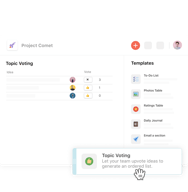
The freeform combination of shared words, data and actions to drive everything from simple teaming to complex business processes. We use Coda for everything from running our meetings to planning our 3yr/1yr and quarterly objectives. It has been invaluable as a place to integrate many of our siloed solutions such as email, calendaring , and task management to create automated connections and manage ongoing projects. It's actually been invaluable as we've had to be distributed during the pandemic. I *love* the new templates and collections that can get you going fast! For example, just try running a meeting with one of Coda's templates. Drag in a topic upvoting collection. Add a Todo list to summarise. If it's a project, drag in a project tracker, etc. Graduate into finding a productivity issue you want to hack or a problem to solve. You'll be amazed what you can do. We eventually learned that we could integrate all our disparate Google docs into a Coda Wiki - it has been amazingly valuable as the single source of truth where we integrate everything from our how to videos to our (Miro) whiteboard or even just photos and files.
It's a learning curve. Starting with a blank page can be daunting, and Coda is a new paradigm so be prepared to "unlearn" the old limitations of old siloed apps like docs and tables and project managers. Do try the Coda videos on their YouTube channel to orient yourself. Then try the templates and collections.
We have automated our investment process, saving hours of manual entry and re-entry of data, and eliminating errors between google docs. It has also saved us countless hours searching for information and instead has left us with a single Coda doc that ends up with a summary investment memo. Coda has helped us, engage our Core community, let them self serve, organize and run Stage, Function and Domain peer groups as well as participate in the investment process as described below. It is a magical way to enable expert participation and support for our founders. For context: Our advantage as a venture firm is just one thing - our Core community. It is a group of several hundred founders and executives that have built tens of billions of dollars worth of companies with thousands of employees in B2B SaaS. We curate them by Stage, Function and Domain, so they can engage with us to source, select, invest and most importantly work alongside our founders to build their companies. And here's the kicker, we reward them with shadow equity in the company they partner with, as Core Partners. It costs our founders nothing, but aligns the Core partner with Underscore.VC's new ventures and enables immediate rewards for all involved as value is realized. Finally we have become empowered by Coda as a tool for enabling our remote work. It's an amazing meeting and task and project management tool.

It’s easy for anyone to build relational databases in form of a doc, a table or a plain sheet of paper. You can easily retrieve, link, manipulate and show data in every common form you need.
The app-like rendering is still clunky and slow, but an amazing idea to further develop. It’s not so easy to explain to people all the possibilities of creating a Coda document.
I was able to built a complete GTD project and task management system on coda, connecting email calendars and referencing of online and offline materials. I have build a database to keep track of numerous crowdfunding projects I am backing and I am using it for project management and test programs.
Coda has made my team far aligned internally and externally, serving as a single-source-of-truth for all we do. I've simplified much of my day-to-day by moving most of my repeatable work into Coda, like project updates, roadmaps, and OKRs. I don't have to re-engineer my content for every new presentation either. I just run meetings right out of the Coda document. Coda saves me so much time on administrative tasks that I can put toward the work that really matters.
It has high barriers to entry for people who want to create documents from scratch.
Problems - Inconsistent information between various docs, slide decks, and sheets (not to mention their copies) - Redundant data entry... constantly repackaging the same information - Unclear sources of truth Benefits - So much better alignment and clarity on what will happen when - Reduced time spent on administrative tasks
The overall UI is really easy to use, the emojis and icons that can be added to a document are a great way to personalize. The best part is that the document allows for so many custom flows of information, integrated tables, people you can tag for feedback, etc. I love that Coda also comes with a breadth of templates that you can use off the bat. Another great feature is you can easily integrate with many 3rd party services like Google Sheets, Jira etc, and you can also save a copy of other people's public templates for various use cases.
There is not much to dislike honestly, however, copying templates and tables usually creates a connection to the original data which sometimes you don't want.
We use it for all our information storage, documentation, notes, daily standup info, demo feature, run sprint reviews. Really our entire company workflow lives on Coda!
Coda takes the best of online collaborative documents, spreadsheets and databases, and supercharges them with 3rd party connections. What we’ve managed to build with it and how it’s streamlined our internal processes, has saved us so much time, confusion and reduced the number of tools we use by consolidating features in one app
The mobile app has a way to go, but i have confidence in the Coda team to make that a powerful 1st class native app soon.
I'm using Coda to run my entire business, from Sales tracking and forecasting, project management, content & editorial management, strategy and operations. So many uses cases that were difficult to do with off the shelf products, were possible with coda.
I can create any format I like. If i want the doc to be super simple, or super complicated, it is only limited to my imagination. There are so many features I am happy to have something to learn where I can always improve my document in the future. My document can also stay simple in the beginning of I am just learning the platform.
At times, my imagination can get overwhelming, so sometimes it takes some thought to organize my thoughts. There are times when I am not sure how to organize so many different features, but having more options is the best kind of "downside" because I can learn something new in the future, and I can always look back to my documents and think about what new creative idea I can use to improve the document, make it simpler , or add features, whatever is needed for the particular task or objective for the document.
I am posting course content on Coda. I am taking my time to learn Coda, so I stick with just the most basic text features initially, and over time I am learning some of the polling and other features of coda that I can incorporate into my document. Initially I am just posting live session links. In the future I will incorporate some polling and some interactive material during class sessions. It is challenging since my class interacts with so many platforms, LMS, and online homework, and paper assignments, but Coda gives me a way to conceptualize creative solutions for improving the navigation to my course. Since I don't have time to learn every feature of coda right away, I can slowly learn and improve. I think using Coda is a long term decision that will help me with the problem of improving my content year after year inside my documents.
The UI and countless training docs for "do it yourself" - I like that Coda is a robust project management tracking tool that provides users with guides for enhancing their docs. Coda also goes one step further to provide 1:1 trainings for our business, which is super valuable for quick learning. I also LOVE the pre-populated document templates - this has been invaluable in my current role in helping me save time and create better docs!
the time it takes to learn how to use tables/views and create buttons or add automations
real time collaboration with teams, multiple use cases (coda combines functionality from google sheets, excel, design, etc) lots of benefits, from unique customization to easy sharing between different teams
Coda is an extremely intuitive platform that allows my customers to have visibility of the shared documents that are critical to helping us at Silktide provide them with an excellent service. Having the ability to give them read-only access ensures the integrity of that documentation.
So far it has worked exactly as planned so nothing really to complain about
Coda is helping me and my team share customer insights in a secure manner! Feedback from our customers has been fantastic!

Coda allowed me to set up and entire system for running my life. It includes personal and professional tasks that are combined in a master list and easily separated too. Every morning I complete my daily journal and every evening I summarize the day. It allows me to track everything I want. Forms a click away with buttons that were easy to style as desired. The option to add formulas makes the system so powerful.
Might be nice if pages were possible to publish to a custom URL. But there are other products for that.
Organizing my life, a mastermind group, keeping up with a fellowship program.