

Unclaimed: Are you working at DigitalOcean?



DigitalOcean Reviews: 4.6/5 — Highly Rated
DigitalOcean is a cloud hosting platform built to serve the needs of startups and established businesses. The software gives developers access to building, deployment, and scaling applications. The platform is best known for its flexible pricing structure and global data centers, as well as an easy-to-use, intuitive control panel.
| Company | DigitalOcean Holdings |
|---|---|
| Year founded | 2012 |
| Company size | 1001-5000 employees |
| Headquarters | New York, NY |
| Social Media |

| Capabilities |
API
CLI
|
|---|---|
| Segment |
Small Business
Mid Market
Enterprise
|
| Deployment | Cloud / SaaS / Web-Based |
| Training | Documentation |
| Languages | English |

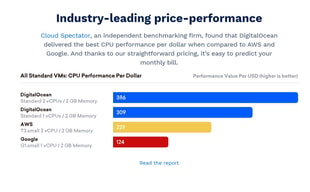
A DigitalOcean Basic Droplet with 8 GB of RAM costs $48 a month. The same 8 GB costs about $7 at Contabo and roughly €8.49 at Hetzner. On price per gigabyte, DigitalOcean is around six times the cheapest credible option — and it remains the right choice for a large number of teams, because the gigabytes are not what you are buying.
- What it is: A developer cloud — Droplets (VMs) alongside managed databases, object storage, load balancers and Kubernetes, tied together by an unusually good API and documentation.
- Best for: Teams managing infrastructure as code, and anyone who will genuinely use more of the platform than the virtual machine.
- Pricing: Basic Droplets from $4 a month; 4 GB / 2 vCPU at $20; 8 GB at $48. Dedicated-CPU families from $63. Verified August 2026.
- The honest catch: Backups are off by default and cost 20–30% extra, and if your Droplet is the whole infrastructure you are paying a large premium for capability you will never open.
What Is DigitalOcean?
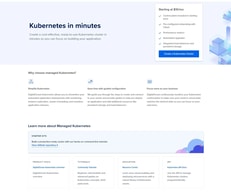
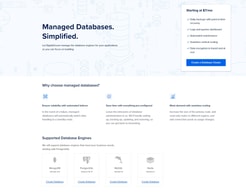
DigitalOcean is a cloud provider built for developers rather than enterprises. Its core product is the Droplet — a straightforward Linux virtual machine — but the reason people stay is everything arranged around it: managed PostgreSQL, MySQL and Redis, Spaces object storage, load balancers, managed Kubernetes, a first-class REST API, a mature Terraform provider, and a documentation library that has taught a meaningful share of the industry how to administer Linux.
That documentation is not a side benefit. Search almost any server-administration question and a DigitalOcean tutorial is near the top, usually correct, and usually dated. The company also dates its documentation pages — “Last verified 13 Jul 2026” appears on the recovery-console guide — which is rarer than it should be and worth something when you are following instructions at 2am.
DigitalOcean also owns Cloudways, which now brands itself “Cloudways by DigitalOcean” — relevant if you are comparing the two, because you are choosing between a raw cloud and a managed layer from the same parent.
How DigitalOcean Works
The Droplet families matter more than most people realise, and DigitalOcean is unusually clear about them.
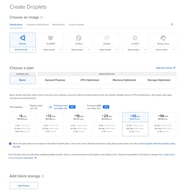
Basic Droplets share vCPUs with other Basic Droplets. General Purpose, CPU-Optimized and Memory-Optimized are dedicated — no noisy neighbours, no contention. The company documents this distinction under a heading called “Shared CPU vs. Dedicated CPU” rather than burying it, which is more than most of the market manages. The dedicated families differ only in memory ratio: CPU-Optimized gives 2 GB per vCPU, General Purpose 4 GB.
Billing is hourly against a monthly cap, so a Droplet that runs three days costs three days and one that runs all month costs the advertised monthly figure. That only pays off if you create and destroy servers programmatically — and note that stopping a Droplet does not stop the bill, since reserved resources continue to charge until it is destroyed.
Storage comes in two forms. Droplets include local SSD; Volumes are network block storage sold separately. Volumes are capped at 10,000 IOPS (bursting to 15,000) and 450 MB/s, and — importantly — that performance does not scale with volume size. Buy Volumes for data that must outlive the Droplet, not for speed.
The Marketplace carries 409 solutions at the time of writing, including a dedicated AI Agents category, with n8n, Coolify and Ollama with Open WebUI all available as 1-Click Apps. Each has its own documentation page explaining what the image installs, which is the part competitors usually omit.
DigitalOcean Pricing
Verified August 2026, in US dollars:
| Plan family | Example | Price/mo |
|---|---|---|
| Basic (shared) | Entry Droplet | $4 |
| Basic (shared) | 4 GiB / 2 vCPU | $24 |
| Basic (shared) | 8 GB | $48 |
| General Purpose (dedicated) | from | $63 |
| CPU-Optimized (dedicated) | 4 GiB / 2 vCPU | $42 |
| Memory-Optimized (dedicated) | 16 GB / 2 vCPU | $84 |
| Backups | add-on | +20% weekly / +30% daily |
Two things to sit with. The dedicated premium is about 1.75× — a CPU-Optimized Droplet at 4 GiB / 2 vCPU is $42 against $24 for the equivalent Basic. And backups are not included. On a $4 Droplet the surcharge is about a dollar; skipping it is nonetheless how people lose projects, because the default is off and nothing prompts you.
Measured as cost per gigabyte of RAM, Basic Droplets land at roughly $6.00/GB — the most expensive tier in our cheapest VPS index, where budget European hosts sit under $1.
Who Should Use DigitalOcean
Buy it if you manage infrastructure as code and will use the API, Terraform provider and managed services; if your Droplet is one node in a larger system rather than the system itself; if you want managed Postgres or Redis without operating them; or if you are learning Linux and want the best free teaching resource in hosting attached to your account.
Don’t buy it if your VPS is a single box running a single stack. At that point you are paying roughly six times the per-gigabyte rate of Hetzner or Contabo for a platform you will not open, and the honest advice is to take the cheaper server.
It is also not the best first VPS for a non-technical beginner, despite the documentation. A Droplet is a bare Ubuntu box with no control panel, so your first task is a shell session rather than a form — and backups being off by default is the wrong default for someone who does not yet know what they do not know.
Honest Pros and Cons
Pros
- Documentation and tutorials that are genuinely best in class, and dated so you can judge staleness
- Excellent API, CLI and Terraform provider — the reason hourly billing is actually usable
- Clear, documented distinction between shared and dedicated CPU families
- A deep Marketplace (409 solutions) with per-app documentation
- Out-of-band Recovery Console plus a Recovery ISO, so a firewall mistake is recoverable without a support ticket
- Managed databases, Spaces, load balancers and Kubernetes on the same bill
Cons
- Roughly 6× the cost per gigabyte of the cheapest credible European hosts
- Backups off by default at 20–30% extra
- No control panel on Droplets, so it is a poor fit for panel-oriented users
- Volumes capped at 10,000 IOPS regardless of size, which surprises people expecting NVMe speeds
- The Recovery Console can itself be blocked by an aggressive firewall rule, needing a temporary allow-all inbound rule to reach
DigitalOcean Alternatives and How It Compares
Against Hetzner — Hetzner is dramatically cheaper per gigabyte and its shared plans give more cores at the same memory. DigitalOcean answers with documentation, API maturity, managed services and a US-centric footprint. If you only need the VM, Hetzner wins on arithmetic; if you need the platform, it is not close in the other direction.
Against Cloudways — same parent company, and the specs line up exactly against the Basic Droplet ladder, so the markup is a near-constant ~2.2× (we break it down tier by tier in Cloudways vs DigitalOcean). Cloudways is the managed layer: you deploy an application and it provisions the server, with staging and backups included, from $14 a month for unlimited sites. Choose Cloudways if you want managed hosting and DigitalOcean if you want root and an API.
Against Hostinger — Hostinger is far cheaper on introductory pricing, includes a control panel and weekly backups, and is the easier first server. It has no comparable platform around the VM, and its advertised rates require long prepaid terms.
Against Liquid Web — Liquid Web sells managed infrastructure with a support organisation that will administer the server. DigitalOcean’s support covers the platform, not your stack. If you want someone accountable at 3am, that is a different product.
The Verdict
DigitalOcean is the most expensive way to rent a gigabyte of RAM in this comparison, and that framing is only damning if RAM is what you came for.
What you are actually buying is the surrounding platform — the API and Terraform provider that make hourly billing usable, the managed databases and object storage that mean you are not operating Postgres yourself, the recovery tooling that makes a firewall mistake survivable, and documentation that is better than everyone else’s combined. For a team managing infrastructure as code, that saves more engineering hours than the price difference costs, and the comparison against Hetzner’s arithmetic simply does not describe the decision being made.
For everyone else, the arithmetic is the decision. If your server is one box running one stack, and you will never call the API or attach a managed database, you are paying about six times the per-gigabyte rate for tooling that will sit untouched. Take the cheaper server and spend the difference on backups.
Whichever you conclude, turn backups on the day you create the Droplet. They are off by default, they cost 20–30%, and the moment you want them is the moment it is too late.
FAQ
How much does DigitalOcean cost?
Verified August 2026: Basic Droplets start at $4 a month, with 4 GB / 2 vCPU at $20 and 8 GB at $48. Dedicated-CPU families start at $63 for General Purpose and $84 for CPU-Optimized. Backups are an additional 20% of the Droplet price for weekly or 30% for daily.
Is DigitalOcean expensive?
Per gigabyte of RAM, yes — around $6.00/GB against under $1 at Contabo and Hetzner, roughly a 6× difference. Whether that is expensive depends on whether you use the managed databases, object storage, load balancers, API and Terraform provider that the price includes. If your Droplet is your entire infrastructure, you are paying for capability you will not use.
Does DigitalOcean include backups?
No. Backups are disabled by default and cost 20% of the Droplet price for weekly snapshots or 30% for daily. This is a reasonable default for teams who manage backups externally and a poor one for individuals, so enable them at creation time.
What is the difference between Basic and CPU-Optimized Droplets?
Basic Droplets share vCPUs with other Basic Droplets; CPU-Optimized, General Purpose and Memory-Optimized all have dedicated vCPUs with no contention. The premium is about 1.75× at equivalent specs — $42 versus $24 for 4 GiB / 2 vCPU. Dedicated cores are worth it for sustained load and wasted on bursty workloads.
Can I recover a Droplet if I lock myself out?
Yes. The Recovery Console provides out-of-band access that works regardless of your network settings, and a Recovery ISO lets you boot into a rescue environment to run fsck or chroot into a broken system. One caveat: an aggressive inbound firewall rule can block the console itself, in which case you temporarily allow all inbound TCP, fix the rules, and remove the temporary rule.
Does stopping a Droplet stop the billing?
No. Powering off a Droplet does not suspend charges, because the reserved compute, storage and IP allocation are still held for you. Only destroying it stops billing — and reserved IPs, Volumes and snapshots continue to charge separately until they are deleted too.

Compare DigitalOcean with other popular tools in the same category.
Very simple to use interfaces and tools for booting up web servers with certain stacks pre-installed. The dashboard is very clear to see utilization, server setup, backups, DNS records. Switching between server "sizes" and expanding storage it very strightforward and their online documentation is EXTENSIVE. I have found myself trying to use DigitalOcean's documentation on other servers that I am forced to use simply because they have done an amazing job of creating step-by-step guides with tips and warnings.
There is not quite the variety of choices for server configurations and special tools (GPUs, AIs, etc) that AWS provides, but I can only get so upset about that because what I like about DigitalOcean is the simplicity. I have never needed to contact their support, but based on some of the things I have read it can be hard to get in touch with a human support team, that being said I have been using their service for years and never needed something that they didn't already ave documentation for.
I needed a relaiable and cost effective service to run a custom-coded eCommerce application (mostly PHP/MySQL) and they had plans that started at $5 and allowed me to scale up as my business needed.

When We have to make a support contact , the response is very fast, and always on the point. Even the free tier of support that has only incedents and bugs, is very very fast and more than described. Other than that , the network is super fast, their CDN is great. Features are getting relised all year round. Hosted Databases and Functions (Miscro services architecture) is reliable and scalable easily. Their API is transparent and you can create you own scalers for bare metal servers. Digital ocean have great tutorials on how to use things and how to create your own server, which is super helpfull for teams without Devops. their live backup feature is great, and their prices are very transparent. Overall it's a great internet provider.
I would like to see some more features for server downtime handling.
We can trust their infrastracture, their uptime is 99.99%+, their internal networking is great. Many location rounds the worls, transparent prices.

I have been a Digital Ocean User since 2016 and its just so easy to start with. One Click and you have Droplet (VPS). And if you need something like a Wordpress Site, its just as easy by choosing one of the Images available in the Marketplace. And 8 Years and Dozens more Features later, its just as easy to use.
I dont really have any, since most things I wanted are already in Digital Ocean now, including Kubernetes, Object Storage and Database support.
Ability to start very quick without overwhelming first time Users.
The speed of servers. Fast deployment. minimum issues with uptime and speed. Proactive handling of infrastructure.
Nothing specially to dislike. If they can provide the same service in low cost or provide more resources then it is better. Otheriwse I am fine with the current charges.
They are providing great service till date. I have never got an option to complain about anything.

Digital ocean provides the best VPS services, easy to set up and scale as per project demands
Nothing at all, they are flawless in making happy users
Hosting frontend and backend of our application that is constantly being updated
The online documentation is what originally drew me to DigitalOcean. Time after time I'd be researching some technical subject and the DigitalOcean page for that subject came up. I quickly learned when I clicked on that link I'd get a detailed, quality, knowledgeable how-to, with helpful comments from other experts for obscure details. Years ago, when I needed a cloud provider, I was already attracted, and signed up with Digital Ocean. I soon discovered this same attention to detail was in their product. The dashboard is easy to use, yet powerful. Their service is very flexible, with lots of options in how to configure and deploy, which I do often. I always know the cost is going to reasonable, too. I have no reason to go elsehwere, but because of corporate structure, I also use a similar service offered by a larger competitor. It is more confusing and more expensive by far. On the other hand, DigitalOcean is easy to integrate with, and the customer support is competent and quick enough, especially for the price. So I love Digital Ocean and happily recommend it to anyone who is looking.
Making snapshots sometimes takes a long time. In the middle of the night it goes quickly, so I assume it's just a matter of resource allocation. That's about it, though, I have very little to complain about.
Easy to deploy, long-term or short-term servers. We can expand or retract the size of our dev lab at will.
Its simplicity and bast community and documentation.
Nothing, by now i haven't found something i don't like.
Installing a base server configuration and management.

Everything works as described and costs less. That's critical when you're a startup. I don't feel like I get nickel-dimed for every little thing.
Haven't found anything yet. It might be nice to actually talk to someone if needed, but I haven't needed it so far.
Provides me with a platform to run my SaaS solution.
Great uptime. Great Customer Services. Easy to use platform. Great for starting a self-teaching environment. Very affordable prices for a variety of use-cases.
There is absolutely nothing to dislike, from my experience with Digital Ocean.
Availability at a great price. I can afford to learn and practice remote productivity, with their services.
I was having trouble to accomodate a Python routine with a Databse to help me on process automation at my business and Digital ocena helped me. THey were easy, fast but overall cheap!
There is nothing I dislike from Digital Ocean
We upload to the clod our bot pfor process automation
The ecosystem it provides to build a scalable app is just overwhelming at an affordable price.
The monitoring metrics are very basic of out the box and is not enough when troubleshooting serious issues in application or in infrastructure.
We are able to create computing infrastructure very quickly and at an affordable cost for our workloads.
Digital ocean is a reliable platform with very high uptime. For our particular needs it has been nothing but smooth sailing when it comes to networking and storage.
The snapshot process takes a very long time to complete.
We use it to host our website and all other user infrastructure
Excellent UI. It can be operated without looking at the manual.
Unfortunately, there is no region in Japan yet. However, we are looking forward to the future.
A DNS capable of API responses is excellent. This allows the issuance of wildcard Let's Encrypt SSL certificates from the TOOL.
DigitalCcean gives me complete control of my VM. It also provides detailed documents for almost everything I want
The only thing I don't like is I have little time to test all the functions that DigitalOcean provides me.
DigitalOcean is friendly to beginners. Compared to another Iaas, DigitalOcean got me in fast.
Digital ocean is reliable, my droplets and apps just work. The basics are all there, networking and basic monitoring are just present. It lets us focus on our products and services and not being cloud architects.
In some cases the major cloud providers offer services that abstract away complexity and these services make unskilled corporate types feel more secure in choosing them. Our company isn't one of those but I have worked for some.
Hosting services like web, api, email and other internal services.
It offers a 99.99% uptime and an advanced detection and prevention of SSD failures.
It does not have an email service or an equivalent to Amazon SES. It does not have an equivalent to Amazon S3.
Streamlined hosting, cost control, perfect for my ventures techs (web app, microservices, and so on)

Digitalocean is a very developer friendly IAAS and well documented. I always use it and recommend it to my clients.
The thing I hope for in Digitalocean is to have a presence in the Middle East region as Amazon did.
Block storage (space) is the main service I use for my apps, it fulfill my needs and has full usage API.
Simplicity: deployment of services with a few clicks! Reliability: services just run!
I like everything so far, have nothing to complain about
So far I was using it to validate POCs
I like the agility, speed, and technology of DigitalOcean.
I find the pricing of DigitalOcean's plans to be expensive.
DigitalOcean is solving several problems for me. One of the key benefits is the simplification of cloud infrastructure management. It provides a user-friendly platform that makes it easier for me to deploy and manage servers and applications without the need for advanced technical expertise. Additionally, DigitalOcean's scalable infrastructure and fast provisioning times help me quickly adapt to changing resource demands, which is crucial for my projects. The availability of a wide range of pre-configured one-click applications and developer-friendly features also saves me time and effort. Overall, DigitalOcean's solutions have streamlined my workflow and reduced the complexities associated with cloud hosting, making it a more cost-effective and efficient choice for my needs.
The aspects of DigitalOcean that stand out include its cost-effectiveness, transparent and straightforward billing, and competitive pricing. The user interface is very clear and intuitive, making it incredibly simple to create a cloud instance in seconds. Additionally, the speed performance of DigitalOcean is excellent, with an impressive record for load speed, which is a critical factor for web hosting. The platform also offers robust and reliable cloud servers with the convenience of one-click application installations, and the flexibility to easily scale the infrastructure with growing business needs is a significant advantage.
One limitation is the reliance on CloudFlare, which restricts request times to a maximum of 100 seconds, leading to potential timeouts that cannot be altered. Additionally, the initial pricing for certain features, such as load balancers, being too high, though there has been a recent reduction in this cost. Despite these disadvantages, DigitalOcean's strengths in performance, pricing, and user experience seem to outweigh the drawbacks.
Easy deployment
The entire interface is relatively easy to understand. Droplets are a very fast and elegant way to deploy a project. I have also had good experiences with assistance.
I would like them to improve docs a little
I don't have that much experience with dev ops stuff, so having a simple way to be able to deploy a project is the benefit from DO for me
The best of digitalocen is User interfac, even for a non technical user can also create the droplet or space object in digitalocean. And meanwhile pricing is also less comparing to the other compitetors
one of the mjor drawback is the support. Digitalocean doesnt have a premium support like AWS provide. If you face any issue in digitalocean and raised a concern through support ticket , the customer support team from digitalocean simply send you some linke which was created in there blog who to solve the issue. most of the articles dosen't solve the issue using the articles
The major benefiting you the pricing and the components which are provide by digitalocean, like in space object the CDN was included by default where in some other services we have to pay some extra amount for using CDN. If i want to create any component i dont to specify I AM rules and policy
I like the easy way to create and deploy resources and also the pricing
I don't like that Digital Ocean doesn't offer an email services
Infraestructure as a Service

A service that grows in the variety of services but maintains simplicity in the way it is used
Some tools still need improvement, I believe they could greatly improve the use of db
hosting my server, automatic container deployment

Its is very helpfull to manage vps and full access of controll
VAT invoices are not generated for nepal
It gives 100% uptime to my vps and makes me easy to work from anywhere
Product offering is a whole is very complete and holistic for independent development, personal projects and more. I like their abstractions for computing resources, storage, backups, etc
Haven't run into any issues for the past 3 years that I've been using them
Hosting websites, backups, CRM management
Pricing is predictable, Easy setup, Great UI
Regions like Latam need to be addresable it would be great to have predictable pricing on insfratructure to serve latam and think on putting an app to production with DO, the developer experience is great I have yet to learn more on other servicer more than Droplets but is great.
In the development cycle is great to predic how much it will cost all the insfracture.

Having Plently of features like user friendly, easy to handle all cloud realated , easy explore. No need of any special traing to handle this.Implementation easy. Customer support also very good.
So far all good. Expecting auto scaling.
Less price and easy to understand the services. No need of any special traing even if you are beginer.
The best Linux cloud servers. Period. They are inexpensive, zero down-time, with all of the configuability of having your own Linux machine.
I am mildly concerned about some of the activities of others using DigitalOcean services. A more proactive abuse prevention program would help.
24-hour SaaS app on LAMP. They take care of the power and internet. I just manage the machine.

On top of solid service, the admin interface makes management of infrascructure a breeze.
Hmm I'm not sure that anything comes to mind. I've yet to be disappointed by Digital Ocean.
DIgital Ocean allows me to scale up my infrastructure as my business grows. I need a bigger droplet for a running project, or a new droplet for a new project? Done.