

Unclaimed: Are are working at Strapi ?






Strapi Reviews: 4.6/5 — Highly Rated
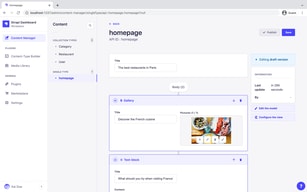
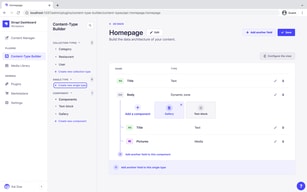
Strapi is a free, open-source, and headless/back-end-only CMS that runs on 100% Javascript. Made for developers, it’s fully customizable and provides a robust environment for creating self-hosted and high-performing content APIs. Content creators can easily define models to build rich layouts depending on the data structure they need for their business. Once a content architecture has been set, it’s seamless to write, edit, and manage any content type. Comprehensive frameworks and services from third-party vendors are available to reinforce the content environment and once ready, content can be easily deployed on all cloud platforms or traditional servers.


| Capabilities |
API
CLI
OSS
|
|---|---|
| Segment |
Small Business
Mid Market
Enterprise
|
| Deployment | Cloud / SaaS / Web-Based, Desktop Linux, Desktop Mac, Desktop Windows, On-Premise Linux, On-Premise Windows |
| Support | 24/7 (Live rep), Chat, Email/Help Desk, FAQs/Forum, Knowledge Base, Phone Support |
| Training | Documentation |
| Languages | English |

Compare Strapi with other popular tools in the same category.
Honestly just how easy it is to quickly start up your API and just start adding data. Going from basically nothing to a fully functional backend headless CMS in 5 to 10 minutes with not a single line of code is great!
Obviously new features take time, and the Strapi team is small. My main dislike actually has little to do with the team or product but the lack of outside contributors helping to make the project better.
I am using Strapi in a free and open source environment in a product that doesn't bring in any income, thus Strapi being free and open source was a huge benefit for us. Our API will be used by many other parties that need a solid standard query framework to pull our data, REST/GraphQL they both work great.

Strapi is very easy to get started . It is one of the best CMS . The documentation is very clear and easy to undersatnd. It is open source so continuously growing.
The deployment is kind of tricky for strapi. There should be much support in strapi.
We are using strapi for headless CMS. It helps us managing and adding data.
The best thing about Strapi is that it is quite user friendly and anyone with a moderate education making changes to the backend of a website can do it without the need for a developer.
There's not much to dislike about Strapi just that it can have more functionalities.
Strapi solved the problem of having a Headless CMS with a great interface for us to easily modify the content on the website that we developed.

Strapi is built on a solid open source community and is both forward looking (via things like GraphQL) and well-established standards (such as REST). The latest version is also beautiful and easy to use.
Strapi Cloud has been slow to release. When we initially ran into installation problems and looked into a hosted version, we were disappointed that it was not yet available.
Strapi makes it easy to define and use many-to-many data relationships. One of the main problems Strapi has solved for us is providing an easy way for non-technical writers to leverage a complex data model.
It gives a very robust and flexible ready-to-use API within minutes. In my previous organization, we had a project with a very tight deadline, and Strapi came to the rescue, all we had to do was configure a database schema on their dashboard, and boom, we were ready with very flexible CRUD, filtering, and pagination APIs for the backend. Also, the overall dev experience with Strapi was good!
Most of the things were above average, if you check the docker image it is one major version behind which might become an issue if you want to deploy the latest version with containers.
Strapi can be helpful for cases where a CMS fits, to make static/corporate websites, blogs, basic software with less scalability needs, etc. It can be used by developers and also the management team due to the clean dashboard provided.
Strapi helps us with the back-end solution. We want to develop a service with user authentication and a database. One possibility was to implement it from scratch, but then we got to the Strapi, which met all our needs. It provides an easy UI for creating DB and also for creating new users, roles, and also managing access rights. It is much simpler and safer for us to use Strapi than to implement this. It was super easy to install and very intuitive to start using. Also, DB schemas are clear, with no extra fields used by CMS itself.
Right now, we don't see a big downside to Strapi. We will see how hard it will be if we need to bend the code to our purposes. Till now, everything seems easy.
We want to build the service with back-end and front-end. It is much easier a safer to use Strapi than to implement the back-end by ourself.
Strapi has clear guidelines and is simple to use. It is very intuitive to design solutions, and as a headless CMS, it provides more functionality than any other CMS I have used.
The documentation that pertains to customisation can be made better. An Enhanced Rich content editor, as well as Support for a Greater Degree of Customization in Regards to WebHooks can further improve the experience.
I have a web application that I am managing the content of with the help of Strapi. We are relieved to be able to handle all of our content in a one location rather than across several different systems. The amount of time needed to construct solutions has decreased dramatically.

It just works! It's lightweight, extremely easy to set up, fast and highly customisable. We have built our application using Strapi together with NextJS and Postgres.
That granular permission control is not available in the free version of Strapi. This has been a slight hurdle when going to production for us.
We can finally decouple our data storage and management from our frontend. Wordpress is no longer needed. Instead, we have a beautiful NextJS/TailwindCSS application for our frontend.
Clean interface and power content type builder. Supports SQLite which makes it cheap to deploy to cloud
Lacks support for Microsoft SQL. Nothing else.
Saves a lot of time rather than implementing CRUD interfaces to all content pages of our website.

How quickly I was able to get up and running with secured REST endpoints
Nothing... so far. I build B2B SaaS products so I may grow to loathe the tax on Strapi's tier that offers SSO, as it's an essential feature to sell to the enterprise.
Strapi simplifies the effort to build a robust backend with its GUI tools to build out entities & generated code. Instead of spending weeks building the foundation to an application, I can bootstrap with Strapi and immediatly focus on the actual data entities and workflows.