

Unclaimed: Are you working at Coda?
Coda Reviews: 4.7/5 — Highly Rated
Coda is a document management solution for creating, editing, and viewing text documents and spreadsheets. , It also helps centralize all documents to ensure seamless efficiency between teams and comes with customizable templates that let organizations create personalized documents for meetings, brainstorming sessions, customer feedback, to-do lists, and market research. It features drag-and-drop functionality, which keeps functionality simple, and has numerous tools that offer role-based access.

| Capabilities |
API
|
|---|---|
| Segment |
Small Business
Mid Market
Enterprise
|
| Deployment | Cloud / SaaS / Web-Based, Mobile Android, Mobile iPad, Mobile iPhone |
| Support | 24/7 (Live rep), Chat, Email/Help Desk, FAQs/Forum, Knowledge Base, Phone Support |
| Training | Documentation |
| Languages | English |
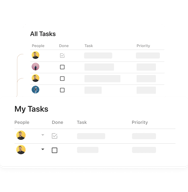
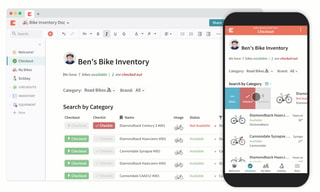

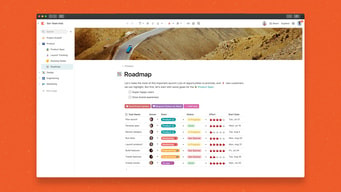


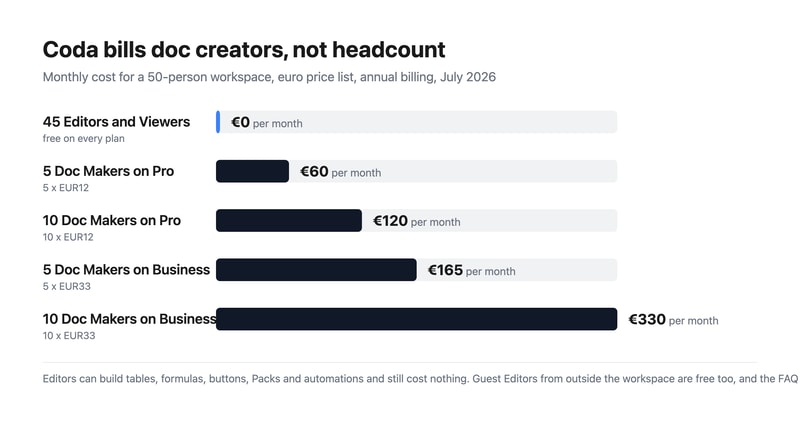
Coda bills you for Doc Makers only. Editors and Viewers are free — on every plan, including Enterprise. An Editor can edit content, add tables and views, build formulas and buttons, and configure Packs and automations, and still costs nothing. So a fifty-person workspace where five people create docs pays for five seats. In a category where almost everyone charges per head, that is the most buyer-friendly pricing model reviewed here this month.
- What it is: A document creation platform combining docs, tables, formulas and automations — now sold as Superhuman Docs.
- Best for: Teams where a few people build documents and many people use them.
- Pricing: Free; Pro €12, Business €33 per Doc Maker monthly on annual billing; Enterprise custom. Verified July 2026.
- The honest catch: The product has been rebranded — every button on the pricing page says “Get Superhuman”.
What Is Coda?
Coda merges documents, spreadsheets, databases and applications into one surface: pages that contain connected tables, views, forms, formulas, buttons and automations, extended by integrations it calls Packs. It cites 40 million-plus people and 50,000-plus organisations.
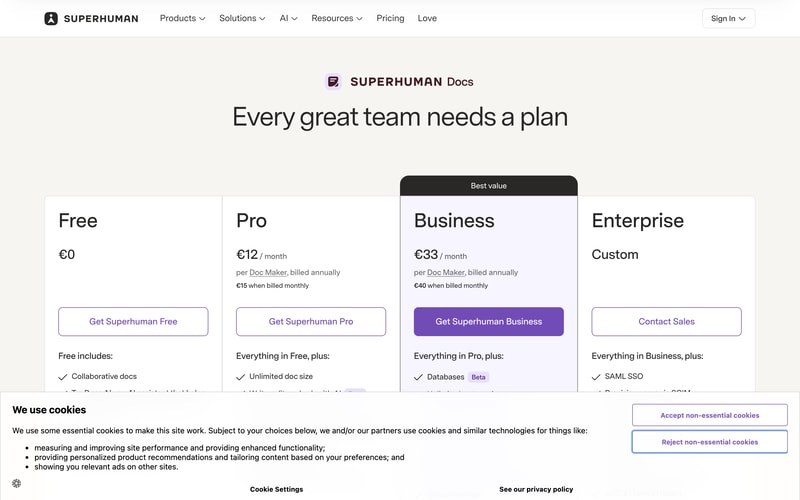
The name has changed. Every call to action on the pricing page reads “Get Superhuman Free”, “Get Superhuman Pro” or “Get Superhuman Business”, and the FAQ refers throughout to “Superhuman Docs”. Coda now sits inside the Superhuman family alongside Grammarly, and the plan cards list Grammarly and Go as included from Pro, with Mail added from Business.
Docs AI is marked Beta and is described as “available during Beta for Doc Makers”.
How Coda Works
- Doc Makers are the only billed role.
- Editors, Viewers and Guest Editors are always free.
- The model holds on Enterprise, per Coda’s own FAQ.
- Two paid tiers plus a free one, and a custom Enterprise.
- Grammarly, Go and Mail are bundled from Pro upward.
- Removals give account credit, not refunds.
Coda Pricing
Captured from Coda’s pricing page in July 2026 on the euro price list.
| Plan | Annual (per Doc Maker/mo) | Monthly | Saving | Key additions |
|---|---|---|---|---|
| Free | €0 | €0 | — | Collaborative docs, connected tables, formulas, automations |
| Pro | €12 | €15 | 20% | Unlimited doc size, 30-day version history, custom branding and domains |
| Business | €33 | €40 | 17.5% | Databases, unlimited automations and version history, private folders, doc locking |
| Enterprise | Custom | — | — | SAML SSO, SCIM, audit events, SOC 2 Type 2, HIPAA |
What actually decides your cost:
- Count your doc creators, not your team. Coda’s FAQ is explicit: “Editors and Viewers are always free”, and “at the end of each billing cycle, you will be billed for the workspace based on the number of Doc Makers in it.” A Doc Maker creates docs and templates and manages folders; an Editor does almost everything else — tables, views, formulas, buttons, Packs, automations — for nothing.
- The free roles are unusually capable. This is not a viewer-only tier dressed up. An Editor building a formula-driven tracker with automations is doing the substantive work of the platform and is not billed for it. Compare that with Notion or Airtable, where an editor is a paid seat.
- Outside collaborators are free too. Sharing a doc externally adds the recipient as a Guest Editor, who can edit content in that doc but cannot manage pages or browse the workspace. Guest Editors cost nothing, so client and contractor collaboration does not inflate the bill.
- Enterprise keeps the model. The FAQ states plainly: “Even on Enterprise, you pay only for Doc Makers.” Enterprise adds SAML SSO, SCIM provisioning, audit events, a SOC 2 Type 2 report and HIPAA compliance rather than changing how you are counted.
- Business is a 175% step up from Pro. €33 against €12 buys databases, unlimited automations and version history, private team folders, page locking and cross-doc actions. Pro’s automations are not stated as unlimited, so heavy automation users should establish the Pro limit before assuming they can stay there.
- Cancelling gives credit, not money back. Coda’s FAQ: “When you remove members or cancel your plan, we’ll apply a prorated credit onto your account you can use for future charges in your workspace.” That credit is usable inside the workspace, not refundable to your card.
Who Should Use Coda
- Teams with few builders and many readers. The clearest case — the pricing model is designed exactly for this shape.
- Operations and product teams. Connected tables, formulas and automations replace a spreadsheet-plus-doc sprawl.
- Agencies and consultancies. Guest Editors are free, so client collaboration costs nothing.
- Organisations needing compliance. SOC 2 Type 2 and HIPAA on Enterprise.
It fits poorly for teams where everyone creates docs, since every one of them is a billed seat; for buyers who need mature, non-beta AI, given Docs AI’s Beta labelling; and for anyone unsettled by an in-progress rebrand.
Honest Pros and Cons
Strengths
- Editors and Viewers are free on every plan, including Enterprise.
- Free Editors can build tables, formulas, buttons, Packs and automations.
- Guest Editors from outside the workspace are free.
- A genuinely capable free tier with connected tables and automations.
- Grammarly, Go and Mail bundled from Pro upward.
- A 20% annual discount on Pro.
Limitations
- The product has been rebranded to Superhuman Docs mid-flight.
- Business costs 175% more than Pro.
- Docs AI is still labelled Beta.
- Pro’s automation allowance is not stated as unlimited.
- Cancellations yield account credit, not refunds.
- SSO and compliance reporting require Enterprise.
Coda Alternatives and How It Compares
- Notion is the closest competitor, charging per member rather than per creator.
- Airtable is stronger as a database, with per-seat editor pricing.
- ClickUp and monday.com approach the same ground from project management.
- Smartsheet targets enterprise work management with a spreadsheet metaphor.
- Google Workspace covers documents far more cheaply without the database layer.
- Confluence, Slite and Nuclino compete on team wikis and documentation.
For a broader survey, browse our document creation directory.
The Verdict
Coda’s pricing model is the best thing about it, and after a month of reviews spent pointing out where headline rates mislead, it is a pleasure to report one that works the other way. You are billed for Doc Makers only. Editors and Viewers are free, and so are Guest Editors from outside your workspace — on every plan, with the FAQ confirming that “even on Enterprise, you pay only for Doc Makers.” Crucially, the free roles are not spectators: an Editor can build tables and views, write formulas, configure buttons, add Packs and set up automations. A fifty-person team where five people create documents pays for five seats.
Set against per-member competitors, the difference compounds quickly. That same fifty-person workspace costs €60 a month on Pro or €165 on Business, where a tool charging per member would bill all fifty. If your organisation has a handful of builders and a long tail of people who read, comment and edit within existing docs — which describes most operations, product and marketing teams — this is the cheapest serious option in the category by a wide margin.
Two things to note before committing. The product is being rebranded: every button on the pricing page now reads “Get Superhuman”, the FAQ calls it “Superhuman Docs”, and Grammarly, Go and Mail appear as bundled products from Pro upward. Anyone evaluating “Coda” should know they are buying into the Superhuman family, and that Docs AI is still labelled Beta. And on the commercial detail, removing members or cancelling produces a prorated account credit rather than a refund — usable for future charges in the workspace, not returned. Neither undermines the central point, which is that Coda charges for the people building and lets everyone else in free.
FAQ
How much does Coda cost?
On the euro price list captured July 2026: Free at €0, Pro at €12 per Doc Maker per month billed annually (€15 monthly), and Business at €33 billed annually (€40 monthly). Enterprise is a custom quote. Crucially, you are billed only for Doc Makers — Editors, Viewers and outside Guest Editors are free on every plan.
What is a Doc Maker in Coda?
The only billed role. Coda’s FAQ defines Doc Makers as members who “create new docs and templates, create and manage folders to organize the workspace”, plus doc administration such as adding pages, changing titles and icons, and configuring locking. Editors, by contrast, “can edit content and collaborate in existing docs and pages, including adding tables and views, constructing formulas and buttons, adding and configuring Packs and automations” — and are free.
Are Coda Editors and Viewers really free?
Yes. The FAQ states “Editors and Viewers are always free”, and billing is based purely on the number of Doc Makers in a workspace. External collaborators become Guest Editors, who can edit content in docs shared with them but cannot manage pages or browse the workspace, and they are free too. The model holds on Enterprise, which the FAQ confirms explicitly.
Is Coda now called Superhuman?
Effectively, yes. Every call to action on the pricing page reads “Get Superhuman Free”, “Get Superhuman Pro” or “Get Superhuman Business”, and the FAQ refers throughout to “Superhuman Docs”. The plans also list Grammarly and Go as included from the Pro tier, with Mail added at Business, so Coda now sits within the wider Superhuman product family.
Does Coda refund unused time if I cancel?
Not in cash. Coda’s FAQ states: “When you remove members or cancel your plan, we’ll apply a prorated credit onto your account you can use for future charges in your workspace.” So downgrading or removing Doc Makers produces workspace credit against future billing rather than money returned to your payment method.

Compare Coda with other popular tools in the same category.
I think Coda is easy to use and is very organized. I love the ability to have a shared document that all of our staff can work on at once and that updates in real time. You can be really creative with it and use it for almost anything.
I think the only downside is that it has a sharp learning curve - it can be tricky to understand it at first and does take some training. But this is no different from any other software. It is also easy to make a mistake/ruin an entire dataset if you don't know what you're doing.
We use Coda for tracking assignments and cases. It's beneficial to us as we have one shared document now that updates in real-time rather than a million different excel spreadsheets that have to be saved and re-uploaded.

The ability to incorporate data/tables from outside sources. Having dynamic tables eliminates needs for files on sharepoint. It can be a place for both process and content storage
* They need private pages like confluence *Ddoc maker license is not the greatest system for billing * Ability to Lock/Unlock Pages by non-Doc Makers * Global admin permission to delete, archive, and move Docs created by others * Ability to block/turn off Doc-Maker trial option for users * “Global Universe” view of all Docs in a workspace
Reducing need for ppt, increasing data processing and analytics in app and overall being a cheaper platform than confluence. Could be more as we continue to scale
Collaboration Rich component library like tables, bullet,etc Awesome formula across documents and components Multiple type of views to collaborate on same normalised data
Performance degradation for large documents Lack of webhooks to trigger external systems Limitations on automation triggers
Document collaboration Buisness documents like BRD, Trackers Task management for teams
Easy to use and create tools for facilitation and quick data capture.
It seems hard to connect complex data sets and visually show the relationships between different workstreams.
It is starting to help me solve the issue of correlating multiple sources of data to create dashboard views for executive review.
I love how collaborative the tools is. There are a lot of functionalities for what we need for documentation purposes. I love the different integrations as well!
The page can get very long and lack structure at times.
A tool for collaboration that allows other pages to also use the same tables (and adjust and filter the table to the team's requirements)
Coda is a user friendly way to store information. I don't like google docs because of the formatting. Their content is always readable and I love the linked tables.
I wish there were some more things that were automated. I wish that there were more flexibility in the types of tables.
A place to store information. I love the multipage document style because then one doc can be a dumping ground for all relevant information.
There are so many features. It's alike gmail docs combined with Asana and all other project tracker, document makers tools out there in one. And it's also very customizable!
It's hard to navigate with all the features. It has a bit of a learning curve.
One stop shop for a company like mine to go to for all processes, project trackers, tasks, team directory, reports, and the ability to integrate.
It's an automation and formulas feature for use with charts and tables making this tool unique and simplifies operations that are regularly performed.
Sometimes coda slows down while accessing documents.
This platform brings all docs, spreadsheets, and data into one place which makes this tool more comfortable to use across various teams and departments.
Coda makes it really easy to collaborate with my team and cross-functionally with other departments. There are so many options for making it accessible at different levels and having multiple people working on the same doc
It has bit of a learning curve and you have to really deep-dive to learn some of the functions.
It has made it easy for me to send employees checklists that are templatized so that I do not need to make a new one each time. It helps me by saving me time and effort.
I use Coda to track things like submission calls and love that I can automate things like deadline alerts, adding to my calendar and tracking status. Additionally, Coda makes it easy to take data from a table and turn them into charts, a Kanban board, a task list etc.
Docs can be a little heavy/laggy at times. Some things require a great deal of hacking (although the fact they are hackable is a plus). Unlike something like Notion, it's not as straightforward to create a database in which every entry has its own page.
I'm able to create Wiki-style knowledge stores and project-level notes which all link to each other. While task management is possible with Coda, I find I don't use it for that as often. It's a great place to store centralised resources.
Clean UI with simple mechanics allow for Coda to be used across a lot of functions and for different use cases (e.g. workshop planning to project briefs to form submissions). Integrations with other tools like Jira are a nice touch. Formulas within tables are a huge plus and avoid the need for spreadsheets. The support team is fantastic with incredible response times and resources!
A little buggy at times (form submission lag). Permissions and sharing access is a bit confusing - being able to share a doc, page, and managing that across what access levels they have to the platform can create some headaches.
Quick and simple place to jot down thoughts and build them out into larger projects if needed. Nice to be able to keep project plans in one place and build views, interactions, and functions that map to different use cases.
The fact that it allows us to use the core of all the necessary software in one place makes it absolutely groundbreaking. Packs are the second best thing making it a one-stop solution for all needs. Finally, the unique pricing structure is boon for small teams.
Grammarly doesn't work with Coda. furthermore, they seem to have some kind of issue with the auto correct on windows. If you enter the word suggested by the windows interface it doesn't change the word but adds the whole word in addition to whatever you have written.
As a product manager, it is a very time-consuming to maintain 20 different files for the same feature Coda helps very much to clean the clutter and be more productive. The pricing structure of coda allows our small team to be more efficient at a very good cost.
It does everything I've always hoped a spreadsheet could do for me, and then more.
Can be a bit complicated to do some of the more complicated things, but the community is almost always able to help.
Complete workload/organizational (for myself only) tool. I'm able to keep databases, todos, and appointments all together and linked.
Basically any solution can be visualised in Coda as long as you have basic understanding of formulas (even Excel ones). Plus with each update the design is getting more and more user friendly.
Still has some space for growth with UI. Most documents look like a massive of word sheets - white background, basic fonts, simple design, close to zero animation.
Describing company goals Monitoring project progress Collecting User Stories Tracking Metrics Setting and distributing efforts between departments Onboarding new employees
The interface and the possibilities for creating different type of docs
The relations between folders and the lack of shortcuts
Contento management system. It's clean and easy to read
The templates available, and the continuous improvement of the product. It shows that Coda is listenign to its users.
Tables. I hope it can be as vesatile as Excel -- you can merge cells easily
Keeping track of our projects, making it our source of truth for our processes.
There are plenty of instruments to design corporate documentation. In my team, we are creating a knowledge base using coda, and this is easy with Coda. Also, coda has an excellent knowledge base, and it's helping to understand what to do.
Sometimes I need more customization in roles and rights for docs. It's happened when you need to restrict some doc pages to other people in your workspace. This improvement will make my user experience much better.
As I said, we are using Coda to create our knowledge base. We are a small IT company but anyway there is a lot of information leaking out when old co-workers are leaving the company. With Coda, we save info in a team.
I like that you can customize all fields so that you can track exactly what you need to
Copy and pasting from other sources, I wish it would automatically change the font and size to match
I am staying on-top of weekly duties and following up. Using Coda in tandem with Salesforce keeps me on track.
It's easy to use; easy to teach people to use. It's always getting new features added.
The help interface is slightly confusing.
Trying to make it a knowledge hub within the copmany_as opposed to Google drive. Conditional formatting, using cards like a kanban board.
Functionality - I like the flexibility and inline formulas.
UI is a bit outdated. Slow on large datasets.
I've been able to build a piece of light duty software for shipping paperwork. Would have required expensive cusotm software hothewise
The connexion in between pages to create nice projects overview
It could be great to have an export too via e-mail, all emails and not only gmail
Save time and easier to track projects
The amount of features that coda provides with a beautiful UI to document your projects is really great. It's integration with Jira, Slack, and GitHub have been the most helpful, which also let you automate tasks!
With the no. of features coda provides, there ofcourse is some learning curve associated. You need to have an account to share data with users who are already not part of the platform.
Coda helps me share details of a project with clients. We track a lot of projects with coda, which helps in tracking them easily. It is a tool that enables us to collaborate easily
Coda's flexibility and quick-access templates (such as being able to create a readily coded OKR table) are incredible... really speed up set ups
The interface can be visually congested and difficult to work with compared to the emptiness of a Notion page, particularly for neurodivergent users
Coda is excellent for centralizing and consolidating research and strategy internally and individually
It's super easy to make live pivot tables. Buttons are super fun and easy.
The app isn't great. It's not easy to design pages for the app. Card view is a little rough and you have to click on the card to alter anything.
I use Coda as a scheduling platform. Internally we can see and update everything, but our vendors have limited views abilities to change just a few things.
The features that I like best include the database structure and the ability to customize.
The database structure and the ability to customize. It's also just...not user-friendly. As much as Coda tries, this software is not intuitive.
So far I have solved a problem that originated in a bad data structure. Coda cross-doc feature is useful, but again was clunky to learn.
I love the overall product concept and how it provides a beautiful UI for gathering and visualizing structured data. I love how you can link all sorts of objects together and reference controls and data types in all sorts of ways. It solves a ton of problems I've had trying to work between Google Sheets and Google Docs, and it's by far the best solution to a project I'm working on to collect data on internal processes and present it in informative, strategic ways.
There are numerous small product gaps that make Coda extremely frustrating to use at times. 1) It should be easier to view and restore a previous version of the document without contacting Coda support. 2) Merging separate documents and copying tables from one place to another is nearly impossible to do, as all the formula links break, and you have to redo all your work. They should make it possible to copy a chart or filtered table to another document with some way to change all the references in the chart to a different source. 3) They should also make it possible to copy styling and conditional formatting from one table or chart to another. It's SO frustrating to have to repeat these things over and over when all you want is consistent styling across the document. 4) They should make an option for non-global table filters so users can filter data for their own purposes without it affecting every single version of the document. I know there's a hack to get around this, but it shouldn't be that hard. I've spent dozens of hours building an extremely complex project in Coda, and it would save me so much time if you could implement these features. Thanks!!
I'm building a tool to gather data from internal Post Mortems and present it in informative ways that help us build reports and track our progress reducing incident impact. I've been able to visualize and filter the data in ways that are far superior to the Google Sheet we were using for the same purpose. I plan to set up automated emails to internal teams to give everyone a better view into the data.
I like all the integrations available (especially with Jira and figma). Really facilitates collaboration.
Perhaps more tools and flexibility in terms of formatting images/videos. It'll also be useful to be able to create timelines and roadmaps.
Documentation and collaboration. We document all of our research and solutions for features in coda.
East to create interactive documents that act like apps without any programming knowledge
Wish there was a way to integrate JSON with outside websites. Wish you could drag rows between tables to move them.
Able to keep a nicely formatted drive inventory sheet
Coda centralizes the project management for projects
Most engineers are used to and enjoy the functionality in google drive so adoption on the team has been slow for some.
Coda helps centralize notes, planning, etc. Docs can easily get lost within Google Drive and links can become overwhelming. Structuring within coda enables the team to jump to the section and content needed much easier.
I love that you do not have to repeat data or content
It is complicated to copy existing formats or formulas, and I often end up adding existing content rather than just copying the format
I love using Coda for project documentation and planning. Great for organizing ownership and progress