
Unclaimed: Are you working at LiquidPlanner?

LiquidPlanner Reviews: 4.2/5 — Solid Choice
LiquidPlanner is a project management solution built for teams who want to prioritize planning and intend to anticipate user needs to ensure seamless operations. With the platform, you can align your people, projects, and priorities to ensure the right team is able to work seamlessly. Predictive scheduling dynamically adapts to change and manages uncertainty, so you always know in real time when work will be done. LiquidPlanner is backed by the power of planning intelligence, ensuring that teams deliver and optimize their work in the best way possible.

| Capabilities |
API
|
|---|---|
| Segment |
Small Business
Mid Market
Enterprise
|
| Deployment | Cloud / SaaS / Web-Based, Mobile Android, Mobile iPad, Mobile iPhone |
| Support | 24/7 (Live rep), Chat, Email/Help Desk, FAQs/Forum, Knowledge Base, Phone Support |
| Training | Documentation |
| Languages | English |
Compare LiquidPlanner with other popular tools in the same category.
User friendly interface, easy to learn how to log hours and make new tasks
Top down structure- everything is dependent which is difficult for multiple projects that are at the same time
Helping log hours spent on various tasks and projects and to see how much time there’s still left to spend.
The ability to see what projects were on everyone's list and the personalization of our individual dashboards
Deleting is a little too easy and navigating lots of projects tends to get a bit overwhelming
Communication by far...it's so much easier to copy emails into LP tasks so that they don't get lost in translation edit after edit.
It is nice that there are reporting features, but I think that the best part about it is the ability to track threads well.
I don't think that Liquid Planner has an attractive user interface design. Especially, the reporting features seem overwhelming. But it is very helpful / useful if implemented correctly. I just wish it was simpler.
We use Liquid Planner to track internal issues and projects at our company. It has been beneficial to have notes and items accounted for in one place. Also, the ability to update the status of an item by sending an email to that item link is very helpful.
Good to have everything in one single place.
Needs to be more userfriendly and interfaced with other tools would be a nice to have, instead of copying information already existing in other tools.
Interaction is clear and we can better see how others are interacting with things that matter to us.
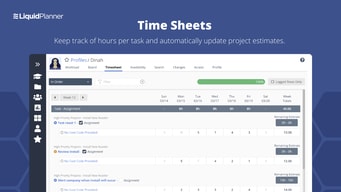
The timers and time tracking/timesheet. It is very intuitive to use and works well.
- Moving around large blocks of tasks. - Rights management being not in-depth enough (not enough granularity). - Clicking too fast the "Save" button for a timer can often save the time on the previous task that had time added instead of the selected one. This issue has happen on multiple OS and web browsers. Pretty annoying since I click fast / use keyboard shortcut. Therefore, I have to slow myself or have to often backtrack time and estimates due to this really problematic issue, since it would be easy not to notice.
Creating RSDE reports was easier with LP available (when used properly). It can also make planing for project leads and managers easier... *when* they understand how to plan for software projects.
Tracking project tasks and hour allocations
The Gantt chart is difficult to use since it is hourly based.
Workload balance.
I like that it is all in one place and everyone can log into one spot to access tasks. I like that you can adjust tasks and folders and make changes. I like getting a daily reminder of tasks that I need to complete. I like the timer feature, as then I was able to time my work when I was working from home, and able to get a good snapshot on how long things were taking, plus being an hourly employee, I could track easily and prove I was working.
I find that it is hard to copy tasks that don't change from year to year. I would like a reoccurring feature so that you can make something go on forever like a calendar entry. I find copying tasks to not always be effective. Once you mark something done, it is hard to adjust. It is also hard to pull a group "query" to see what tasks are coming due, so that we can talk in meetings about what tasks are "on fire." I still have trouble navigating the site and making stuff. I have never had proper training, maybe a tutorial would be helpful when you log in, not sure if this is something that is offered. I feel like there are a lot of features that I nor my team know, so if we did I think it would work more effectively for us.
We are able to pull up Liquid planner during staff meetings and check what needs discussing or is coming due. I like there is one central location. I don't always have the time to make a task, so if there was linkage to outlook, that would be helpful. It is time consuming to make a task/folder. But I like the accountability when it is in the group so others can add to my workload or change things.
Streamlines communication for our team. Love that we can keep all emails in one place and keep each other posted on updates.
UX experience. I think some of the functionality and the overall interface could use an improvement. It took a while to figure out the appropriate way to use the tool and wasn't as easy to figure out as other platforms.
Project planning and looking at our overall resources.
LiquidPlanner's API allows us to track our progress on 3rd party reporting software.
They don't really have a good method of repeatable tasks. Each month we are adding in new tasks for the month and a lot of the tasks are similar to the previous month. We wish they have a way to do repeatable tasks.
We use LiquidPlanner to better figure out availability and bandwidth with our team. We have found that if we adjust the team availability each month we are able to get better estimates on our projects.
I love the level of detail when it comes to separating client projects, assigning due dates and priorities. It also does well with the ability to track time - from estimate to remaining.
The email alerts can be misleading, some dates are stripped and it may appear that a notice that came through today is due today, though it was a comment from a year ago. Also, the interface is difficult to use at times. I have a hard time finding the exact project or task my manager is referencing on the fly - makes being put on the spot in a meeting very difficult, whereas other tools I've used have "search all" type functions or other more usable sort and find abilities.
Multiple client and multiple task organization. Along with multiple team mates. The main benefit I see is that all the comments related to a specific task are always right there in the task which is nice.
Organization of projects very intuitive.
Hard to track retroactively.. the dates are not easy to navigate
How much time we're spending on data
This is GREAT for being able to determine the project's timeline based on the availability of our employees and you can easily see if someone isn't going to meet a deadline.
It is not intuitive at all and there are A LOT of details that need to be included in order to set up a project for success and not throw others off.
Problems Solved: time tracking and determining when a project can be completed for projects Benefits: I like how you can adjust the effort and due dates to determine when a project can be completed based on each employees workload.
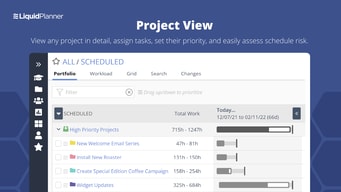
I like how it is easy to organize and create major projects with subfolders under. We use Liquid Planner in our meetings to go through each project and give updates. I enjoy how you can not only document projects and stages of each, but also track your time.
There is not much that I dislike about the product. One thing that is a bit bothersome is it can be a bit confusing. There are many categories and a lot to read when you create a project.
Business problems include organization. LiquidPlanner is very beneficial to companies, especially those in the Marketing industry. You can keep track of what you are doing, and so can your coworkers.
Calendar features allows users to see, at a glance, what projects they're scheduled for on which days. Makes advance planning a breeze. System to clearly identify projects that will not be completed by deadline is helpful for realigning staff and project timelines.
No repeating task feature. Often our tasks are repeated daily, weekly, monthly, etc. and each has to be created uniquely. These types of repeating tasks do not work well with what they have suggested as a work-around: the "Events" feature.
Project management for busy firm with many clients, teams, obligations and varied deadlines. LiquidPlanner has allowed us to more quickly prioritize project timelines and establish realistic deadline estimates.
It's great for keeping track of tasks and projects, that's mainly what I use it for. Also like the ability to upload documents to a central place for everyone to review.
Learning curve was pretty steep. I know they have tutorials and whatnot, but even with those it took a few months to really get the hang of it. Even now though, I'd say we still aren't using it to its full potential.
Project tracking and most recently work hour tracking. It has made our work flow more efficient and helped with collaboration.
Great way to duplicate tasks and see projects from an overview standpoint as a project manager.
From a marketer standpoint, it's difficult to keep track of the tasks, there isn't an easy way to see tasks listed out. Also the way it shows priority items is different from other platforms. The learning curve for this product is quite high.
It's great to bring together the different teams on a company such as the graphic/web/marketing teams.
I like that you are able to get automated schedules based on people's estimates. Adding the dashboard was great, and I am looking forward to trying the scrum features.
It is not as intuitive as it should be for regular users. So while I have become an expert on how to use the tool, most of the people I manage are still struggling and making mistakes. A lot of them only use "My work" for example, which causes them to lack greater perspective of the projects they're involved in. And my main pet peeve: it is not possible to export original estimates in any way. Yes, I can set a baseline date, but for 60+ projects that's not very convenient. Also there seem to be no good way to notify me about changes in estimates, even though I follow the whole workspace.
Scheduling. keeping track of budgets and creating estiamtes.
The assignation of the task are very simple and efective.
Some items are difficult to see and prove.
We have a lot of benefits in relationchip with the order and planification.
I like the fact that my tasks are listed out and scheduled for me with at least some degree of accuracy. This is much more efficient that with pencil and paper.
Estimating my own time for lengthy projects is not an easy task and is rarely accurate.
This software helps us to organize our tasks by type of task and by priority level.
Tasks can be kept in a project organized by type of task, and then linked in another project used as a sprint. Tasks can be shared among developers.
Updated information is not immediately displayed, but a button "schedule ready" must be clicked
We use this to record our scrums
Being able to associate tasks to separate packages and for checklist items to be able to be associated to different team members on a task by task basis. It is is also useful to be able to add notes and associate files with an individual task.
On bulk uploading multiple tasks in the single line window, you can't add in more data. eg. Max efforts, expected activity, etc. Excel upload of data is very buggy and doesn't offer much feedback on data issues. It would be great if you could set different team members' work piles to be separate of one another if required so that it doesn't affect one another's time frame or schedule. It would be great if this could be integrated with Google Calendar as well.
The ability to get a picture of resources and who in the team is putting in the most hours to measure performance. The company is also benefiting from working to best case scenario timings as opposed to working within a rough budget. From the data in LP we can then revise our budgets for work and amend how we price a project.
LiquidPlanner appears to have every capability a project manager would need in creating discrete tasks, dependencies, time estimates, and parent categories for task-based, measurable projects. The UI allows for granularity with nests and tree branches of related and contingent factors. It has several layout types and more functions and features than is apparent at first glance.
The very strengths I've noted are perfect for detail-oriented people obsessed with analytics such as project managers but are not so intuitive for employees who are not hard-wired in their brains the same way. Several editors, writers, artists, and software engineers have told me they are challenged when interfacing with LiquidPlanner and understanding and utilizing all its features, since those very powerful features do not resemble their workplace skills and knowledge.
I am not in a role at my company in which I plan projects with LiquidPlanner. I am merely required to log my task time in it, so I cannot answer this accurately.
It is extremely helpful to see all the tasks associated with a project in one place and the timeline to achieve them.
LiquidPlanner is helpful if you input every single task and track your time properly on each project. This can be time consuming and I often feel my organization needs a project manager just to input info into LP. We do have an external consultant that adjusts the dashboard, add projects, and trains people on how to use LP. Even with this consultant, I find LP cumbersome. For my organization, we need to code our time to LP and a payroll clock, which feels like double work. It would be awesome if LP integrated with payroll applications to solve that problem.
LP most definitely helps keep me on track and let's me know if I'm not on track to finish a project on time. Based on the information you submit into LP, it will let you know the timeline for the project.
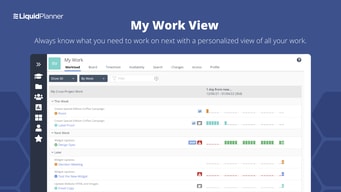
I like the dashboard, the view of tickets that I have been most recently tagged in so I know what i need to look at first.
We have a lot of issues with LP from a client services perspective, when a support ticket lands in LP the flow of the system is difficult to integrate with other systems we use. We use a very common support system to track client issues, and when those issues are pushed to LP for developers to work on the status of those Bugs and Features are very difficult to follow. Users have a hard time finding tickets, there are duplicates, just overall the system seems hard to use and hard to keep the company/clients abreast of where issues being worked on stand.
I know other departments like the sprint planning and dev hours piece of the system. I don't personally use that so I don't have much personal experience to add to this question.
The UI is fairly intuitive for both users and managers. Tracking projects and providing estimates with some room for low and high effort needs is nice. Adding tasks is also fairly easy, as is tracking weekly progress. Widgets are a neat way to visualize effort towards a task across team members as well.
Liquid Planner is a subscription-based closed source application that requires a significant buy-in in order to make the most of it. Project reports are useful but this platform is on the more expensive side and does not provide an easy means to export contributed data to general formats (like CSV). This platform is very much targeted at high-level project managers and is not much more than a time-tracking platform for lower-level workers. To my knowledge, there are no plugins available to extend the use to middle- and lower-tier managers that subscribe to different project management styles (e.g. agile, kanban).
Tracking hours worked is fairly straightforward. Upper management seems pleased with the report-generating features.
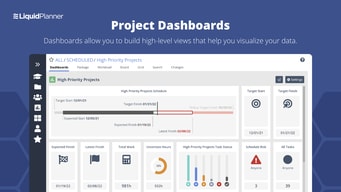
The clean dashboard for upper management
I miss easy swim lanes and priority ranking. Also needs easier unique IDS.
App defect testing
The timesheets dashboard is a helpful way to manage tasks that span over a few days or weeks
Trying to create a task is very confusing and looking for tasks that have been created but you haven’t tracked time in is difficult
Benefits of having an aggregated place for all workers to manage time and tasks
The program has the ability to track your work, if your work is done in it. The way we use it in our department is a centralized place for teachers to send a support ticket.
The analytics are clunky at best, you can't search by tags. You can't send email's from the system so the follow-up get's lost if the person doesn't reply on.
As of right now we use it as a ticketing system. If used well it can be a centralized place to track support.
I like the idea that I can track the jobs from start to finish.
The filter system. It does not include everything I need.
We are solving efficiency problems.
Ease of tracking projects. Tracking easy. Knowing completion status of projects
How some detailed reports cannot be created. When some templates cannot be duplicated due to the number of tasks the template has.
Accurate logging time. How accurate the deadlines are for the completion of the project.