

Unclaimed: Are you working at Strapi?






Strapi Reviews: 4.6/5 — Highly Rated
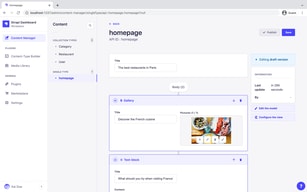
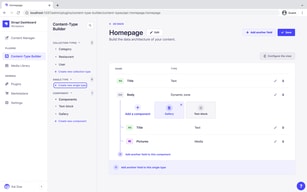
Strapi is a free, open-source, and headless/back-end-only CMS that runs on 100% Javascript. Made for developers, it’s fully customizable and provides a robust environment for creating self-hosted and high-performing content APIs. Content creators can easily define models to build rich layouts depending on the data structure they need for their business. Once a content architecture has been set, it’s seamless to write, edit, and manage any content type. Comprehensive frameworks and services from third-party vendors are available to reinforce the content environment and once ready, content can be easily deployed on all cloud platforms or traditional servers.


| Capabilities |
API
CLI
OSS
|
|---|---|
| Segment |
Small Business
Mid Market
Enterprise
|
| Deployment | Cloud / SaaS / Web-Based, Desktop Linux, Desktop Mac, Desktop Windows, On-Premise Linux, On-Premise Windows |
| Support | 24/7 (Live rep), Chat, Email/Help Desk, FAQs/Forum, Knowledge Base, Phone Support |
| Training | Documentation |
| Languages | English |

Compare Strapi with other popular tools in the same category.

It can be used as a simple and easy-to-use CMS without any complications and comes with built-in graphQL support, API tokens with custom permissions, localization and ready to pair with Next.JS! And all of these features can be used under a community license without any fees.
I have been trying it for 2 days, haven't found any issues yet.
Quick and easy to manage content management system
The interface is easy to grasp and implement. Creating carousels and video feed within our app has optimized thanks to strapi.
Its difficult to manage the team and add more users for non-tech people like me.
Strapi is helping us deploy in app banners and carousels on different screens. We also use it for uploading videos in different categories for our in-app training.
Strapi is a great CMS(Content Management System) which provide a lot of great features like easy integration with the product, fast content change, inbuilt editor with multiple formatting options. The content also includes and option to support media files.
Although Strapi is a great product, but there is one thing that can be improved which is the editor provides a very limited formatting options. The editor is a bit basic.
We are using strapi as content management system for our course content in Learning Management System. We also use strapi for managing the content of our blogs and events.
For us, as a non-profit organization with limited funds, Strapi offers one of the best solutions on the market when it comes to headless CMS: - It’s easy to install and configure - It can be deployed to a PaaS (e.g., Heroku) such that we don’t have to deal with the runtime environment, OS and so on - We keep complete control over UI, extensions, data, and models - Maximum flexibility through extensions, i.e., use the HTML editor of your choice - It is open source - Excellent documentation—most questions have been asked and answered before - GraphQL API (it’s an extension)
Unfortunately, this highest flexibility comes at a cost: We have to install, deploy, and test it ourselves, but Strapi is about to launch the Strapi Cloud bringing this flexibility to a SaaS. So don’t take this dislike too serious.
We are developing new projects on a modern tech stack, e.g. with NextJS. Thus, we heavily rely on a predictable and potent API. With Strapi, we can decide whether to consume REST or GraphQL—both work well. Editors get a fantastic user experience with components in models, the media manager, and the navigation extension for drawing the site’s/menu structure.
Overall content management is so great. And the best part is the API services that we are getting out of the box.
I feel Strapi 3 Dashboard UI/UX was better than Strapi 4.
It is solving our scalability issue.
I really like Strapi, it make products management very easy and it's a very ergonomic software.
The only think I don't really like is that to change the defaults role, you need to have a premium subscription
Strapi is solving management problems by making them easier to manage
Speed of production and the ability to create custom functions easily in NodeJS through its framework. As much as its advertised as a CMS, its much more powerful than that - i've used it for developing an internal HR system for governments, School Websites & LMS Integrations.
I have not encountered any problems with this application so far.
1) Speed of Production. 2) User Management. 3) Content Management. 4) Ease of Deployment 5) Admin UI/UX
Strapi promotes an API-first way of doing web. It delivers a means to build quickly and efficiently a valuable API, which is what you should expect from the modern web.
Graphic Design could be a little more colorful.
Ship fast standard web applications.
The plugin system is generally really simple to get started with and enabled us to quickly extend our installation, such as using Cloudinary as a CDN. Similarly, it's proven quick to build with, and the plug-and-play GraphQL support meant we could integrate with our TypeScript codebase easily.
Sometimes the errors when plugins conflict are really obscure, and I wish that content management was viewable as a top-level navigation item, instead of it being a sub-menu.
We replaced our website and needed CMS that was more customisable than we were previously using. It has so far proven itself in this way. Specifically, our team seems to be able to navigate it with ease.
Super quick to get up and running. Allowed us to build out our CMS quickly, allows us to generate our site dynamically and allow our non-technical staff to view all of our relevant data items and page content without hassle.
It would be great if the top-level navigation could be customized. It would be great to bring out certain object types such as from within the content manager and "pin" them to the top-level navigation.
Providing a centralised API/CMS solution that we can sync our various other tools such as Salesforce too, allowing us to request data easily and in a quickly customisable manner.

To-go tool for developing a fast and modern WebSite!
Nothing significant to mention, I find the experience very satisfying
Ready to use and secure back-end for your website

With strapi it is possible to accelerate development without losing flexibility for customizations
changes in product usage (Bracking changes to version4)
Back end easy
Offers a good way for students to understand the development process.
Cloud hosting is not yet available, which could prove to be an issue for some.
Strapi will allow me to understand the development process as a designer.
The documents are very informative. Easy to get started.
Not have cloud support, need to self host everything
Strapi brings the headless CMS. I love the built-in CRUD system.
The extent to which it just works out of the box. The most important configuration can be done in GUI form for live previewing the UX for your nontechnical operators.
Large extents of customisability are baked into the packages, meaning to edit things like the landing page, while not techically important greatly impacts the UX, requires forking the project, adding to the tech debt for updates
We needed a highly customisable CMS for handling accessibility data of different buildings on a college campus. Other prebuilt systems were configured for blogs, or products, and was not as blank slate as Strapi
Most websites (if not all) require dynamic content to be put, edited reviewed, and deleted from their website, so I used to build (reuse) an admin dashboard for each use and manage the database choosing and connection, backend, etc... with Strapi, I can just create a new strapi project, hook it with a database hosted on a PAAS service, and the CMS part is done! it's an amazing time-saving solution and more scalable because a whole company is backing it up with updates and fixes thanks to their team.
Things to improve are the language available in the admin interface, Arabic for example is available as an option but about only 20% is translated. RTL Supports languages like Persian and Arabic. Customization of the title just next to the icon, and also to the colors of the interface (more themes).
Every app needs content (Mobile app, website, desktop app, etc..). Strapi is solving the problem of modeling content and providing it to apps in an ease-wey that saves a lot of time and effort. What used to take some times weeks to prepare, which is preparing the backend, modeling the database with raw languages like MySQL etc..., building routes to access the database, providing roles for authorization, etc.. is now done by strapi, so you only focus on the task at hand, not the abstractions that come with each project (authorization, sign-in-out, admin dashboard, etc.).

We have a lot of very specific content formatting and structural needs. No matter what I've thrown at Strapi so far within the CMS, it seems to adapt well on the fly. Something I like a lot is being able to customize the administrative front-end for our editorial team. This affords them an incredibly user-friendly interface, all while guaranteeing a stunning experience by connecting it all to a custom front-end. The opportunity for us to use this at scale for future content distribution needs is already very promising. It's genuinely quite fun to use once you familiarize yourself with the feature set.
Working with content "collection" types feels a little different from past CMS work, but once you get the hang of it it makes building richer content very fast and reliable. The distinction between "Saved" and "Published" states also takes a little getting used to, semantically. Lastly, we're currently figuring out how to make certain input fields feel more familiar and easier to parse through. But these feel like solvable problems that are far outweighed by the positives.
It's allowing us to better share control over our content distribution pipeline with our colleagues, and introduce more consistency to our workflow as designers and developers. It's ultimately saving us a great deal of time and energy, and guaranteeing our end users will receive a more consistent and timely experience.
The Out of the Box experience is amazing. It comes configured to already provide much of the functionality I need, saving my team a lot of development time. Additionally, the plugins available fill in any gaps. My team is also happy to know that the project is open source so that, if needed, we can extend the code to support any use cases not covered by Strapi or its plugins, although we have not had to do that yet.
There currently is no v4 docker image available and it seems that an official one won't be available for a while. The Strapi team have posted a guide on how to build one yourself, created by a trusted community member; we've used that successfully. But we'd be happier with an official published image.
It provides a configurable API GUI that I would otherwise have to code from scratch. It has saved me tons of time and improved my time to market.
It is the most advanced open-source Content Management Framework to build powerful API with no effort.
The account-creating process took me longer than I expected.
It helps to create a powerful API while it is handling content management.
East to get started, customize and scale.
Migration from v3 to v4 is a bit tedious, hopefully, will be improved over time.
Implementing headless CMS, much faster time to develop...

The simplicity and effectiveness in content building
I miss a configurable admin desktop panel
I'm developing a non-profit organization backend website with many content types, users management with specific permissions and roles
Speed! The user interface runs incredibly fast making development a snap. Very low overhead compared to something like a headless WordPress install. The free version seems to provide a generous amount of features and the enterprise options add even more.
Haven't found anything yet, our developers have been loving it and it sounds like we'll be using it for lots of projects in the future. Will certainly benefit from a larger community as more folks find out about it and start using.
We are creating a custom app to allow our reporters to send demographic surveys to their sources. Strapi lets us create interfaces for our editors to create forms and reporters to send as well as the actual surveys that are completed by the sources.
It allows an almost unlimited number of content types. The relations content types are most useful and helpful types.
The different architectures between strapi v3 and v4.
Choices of different frontends working with Strapi. I am working with Gridsome but it's rather hard to work with Strapi v4 then v3.
Strapi helps me to focus on front-end development by making backend and API implementation very fast and easy !
Backend interface should be fully responsive. Adding entries from a smartphone is not simple.
Get rid of a fastidious API/backend development
Strapi makes it super easy to set up APIs to retrieve, edit and create new content for a static website. It's super easy to work with out-of-the-box but offers the flexibility to customize to each users need.
I think the biggest downside of Strapi so far is the outdated documentation for plug-ins. Both Strapi and consumers heavily documented V3, but that documentation doesn't necessarily translate to v4 that well. With a little bit of finagling, I was able to get my plug-ins to work, but having updated documentation of out-of-the-box features would be great!
The main benefit is that of the headless CMS in general, but also the execution of that idea. Spinning up a new instance on AWS or similar platforms is really helpful!
I can structure data however I want basing on my requirements. Exposablea s REST API.
Not much so far. It mainly covers all our needs.
We are serving content to our mobile app and web app as well.
Strapi is perfect for quickly setting up microservices and start serving data. It's flexible enough to support many different data structure and with GraphQL API out of the gate it's really easy to integrate with an existing infrastructure.
There are some downsides to it, one of the biggest for us being the lack of ability to create label/value lists. Although I understand that this is a limitation connected to having GraphQL support I still think you should be able to "fake" that functionality in some other way. At the moment you have to create a new collection for every category/section that you need and that can become quite cluttered in the admin UI.
The main benefit is that of the headless CMS in general, but also the execution of that idea. Being able to quickly spin up a new instance on GCP or similar platforms is really helpful
Easy to work on backend for frontend developers. Its like drag and drop feature
I think, they should bring a better documentation on how to host it in a individual servers like from Digitalocean or elsewhere
I am workings on a LMS for which Strapi is help me arround
Seriously so easy to use because things are (1) drag and drop and (2) pre-built functions
Strapi is good for new developers, but is restricting to existing senior devs. We personally love it because our whole team is high school engineers.
We have solved problems of getting to production quickly and the benefit is fast launch. We are definitely more productive. Performance has increased significantly.

Provides the quickest solution to setup APIs for your frontend.
As it's still growing it lacks some of the features to be used by masses.
Strapi is helping me skip the backend part and focus on frontend by managing the backend all from one place.