

Unclaimed: Are you working at Wrike?
Wrike Reviews: 4.2/5 — Solid Choice
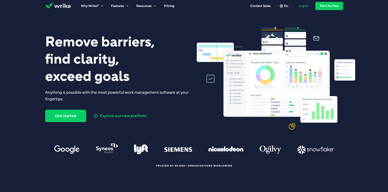
Harping on its versatility, Wrike is a project management software that features highly customizable dashboards and workflows and team-specific automation to give businesses a project platform that adapts to their current ways of working and not the other way around. Wrike’s functionalities involving over 400 tools revolve around giving a 360-degree view of projects, true interdepartmental collaboration, approvals acceleration, smarter data use, efficient workload management, and enterprise-grade security. Wrike has more than 30 well-documented use cases involving more than 15 departments and teams. Wrike also has a proprietary AI-powered capability called Work Intelligence that catalyzes results through smart automation and project risk prediction.

| Capabilities |
API
|
|---|---|
| Segment |
Small Business
Mid Market
Enterprise
|
| Deployment | Cloud / SaaS / Web-Based, Desktop Mac, Desktop Windows, Mobile Android, Mobile iPad, Mobile iPhone |
| Support | 24/7 (Live rep), Chat, Email/Help Desk, FAQs/Forum, Knowledge Base, Phone Support |
| Training | Documentation |
| Languages | English |
Wrike Pros and Cons
- Easy to use Gantt charts
- Customizable dashboard and schedule
- Comprehensive reports and insights
- Time-tracking tools included
- Excellent customer service
- A little pricey
- Can be difficult to get used to at first
- Frequent reports of unresponsive support
- Recorded incidents of unreliable software functionality


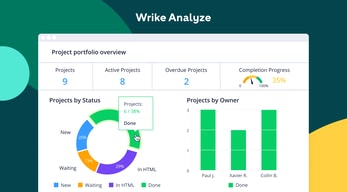
Wrike Review: Is It the Right Project Management Tool for Your Business?
Wrike has been empowering professionals and teams to better manage their work since its launch in 2006. It’s a comprehensive solution for professional service providers, marketing teams, and agencies. But all this versatility comes with a high price tag.
Is it worth it? In this Findstack review, we’re going to find out.
What is Wrike: A Quick Overview
Wrike has introduced Work Intelligence, an AI engine that powers risk prediction, task automation, and smart recommendations.
Wrike is an all-in-one work management platform that helps teams collaborate, plan projects, delegate tasks, and track progress. The platform offers a range of plans designed to meet the needs of almost any kind of business. Whether you’re a solopreneur or a department head at a Fortune 500 company, Wrike has a plan for you.
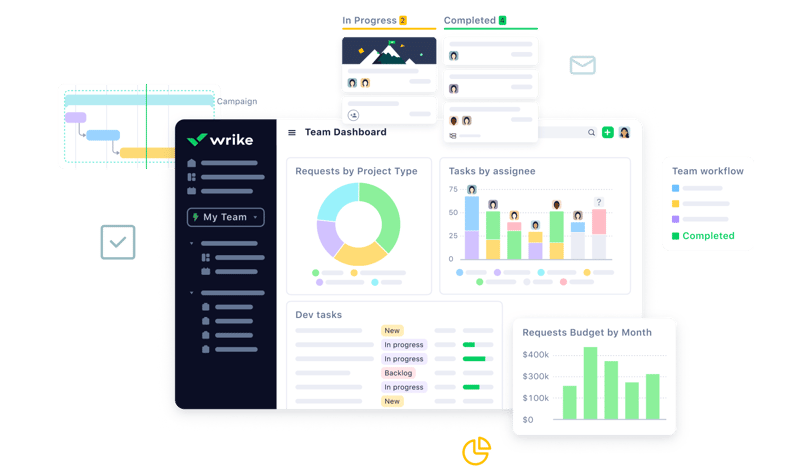
Wrike’s power lies in its ability to support both project management and collaborative work, which explains its appeal to a wide range of industries. The tool boasts a user-friendly dashboard that’s pretty simple to set up. It’s also very easy to create tasks, assign them to team members, set due dates, and track their progress.
Getting Started With Wrike
Wrike is one of the more intuitive project management tools for a new user to get started with—especially compared to competitors like ClickUp.
Wrike is available to users via web browser, desktop application, and mobile application for both Android and iOS devices.
To get started with Wrike, new users have the option to register for a free account using their business email. Once the email address is verified, users will be redirected to Wrike’s homepage to complete the initial registration process—which involves a guided walkthrough.
How Wrike Works: Key Features
Dashboards
If you’ve ever used a project management tool, Wrike’s Dashboards will feel very familiar.

For every project you create in Wrike, you can create Dashboards to display, manipulate, and analyze the project data that you’ve collected within it. They essentially give you an overview of project KPIs, metrics, due dates, and progress at a glance—saving you the hassle of seeking out each piece of data at the source.
When you create a Dashboard, you can start with a template or build one from scratch. If you go the latter route, you have quite a bit of flexibility thanks to a modular design and a wide selection of interactive widgets, including:
- Assigned tasks
- Overdue tasks assigned to you
- Overdue tasks that you assigned
- Tasks you’re following
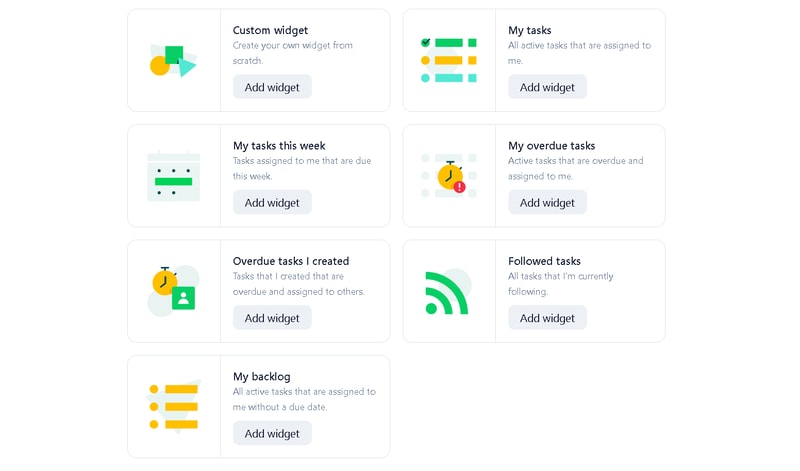
Wrike is unlike a lot of project management tools because everything you need is right at your fingertips. You don’t need to navigate to another window to see it all.
Automation
Like most modern project management tools, Wrike features an automation engine that works in the background to synch related tasks, assign workloads, and ensure tasks are completed on time with botted @mentions and comments.
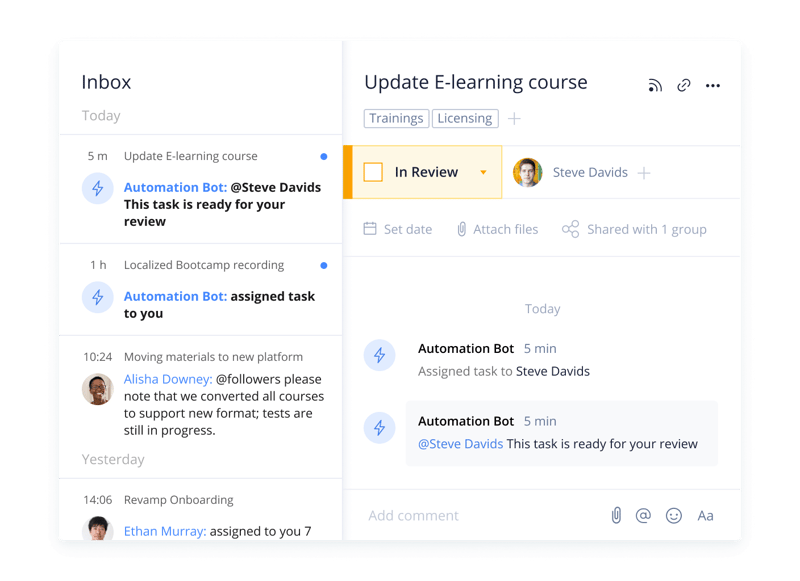
Wrike’s automation engine may not be the most complex or versatile on the market, but it’s intuitive and practical. There’s no feature bloat here—every feature is sure to get some use.
Integrations
On a related note, Wrike’s automation capabilities are supported by 400+ integrations with third-party tools. Pretty much every tool category is covered, including:
- CRM
- Communication
- BI
- Calendar
- CMS
- Storage
- Accounting
- Reporting
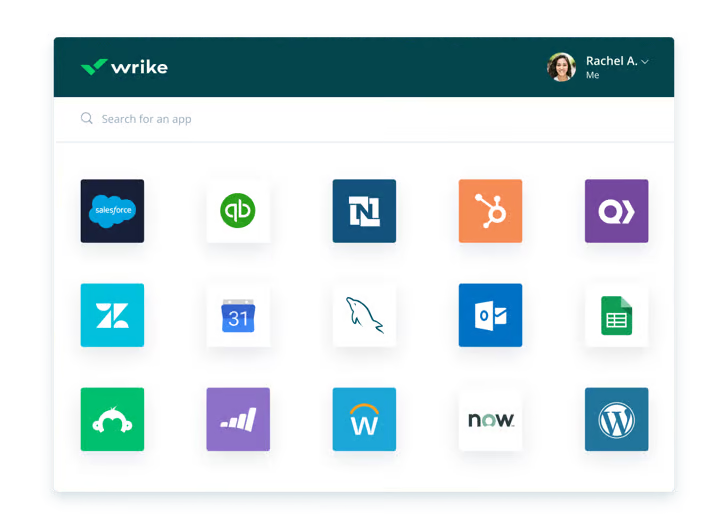
Integrating Wrike with other tools in your stack is a great way to cut out some busy work from daily workstreams and improve productivity. It’s also a surefire way to minimize human error.
Live Analytics
Wrike automatically updates every report, chart, and dashboard every 15 minutes, so you never miss a thing. 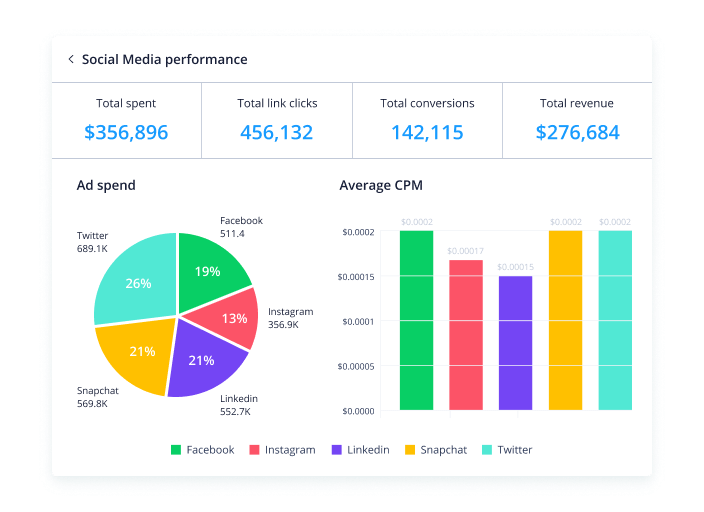
That’s a huge benefit—it means project managers don’t need to manually collect and input data from multiple sources to draw meaningful insight. Less time on busy work means more time analyzing the data for patterns, trends, and inefficiencies.
This feature is also great for project managers who are juggling multiple projects. They get a real-time overview of project statuses, team workloads, pending approvals, and tasks waiting to be assigned, so they can easily prioritize work and make meaningful progress.
Customizable Forms
Wrike has a custom form builder that you can use to create almost any kind of form—from simple team surveys to content request forms.
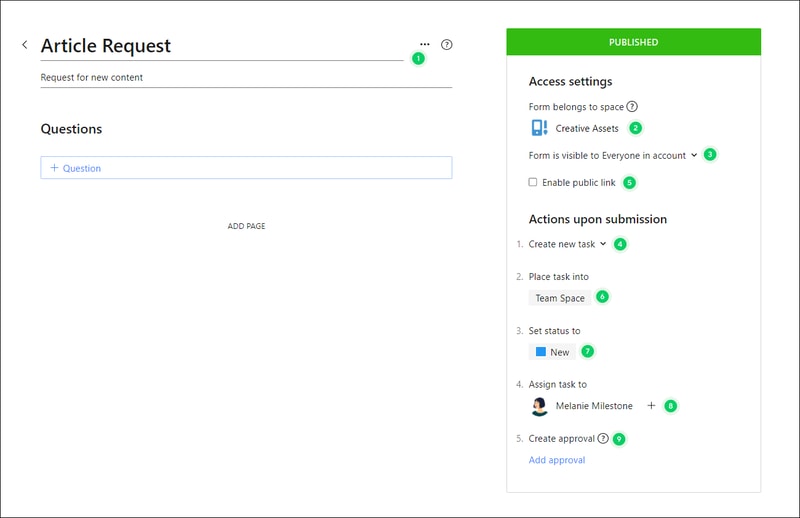
Wrike’s forms are fully customizable, and you can take advantage of role-based access controls to grant or deny access to certain pages or sections. Plus, when you create a new form, it can automatically assign tasks, set due dates based on the submission date, and populate subtasks.
Enterprise-level project management tools
Wrike offers advanced project management tools that you can access on your Home workspace to help you measure key performance indicators.
These tools include time tracking to assist in managing billable hours, visualizing cost and budget calculations, and business intelligence to assess project risk. While these tools are particularly useful for large enterprises with complex needs and a variety of teams, they can also be beneficial for small businesses that plan to scale.
In addition, the platform allows you to share files and publish assets with enterprise-grade security. The sheer number of features may be overwhelming for teams new to project managers, but Wrike provides great walkthroughs and tutorials. You may even discover features by accident that end up accelerating your workflows.
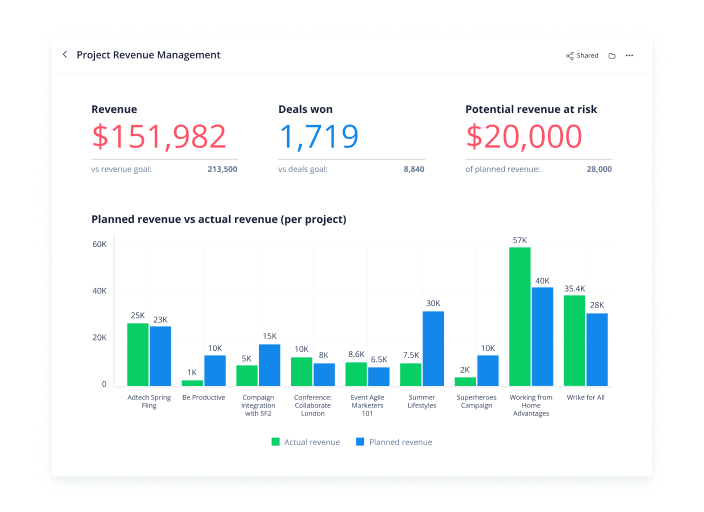
Wrike offers pre-built templates based on team roles to simplify task creation. Some of these templates include:
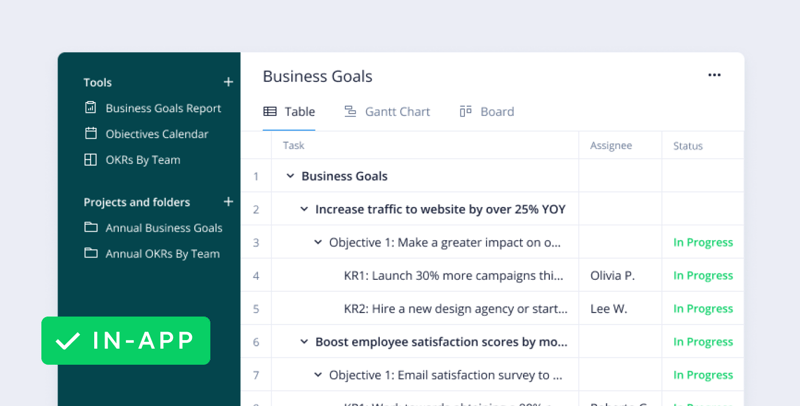
- Project performance templates
- OKR templates
- Weekly to-do list templates
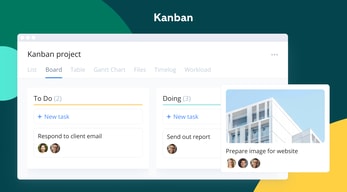
- Kanban board project templates
- Agile and IT templates
- Content operations templates
- Quarterly business review templates
- Ticketing and help desk templates
Collaboration Tools
Wrike—like most project management tools—is designed to make it easier to collaborate with your teams.
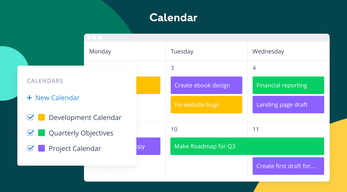
All team members have access to a global or project-based live stream of task activity, so nobody is left behind. Team members can easily communicate on specific tasks via comments and notes so that conversations are kept organized. Shared team calendars can be added to the dashboard to help with awareness of progress and submission dates. 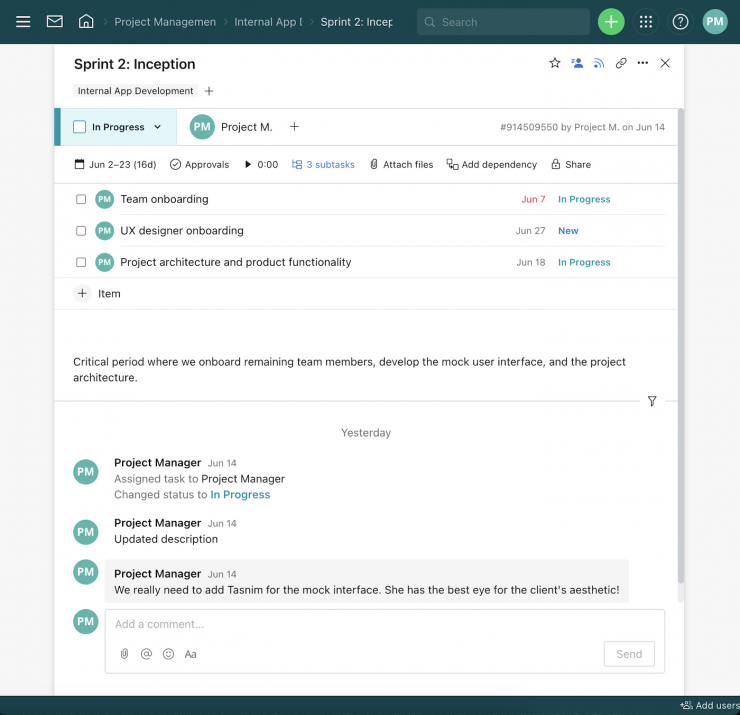
You can also invite third parties such as clients, vendors, or contractors, at no extra cost, to view the status of their projects and provide input that goes towards successful project completion.
Wrike Use Cases
Wrike’s use cases are quite impressive. Over 20,000 companies in over 140 countries have relied on Wrike to streamline their planning processes. These are companies that span a range of industries, including:
- SaaS
- Technology
- Healthcare
- Education
- financial services
- Construction
- Manufacturing
- Retail
What makes Wrike stand out from other project management platforms?
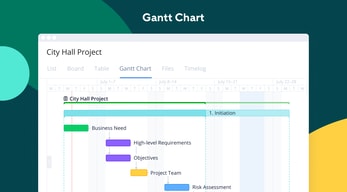
Wrike’s easy-to-create (and even easier-to-understand) Gantt chart view sets it apart from many other popular project management platforms. Plus, Wrike offers a range of other views, such as List, Board, Table, File, and Timelog. While this isn’t unique to Wrike, it isn’t super common to have that much flexibility,
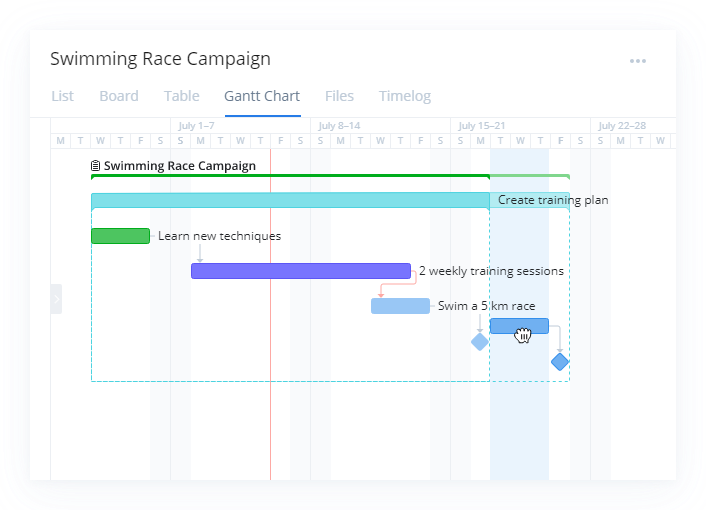
Overall, Wrike’s differentiating factor is the ease with which you can use it to manipulate project data to gain new perspectives and insights.
Wrike Pricing
Wrike offers a total of five plans, starting from a basic Free option, all the way up to an advanced Pinnacle option for large enterprises with complex needs.
Here’s a breakdown of the plans: 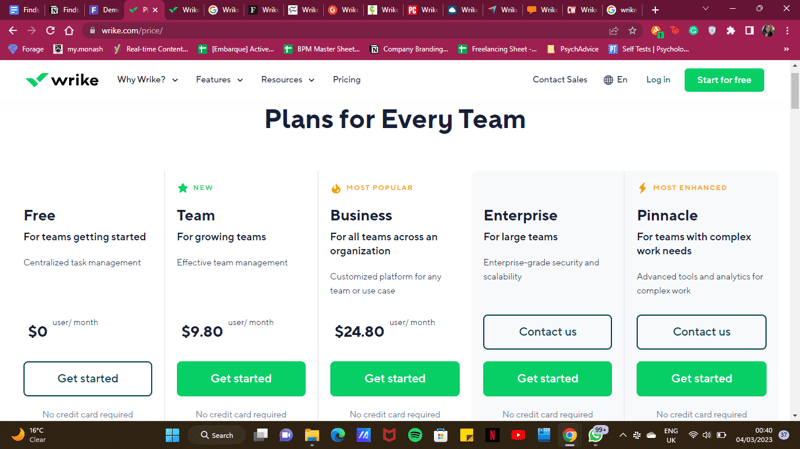
- Free : Wrike’s free plan is suitable for small teams that are just starting with project management software. However, it has limited feature options, including limited storage space, and excludes Gantt charts, time-tracking, and many customization tools.
- Team : Tailored for small teams that want to plan and collaborate on projects. This plan includes the Gantt chart view and the option to integrate with a wide range of services.
- Business : Provides access to advanced project management tools. The Business plan has everything you may need for project management for a large team.
- Enterprise : The Enterprise plan has custom pricing because Wrike will draw up a plan depending on your business needs. It is a plan to consider for large businesses that require more security controls.
- Pinnacle : This plan is for large businesses with complex work needs, including billable hours tools, job roles, and tools for planning and tracking effort put into different projects.
See Wrike pricing for current rates and plan details.
Pros and Cons of Wrike
Pros:
- Wrike offers plans for everyone, from small teams to large corporations.
- Real-time analytics are updated every 15 minutes.
- Wrike offers department-specific solutions which help different departments across your business align and communicate projects on one platform.
- Special customization is available for professional services and marketing and creative teams.
- Wrike offers training resources to help you get started on the platform.
- The free plan offers up to 2 GB of storage.
- It supports eight languages.
Cons:
- Although the project dashboards are user-friendly, those new to project management software may find Wrike overwhelming due to the wide array of features.
- Wrike’s costs can be a burden for mid-sized teams – there are cheaper project management tools with roughly equivalent features.
- Many of Wrike’s useful advanced features are offered as add-ons that can effectively double the price of the tool.
- The mobile app is not as user-friendly as other project management apps (e.g., Click Up). Managing tasks from the mobile app is not as smooth as using a desktop, and you may find that you’re unable to move and edit tasks.
- The interactive Gantt chart view is only available in the paid plans.
- The time-tracking in-app timer is only available on the Business plan and higher, and even small collaborative teams should be able to benefit from this feature.
Is Wrike right for your business?
Wrike is a comprehensive project management platform that also functions as a collaborative work management tool, making it ideal for businesses of all sizes. If you offer professional services or are part of a marketing or creative team, you can certainly benefit from Wrike’s highly customizable features.
It’s important to note that Wrike can be a bit pricey—especially with add-ons. Plus, it may be a bit overpowered for small teams who are looking for simple project management capabilities. That said, it’s a solid tool for managing multiple departments and complex projects.
If you want more insight and information into other project management software, Findstack has more helpful reviews you can take a look at.

Usability to create a task and assign members to the project.
Wish there was customization for all licensees to be able to duplicate and edit templates.
Cross-departmental efficiency. It's a great way to organize projects.
Its project and task management features.
I wish it had more themes available to choose from, but this is not a big deal.
IT support tickets and many projects. The software is very customizable.
It's flexible and allows for different kinds of projects and timelines within the same project team. It's easy to stay organized and check in with team members on the progress of different projects.
It could be more user-friendly, the dashboards and to-do sections sometimes leave new team members confused, or it takes a few days for them to get the hang of it.
Delegating and quickly sending different departments all the info they need to execute complex tasks is easy with wrike, so everything stays in one spot rather than being lost in an email thread.
The most helpful thing about Wrike is that it allows everyone to stay on the same page with projects, and it maintains a record of communication throughout the project.
I wish Wrike had a better or more built-out calendar functionality. Right now projects get transferred to the calendar, but the individual sub-tasks within the project don't get carried over in a color-coded and easy to understand way.
We can now communicate easily across multiple different departments that are all working together to complete one project. It has made information more visible and readily accesible.
Wrike is very adaptable to whatever you need it to do. Lots of great and unique features. The interface is typically easy to navigate and keeps things well organized and easy to read.
Wrike's interface can be a little bit clunky and unintuitive at times. It does take a bit of a learning curve to understand Wrike and all of its capabilities and features.
With Wrike workflow is improved and tasks are more organized. Our remote team is able to communicate and stay on track with all of our client's requests and needs.
I love that Wrike gives us the ability to assign tasks to multiple people and schedule them for specific dates. It is significantly easier to keep track of these tasks using Wrike than any other programs we currently use.
Unfortunately it can be somewhat challenging to manage different dashboards. I don't personally have much use for a Personal dashboard, as the majority of my tasks are collaborative or to do with certain projects.
We are solving our problems with keeping track of all tasks. We are a small but constantly busy Architecture and Design firm, and it can be easy for small tasks to slip through the cracks and blow up into much larger problems down the road.
I like it's Ability to project manage and keep tasks and projects moving forward.
I think I am not using wrike to its full functionality. I would like to have easily accessible classes or way to learn more about wrike language capabilities.
I am solving workload management as well as project management. It allows other teams to schedule accordingly
I like the ability to create project schedules, assign tasks to team members, and do project intake all in the same tool.
I wish there was an ability to have a calendar view for projects or folders. I also think the tool can be slow/glitchy at times, especially when trying to load large projects.
Project intake and timeline management
Team communication organizing project workflow keeping track of budgets
reporting is difficult to get the right information out of without a lot of creativity integrations could be better
Remote team Project management Remote Team communication keep track of budgets and time
The calendar function is the best, its very helpful to view multiple calendar at a time
It's a difficult platform to learn and integrate with other platforms
We're adding multiple projects with Wrike and are able to organize all our materials in one space
I like the ability to create separate tasks to manage individual parts of a linear process among my team. I like that is balances time management, project management, and team conversations within the task.
Wrike takes a while to get the hang of it, even with training! I wish there was the ability to set the view you'd like to have as a default (columns/layout/etc.) when viewing in table view (what I most frequently use.)
At my company, we problem solve team capacity to ensure team members have enough tasks to fill their week but not overwhelm them. Another benefit of Wrike is keeping project-focused communication out of an internal comms channel such as Slack. It's easier to find and reference those items within a specific Wrike task.
I like how easy it is to keep track of tasks and it makes it easy to work with our Ops team.
I wish there was more training on how to use all of the features
Helps sales and ops collaborate and troubleshoot issues.
Wrike is a great tool to be able to compile, assign, and complete tasks. Since we've started using Wrike at our company, we've been more efficient and effective in the realm of project management.
The software is very customizable and allows you to copy from blueprints to save on time. We house our request forms there too which makes it a great tool to create and complete tasks. It also allows us to stay on top of tasks. I like how you can reply to an email from Wrike and it will leave it as a comment on the specific task.
We bottlenecked when it came to organizing our tasks, assigning them out, and following up on completion. This has helped our company become more efficient and effective and allows us to be more competitive in the market.
Intuitive interface and easy to use and to setup
Need to pay a significant fee to access the API and integrate to ERP
Go Paperless, streamline the processes, realtime communication between departments
Allow my team (Technical Customer Success) to manage our day-to-day tasks and planning. Other teams in our group (Solutions and Services) also use it for the same purpose.
Sometimes I think there are too many steps (clicks) that need to be done in the UI to complete setting up a task. I prefer a faster UX.
Keeping track of all ongoing tasks, some are internal, some are customer facing. Managing my team activities to know the load of my team members. Planning future tasks, with visibility to my manager.
I really like this tool's ability to work with other teams on projects.
The learning curb if you are new to the software.
I use Wrike to work with other teams and set deadlines on projects.
How customizable the spaces and dashboards can be. Once I learned how to build these and teach the team, it significantly helped us stay organized and on track. The platform also seems to be constantly rolling out updates.
Like any robust tool, it can feel intimidating to learn. But once you're used to it and have it tailored to your work, it's great.
The team is better organized and human error has reduced, as it's much harder to forget or miss tasks.
Most of our workflows require multiple people, with all tasks relying on dependencies. Wrike allows us to coordinate tasks and build accurate, live schedules.
The interface can sometimes be overwhelming for new users. I wish that there was a way to batch edit/add tasks across multiple folders/projects at once.
We are coordinating a large team across multiple time zones without bogging down with emails and unreliable shared spreadsheets.
Wrike is a great tool for workplace collaboration. It allows for more visibility across the entire company - as long as people know where to look. There is a lot of room for customization.
Wrike has a very steep learning curve, and it can take several months for a new hire to feel comfortable with using Wrike. There's a lot going on with the UI, so knowing where to look is just the first step.
Wrike Approvals has worked very well for my company. It has streamlined our processes, and made our work more efficient. Wrike has given our company more work structure and organization.
Easy to collaborate on a wide range of projects with a wide range of teams.
It can be difficult to find a particular assignment sometimes.
Project management, much easier to keep a record of progress.
Customization and the different ways to organize hierarchy
Some key features missing. App and mobile functionality weak.
Project mgmt. acxountability. Streamlining communications.
I'm impressed by how easy to manage our projects on Wrike. I like that it links to your email and you will receive a confirmation email when someone @mention you in Wrike.
I would suggest to move the "download all" button away from the "delete all" button. They are currently so close to each other and sometimes it's easy to click the one you don't intend to click.
Our team has been using Wrike to manage our projects and time. Thanks to Wrike, we're able to keep track of our projects and complete them on schedule by looking at different status of each project. What's more, it improves our collaboration with our business partners.

Wrike helps streamline internal processes and drives efficiencies across various teams within our ogranization.
Wrike can be a bit overwhelming for those who are less familiar with the tool.
We've enhanced process management, specifically tracking project status across different teams and employees.
The dependency functions and ability to collaborate with other team members
I think there could be improved integration into other calendars and improved notifications of daily tasks
I think the setup time is a big hurdle, it would be great to be able to create custom templates
It keeps track of the project from start to finish and helps me schedule upcoming work. I like that there appears to be no limit to how deeply I can break the project down to assign each work step.
I do not like the Gant chart function limitation. I am used to the flexibility of microsoft project in data entry and the final product that can be presented to my end customers. I have not found an easy or presentable method in making this work. I am still forced to use an additional product because of this limitation.
I like the visibility of all my open projects in one place this is the greatest benifit of Wrike. I have the flexibility to see if any assigned individual or equipment has been douible booked that may result in a delay or conflict.

Wrike is great because of its ability to track your own time spent on projects, add people to collaborate on a written brief with the provided project title and description, keep track of deadlines and project deliverables.
There are some issues with archiving projects, and it's not very consistent. Sometimes when a project is marked completed, it stays in the inbox for some time and disappears completely. The only way to refind projects is to remember the original title or do a backward search on your email to find those completed ones. I wish a more visual or detailed view of completed projects in the queue and still in progress. (Similar to how you can organize things on Trello, where you know what is in the current queue and move/ group stuff on completed, archival, and so on & much more customizable)
Wrike solves problems like collaboration, breaking up bigger projects into smaller assignments, syncing expectations amongst team members, and delegating roles throughout our company.
I love the options to create reports and dashboards to easily summarize the items I'm tracking. Using the timer feature keeps me aware of how long I've been working on a project and where my time is actually going in a day.
The steps to create different task filters can be time-consuming.
Wrike keeps all of my to-dos in one place. I can see what I have going on as well as the tasks I have assigned to others. Having the tasked grouped together by project is very helpful.
After concise guidance and continued support in building your workflow, the process for tracking your assigned tasks and projects become clear.
There are still restrictions/limitations when building forms to collect users' inputs. Would love to get better understanding of user's behavior.
It was centralizing all of our incoming requests that hit across various skillsets, and the benefits of using Wrike allows us to identify the correct individual to assign.
Color themes, ease of use as end user, ease of scheduling, block off days I am not in office, flexibility, to do today.
Inability to block off half day, can be confusing at first, but it is a complex software so that makes sense. I would like overdue to be able to be automatically collapsed, or at least have the option to do so.
Easy to schedule around people's days off. Easy to track time against budget and see where we are under or over spending time.
I like the way in which the user interface was created and how easy it is to create a job and share it with your team, how files can be shared and how you can collaborate.
I don't like that there's too much information and options that sometimes just create confusion. I also dislike the fact that some plans don't have the basic tools for project management, not having the Gantt available or folders names customization unless you have the most expensive plan is very bad.
I solve the internal problem of having the clients divided by folders and inside each, you can create different projects under the same umbrella. Also, I like how with the boards you can have one conversation about just that topic without having to share it with the rest of the coworkers that might not be involved in that part of the project.