Unclaimed: Are you working at Notion?
Notion Reviews: 4.7/5 — Highly Rated
Notion is the all-in-one workspace that combines docs, wikis, and project management. Tens of thousands of teams around the world use it to collaborate, stay informed, and get more done together.
Notion is also often used as Knowledge Base of choice in Venture Capital and Personal Productivity tech stacks.


| Capabilities |
API
|
|---|---|
| Segment |
Small Business
Mid Market
Enterprise
|
| Deployment | Cloud / SaaS / Web-Based, Desktop Mac, Desktop Windows, Mobile Android, Mobile iPad, Mobile iPhone, On-Premise Linux |
| Support | 24/7 (Live rep), Chat, Email/Help Desk, FAQs/Forum, Knowledge Base, Phone Support |
| Training | Documentation |
| Languages | English |



Notion Review: Is This Project Manager Right For You?
While a relatively new entry into the project management space, Notion has evolved quite quickly to meet the needs of its users. It’s a platform that is notable for its versatility, and it is a well-known option for individuals and teams who want a reliable tool to organize and manage tasks–from note-taking to in-depth project management.
But does it incorporate the best project management techniques to help you or your team get organized?
Let’s find out.
What is Notion?
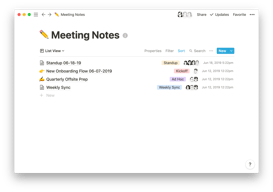
Notion is a cloud-based workspace where individuals and small teams can take notes, create documents, track projects and organize and manage tasks all in one place. It’s often referred to as an “all-in-one” workspace because users can collate all of their projects onto a single platform.
Notion’s popularity among professionals and students is credited to its personalization that caters to any workflow. As a user, you’ll have the freedom to customize the layout of your workspace, while still getting helpful guidance and templates to help you get started.
Background on Notion
Founded in 2016, Notion started as a note-taking app but has evolved into a comprehensive project management tool for solopreneurs and small teams. The platform’s mission is to make it possible for people to shape the productivity tool they use every day to match their needs.
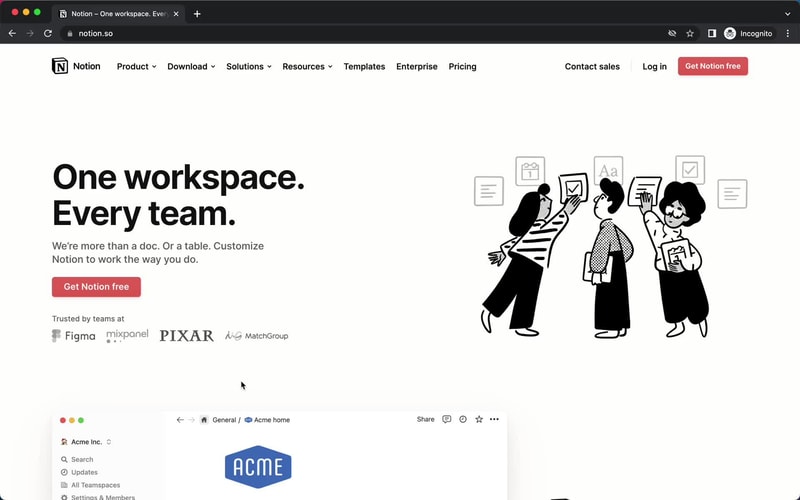
Getting Started with Notion
Every feature on Notion is designed to help users be as organized as possible.
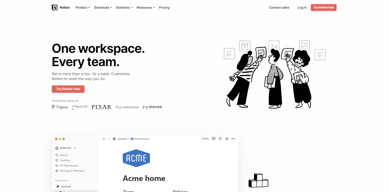
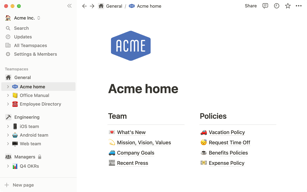
The platform is segmented into pages that can be nested or interlinked at your convenience. As soon as you sign up, you’ll be redirected to your Welcome screen containing some tips to get started. This includes linked videos that guide you in creating your first page and setting up your to-do lists and projects.
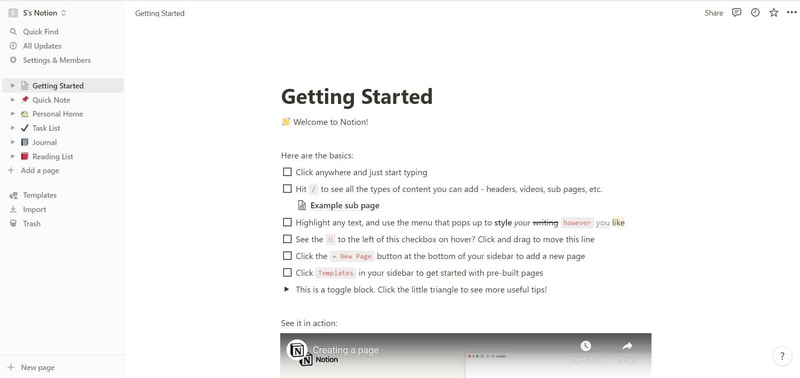
On the left side, you’ll find a list of default pages, such as ‘Quick Note’, ‘Personal Home’, and ‘Task List’ which you can customize and add. Whenever you create a new page it will show up on the left panel. You can add personalized header images, descriptive comments, and add associated icons to your pages.
Simply click anywhere on a page to add blocks for individual pieces of content such as text, lists, media, links, and sub-pages. You can also just type “/” to bring up a menu of blocks you can add to your new page. 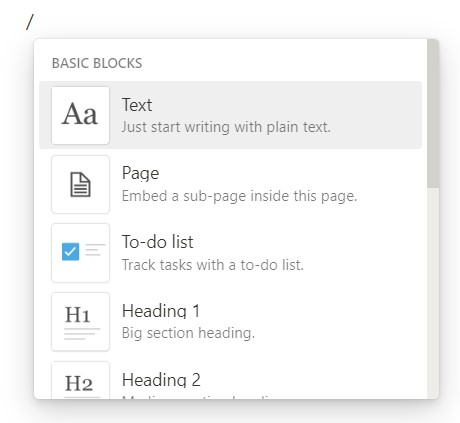
How Notion Works: Key Features
Although Notion started as a note-taking app, it has become far more than that. The tool has promising features that go beyond creating to-do lists and make it a competent productivity and project management app.
Integrated User Guides
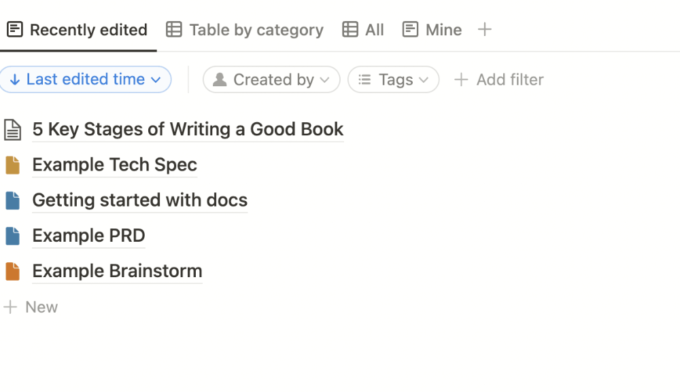
A commendable feature of Notion is that user guides are already embedded in the platform. For example, if you want to create a new document, you’ll find guides on how to get the most out of the preinstalled page.
Of course, this can be a hit or miss. Some users may be grateful for the step-by-step guides, while others may be frustrated with manually deleting pre-installed guide pages to clean up their workspace.
Customizable Pages & Templates
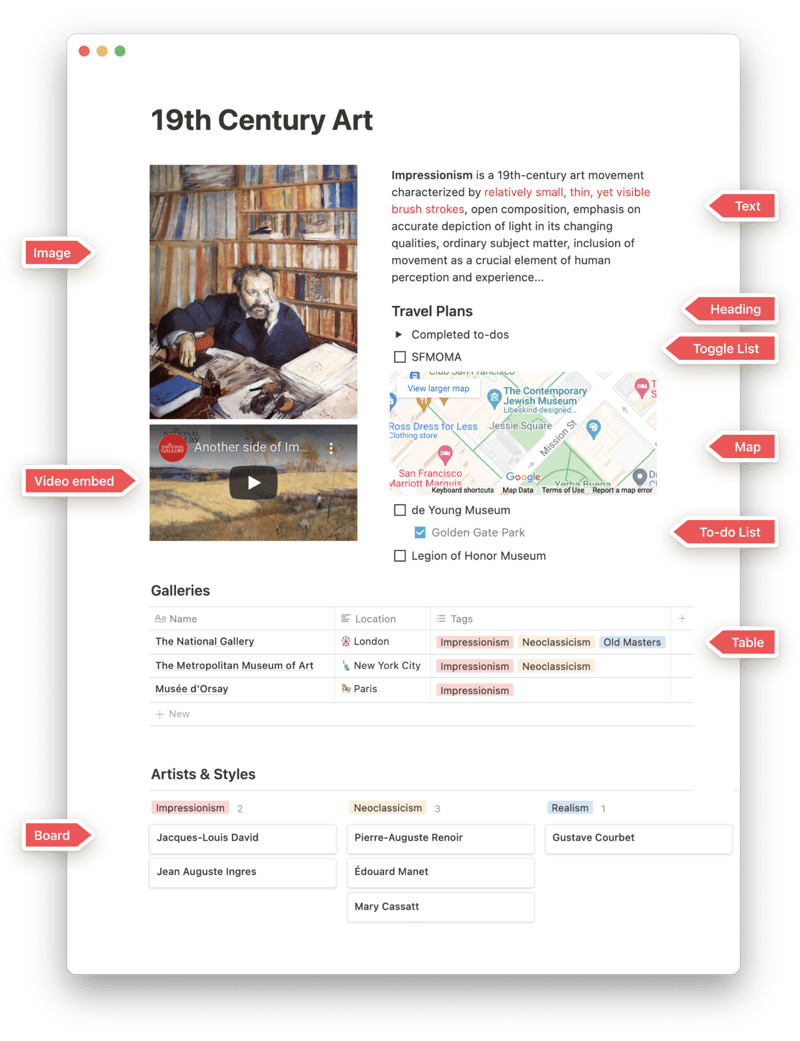
Notion makes it easy for you to create pages and documents in whatever style you want. Pages are like folders where you can store all information related to a particular topic. You can include a range of blocks or items on your pages such as text, toggle lists, to-do lists, images, video links, tables, boards, and maps.
Every change you make to a page or block is automatically saved in Notion. So you can always go back and view the history of a page if there’s something that you want to restore. This is pretty useful for when you make a mistake or just want to experiment with different versions of a page.
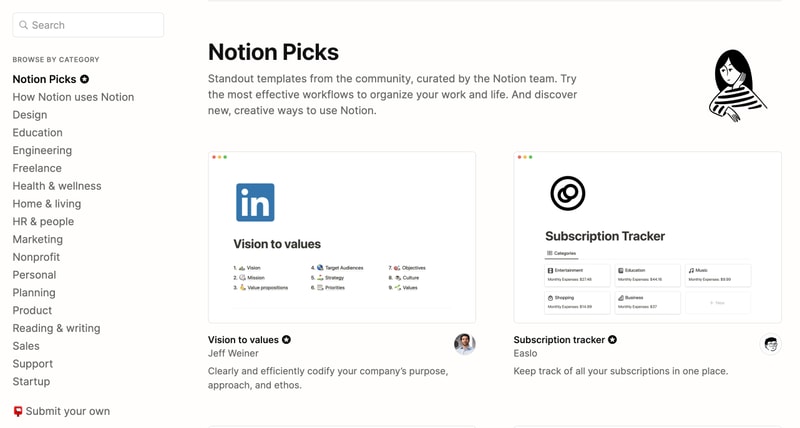
Notion is also very generous when it comes to templates. It provides users with a ton of options, whether they’re creating blog posts, articles, event schedules, or product launch plans. Fortunately, all templates are fully customizable so you can modify them to your taste without having to build from scratch. The platform also encourages users to submit their own templates so the library grows to fit a wider range of needs.
Collaborative Workspaces
Users can create different workspaces for different projects, which is useful if you need to manage multiple projects at once. Every workspace will have its own pages so all your information will remain separate and organized.
Notion allows you to invite other people to your workspace so you can collaborate in real time. The limit of guests you can have at a time depends on the plan you choose.
Integrations
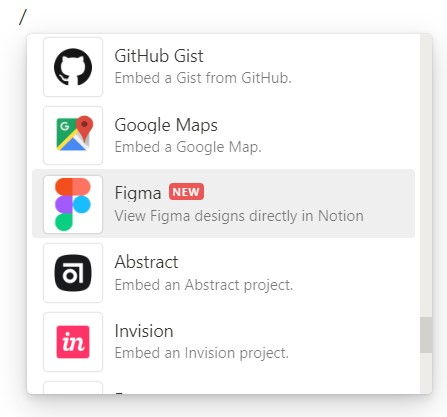
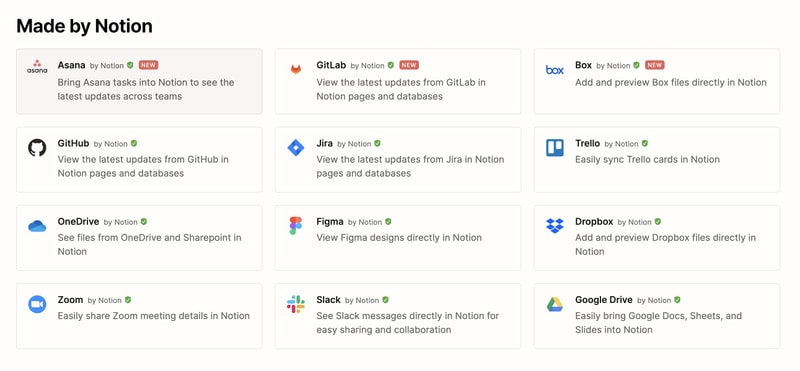
As a good workspace should, Notion integrates with a wide range of popular productivity tools so you can easily share information across the platforms you use. These tools include Slack, GitHub, Zoom, Trello, Google Drive, and more.
For instance, you can make use of the Google Drive integration to quickly add and share files from your Google Drive directly to your Notion workspace.
Notion AI
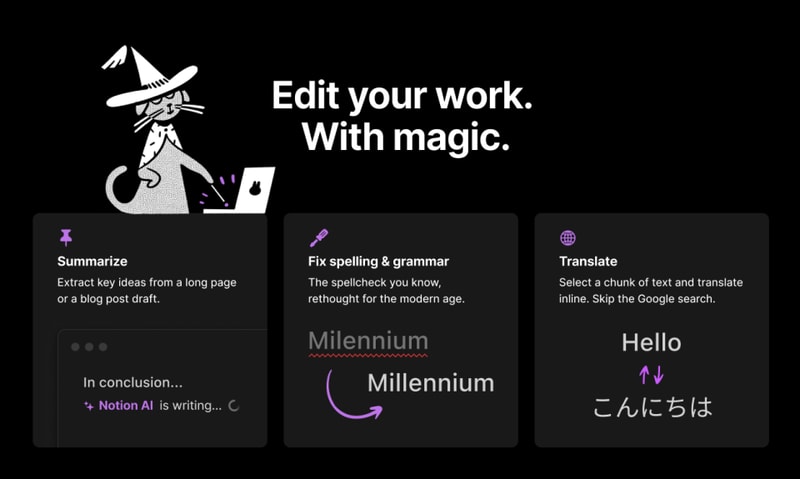
Notion AI is a core feature for workspaces. It’s a connected assistant powered by multiple large language models that’s developed to help boost your creativity and write content faster. Essentially, it eliminates the need to jump between your work and a separate AI-powered tool.
The feature can help you generate ideas for blog posts, social media posts, press releases, job descriptions, meeting agendas, and more. You’ll also be able to summarize pieces of content, correct spelling, and grammar, and translate text (English, Spanish, Chinese, and French).
Notion Use Cases
Solopreneurs
Individuals who are working freelance will benefit from an organizational tool like Notion. It can help with a variety of processes such as:
- Documenting and managing career goals
- Organizing projects for different clients
- Managing content creation schedules
Professional teams
Small professional teams can benefit from Notion’s features because it ensures that all team members can collaborate on the same tool for multiple purposes. These purposes include:
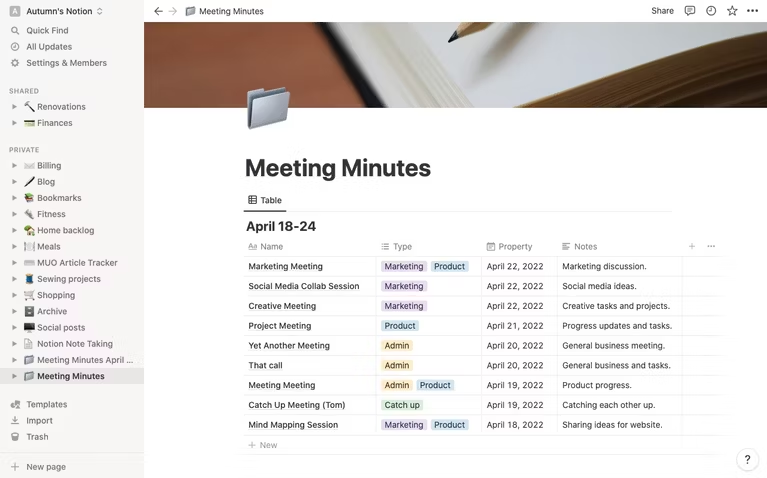
- Planning meetings and recording meeting notes
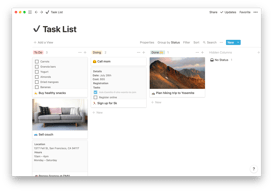
- Setting task lists based on priority
- Drawing up onboarding documentation for recruits
- Brainstorming internal team goals (digital suggestion box)
- Organizing a company roster
Students
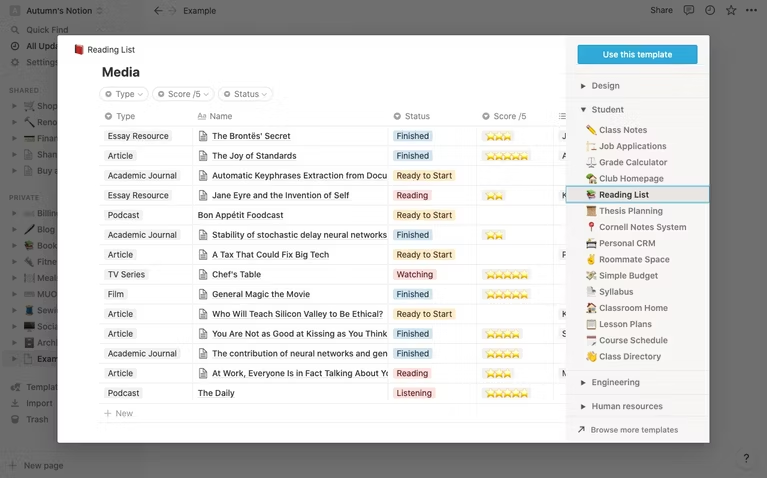
Students also make great use of Notion because of its impressive note-taking and organizational capabilities. Students can easily organize their notes by class and keep track of all reading and assignments (by the due date) for each class. The best part is Notion can even allow easier collaboration for group projects since the free plan allows sharing with up to 10 guests.
What makes Notion stand out from other platforms?
Notion stands out in two major ways; it’s very customizable to support any workflow, and it brings all work together in one shared location.
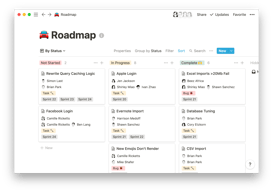
Unlike many productivity tools, Notion doesn’t just focus on solving one problem, such as organization. The way Notion is designed gives users the freedom to mold their workspace in a way that works best for them. On one hand, individuals can use it to keep their notes, to-do lists, calendars, and journals in one accessible platform. Additionally, professional teams can use it to build collaborative docs, product roadmaps, and wikis for their company.
Notion Pricing
Notion has four pricing plans: Free, Plus, Business, and Enterprise. Visit Notion’s pricing page for current rates.
- Personal (Free): The forever-free plan allows users to create unlimited pages and blocks with an allowance of 5MB file uploads. You can also share or collaborate on projects with a maximum of 10 guests, and receive basic page analytics, 7-day page history, and integration with other tools such as Slack or GitHub.
- Plus: The Plus plan is geared towards small professional groups. On this plan, you can invite up to 100 guests for collaboration. You’ll also get unlimited file uploads and 30-day page history.
- Business: This plan is for companies that use Notion to connect many teams and tools and you can invite up to 250 guests. You also get authentication features (SAML + Single Sign On), private team spaces, bulk PDF export, advanced page analytics, and 90-day page history.
- Enterprise: This subscription is targeted toward medium to large businesses and offers more advanced capabilities. You will need to contact the Notion sales team to discuss the pricing plan that fits your business’s complex needs. You can request a trial of this specific plan if you’d rather try it before making any significant investment.
Notion AI is included in all paid plans at no additional cost.
Beyond its core workspace, Notion has expanded its product suite with Notion Calendar, a standalone calendar app that integrates directly with your workspace, and Notion Sites, which lets you publish any Notion page as a polished website.
Notion’s Pros and Cons
Pros
- The customization features are better than most.
- A great solution for note-taking and creating to-do lists.
- You can use Notion to create wiki pages or simple websites with useful information about your business or products.
- Pricing is affordable for solopreneurs and small teams.
- The forever-free plan has sufficient features for solopreneurs.
- The structure of folders allows for shortcuts so you can reach your content from multiple places.
- Notion’s tutorials are comprehensive for everyone to understand and the support team is responsive and helpful.
Cons
- Although Notion’s UI is very usable, it can sometimes get cluttered once you start adding multiple projects, which can be overwhelming for newbies.
- Advanced project management features, such as reporting, time tracking, and Gantt charts are lacking.
- Managing multiple projects on Notion can become tedious.
- May not be the best option for those looking for project management software for software development.
Is Notion Right For Your Organizational Needs?
Notion should be commended for its simplicity, familiarity, and affordability. If you need a straightforward entry-level solution for creating content and planning and managing projects then Notion is a great choice.
With that being said, large businesses that have complex needs may not see the platform as comprehensive enough to streamline their project management. However, Notion is a tool that keeps evolving and works hard to improve its capabilities to fit businesses of all sizes.
If you want to keep checking other project management software that may suit you better, Findstack has more helpful reviews and insights that you can take a look at. Our goal is to help you find the right tool for your needs.

Compare Notion with other popular tools in the same category.

The customization possibility of many things, the pro offer which is given to students for free and the recent added AI which has been a game changer for me for sure
Sometimes there are minor bugs but they tend to get fixed rather quickly and the desktop app needs to be improved its not fluid and I wish they would allow the same shortcuts on the browser version
AI Writing Assistant has been a game changer for me as a master biology student it helps me write the lab reports faster than ever and allows me to keep organized
The AI capabilities. I have used it to write copy for blog posts.
Sometimes the layout can be somewhat confusing - the back buttons are unclear
Writing simple blog posts with correct grammar and punctuation. Also I like how you can specify the tone you are looking for. It has been helpful in writing announcement posts.
Notion has completely transformed the way I run my English teaching business. This versatile tool provides a seamless way to organize teaching materials, lesson plans, and student progress. With customizable databases and templates, Notion adapts effortlessly to my needs. Collaborating with my students is a breeze, thanks to its sharing and commenting features. The robust note-taking capabilities have made it a favorite among my students, who use it even outside of class. Seamless integration with other platforms and responsive customer support add to the overall experience. Notion is an indispensable tool for any English teacher looking to streamline their workflow and engage students.
Until now, Notion has exceeded all my expectations as an English teacher. It has proven to be an invaluable tool for organizing my teaching materials and collaborating with students. Notion's flexibility, seamless integration, and responsive customer support have made it a seamless experience. I have yet to come across any downsides or limitations with the platform. Notion has truly revolutionized the way I manage my business, and I highly recommend it to fellow educators seeking a comprehensive and user-friendly solution.
Notion AI has been a game-changer in my English teaching journey. Its powerful capabilities have greatly assisted me in preparing engaging classes for my students. The AI-powered features enable me to quickly generate lesson plans, correct homework assignments with precision, and even create original content tailored to their specific needs. Notion AI has significantly reduced the time and effort required for these tasks, allowing me to focus more on delivering high-quality lessons and personalized instruction. It's an invaluable tool that has undoubtedly elevated my teaching approach and enriched the learning experience for my students.
Notion is great tool for technically shaped humans who wants to move their notes to another level.
Might be quite confusing on start, after download and first note taken
Notion helps me with organising life, product development or business decisions.
the fact that you can publish great text with great u/X and awesome AI features
nothing, its a great tool for teamwork and collaboration
coordinate all our content as a knowledge management tool. it enables version interaction
Linking different data sources and data types. AI Writing Assistant helps me write efficiently.
Takes some thought to organise databases properly
Generates ideas for work. Blocks of different datatypes work really well to organise thoughts and boost productivity.
It's ability to make note taking more engaging. It's interface is generally user friendly.
Use of tables. It is quite challenging to use the tables.
Note taking of meeting discussions. AI assistant helps in summarizing the discussions.
Writing emails and texts, making summaries
It is not up to date, sometimes it makes up the things
Summarizes data I give, prepare texts for slides

Notion is the best tool to organize information and make itself useful to you and for others.
User interface bugs. Poor copy and pasting options into Notion app to specify what kind of information I want to put in a page. Also lacks importing options.
Notion helps me to write and develop thoughts about subjects I would like to discuss with other parties and make information more legible and understandable.
I like using is for checking my spelling and grammar. The other commonly used scenario for me is Improving writinng. I specifically like an ability to change tone
Nothing really serious in my user scenarios. The thing is that it's not. Chat gpt which I use for all of my other tasks. Maybe the ui is not inviting enough for me to understand exactly how it can be used
As I already said it helps me improving my writing and that's it. But what you do with the minimum words amount is wasting of my time, hope you enjoy reading it
Best way to be organized for everything.
I can't think of anything I dislike about Notion.
Notion is helping me stay organized with content marketing and blogging notes and article writing.
The integration tools are robost and lets me connect all the software I use right into notion for seamless reporting. I like how organized it keeps my meeting notes
Learning to use the database feature has been challenging, and the how-to makes it a little tricky for a layperson to understand. Once I was able to overcome that, database usage has made my meetings run a lot more smoothly.
AI Writing Assistant tool makes it super easy for me to turn my shorthand into comprehensive meeting recaps for my team! I also love how it can pull action items based on the notes
I really appreciate this application's simplicity and ease of use. it's got advanced features for experienced users, but doesn't require new people to fully understand them to engage.
if you don't know how to write in markdown, it's a bit hard to use. it's also kind of difficult to navigate quickly between recently accessed pages without manually managing bookmarks and extensions
google drive is great at making deliverables but not great for managing notes. as a google suite based company, I needed something to supplement my work here. notion filled the gap.
I can keep my notes very organized and now with the AI Assistant making notess got easier
It doesn't have a automatic grammar corrector
With notion I can keep my notes very organized and easy to find when I need them

Very versatile app. The AI is very helpful. You can create all you want.
Some thing are not easy when you don't have preknowladge. But out there are many videos what you can do.
Brainstorming or prewrite articles become very convenient.

A lot of useful functions and the Databanksystem is very good.
More functions for basic tables and there is not appointments for change the writing style
Management my work und searching
Lo que más me gusta de Notion es lo fácil que resulta documentar y generar ideas o estructuras con su asistente de inteligencia artificial. Todavia Microsoft y Google no implementan esto.
A veces, el asistente de Notion borra todo el contenido y vuelve a escribir lo mismo sin control. Es una fase de pruebas, asi que en el futuro creo que debera estar mejor esta seccion.
Notion permite crear un segundo cerebro con sus bases de datos y asistente de inteligencia artificial. La información se puede estructurar y hacer accesible para cualquier persona en el equipo.
Collaboration and Teamwork: Notion excels in promoting collaboration and teamwork. Multiple users can work simultaneously on the same documents, databases, or projects. It enables real-time collaboration, commenting, and mentioning team members, making it easy to communicate and coordinate within a team.
Limited Mobile Functionality: While Notion is available on mobile devices, the mobile app experience may not be as feature-rich or polished as the desktop version. Some users find the mobile app to be less intuitive and encounter limitations in terms of editing capabilities or accessing certain features.
Information Fragmentation: Notion helps address the issue of scattered and fragmented information. It provides a centralized workspace where users can consolidate their notes, documents, tasks, and databases in one place. This helps users keep their information organized, easily accessible, and reduces the need to switch between multiple tools or platforms.
Notion.AI It is easy to share documents with friends and colleagues and collect their comments
Price structure is inflexible. Sales team did not leave me with a good impression when I enquire about enrolling my whole department in Notion.AI
Overcome writer's block the improve writing function

Using artificial intelligence to organize my work allows me to manage multiple tasks and responsibilities in an organized way. Having everything categorized helps me keep up with the pace. As a non-native English speaker, having an option to check my spelling, grammar, and summarize my ideas has been quite important.
The copy and paste function is sometimes not as responsive as I would like it to be. When reviewing my writing, I often need to copy and paste it into a different document, such as an email or Word document. The copy and paste function is not as intuitive as the overall Notion software.
Currently, I am working on multiple projects simultaneously while also pursuing a master's degree. To manage my daily tasks, jobs, and studies, I have organized my tasks on Notion. Additionally, I have found that combining Notion with other add-ons has improved my efficiency and allowed me to invest my time in more productive tasks rather than spending it on minor and irrelevant ones.
Notion AI assistant is an efficient very easy access service that complements my organization goals perfectly. While it can get a bit confused, this AI has a reliable accuracy rate and its rarely out of service.
While it's harder to adapt to its system at first, it's an excellent tool when fully taken advantage of. The only feature it's missing is a note section compatible with IPad technology
Notion lo is Tammy number one platform to keep me organized both in my professional and personal life. Its features compact from my work spreadsheets to my personal to-do lists.
It allows me to better organize my schedules, jobs, times, plus now with the AI assistant, everything becomes easier because I can add content automatically. I have used various management tools and so far the best is this.
I like everything, maybe if there was a plugin hub where you can code for Notion, that would be great.
It allows me to organize everything as if it were a big notebook, I keep all my current notes and I set my short and long term goals, it allows me to better manage my days.
I love Notion, there is a bit of a learning curve, but once you play with it enough to work out how it fits your needs, it is astonishingly useful and adaptable.
I would like the ability to mix up The presentation a bit more. Also it would be amazing if notion so could read and interact with embedded documents. Overall great though.
Dealing with large quantities of diverse information. Synthesis of data. Extracting key findings. Crafting correspondence. Organisational management. Housing databases.

The AI writing assistant, and the page image selection, and also only use / can navigate different tools for different purposes. I like the checkbox one. Love it !
The web version is a bit easier to manage than the application itself.
it can help me to make sentences longer and shorter, and change tone, also fix the grammar and spelling errors.
How great it is to share documents and keep things organized. Both personally and working with a team, notion is great. The new AI tool is also excellent. May favorite is using the summarization tool.
Wish working offline was a bit easier but otherwise, it is great! Sometimes the "rewrite" part of AI isn't the best but that's just me being picky.
Notion solves a creative slump with their AI tool to help me begin in a good direction and saves time getting started in what usually takes me some time to get creative
I am very satisfied with using Notion to organize my work. It is a wonderful tool that helps me manage my tasks and projects, as well as share information with my team and clients. I have found that Notion makes my life easier, especially when it comes to writing texts and documentation. Previously, I often spent a lot of time searching for information and organizing it in the system. Now, thanks to Notion, I can easily find the necessary information and quickly organize it. In addition, I have found many useful features in Notion that help me manage my projects. For example, I can create task lists that I need to complete and track their completion. I can also create tables that help me track information about my clients and projects. This is very convenient and helps me be more productive in my work. Overall, I am very satisfied with using Notion and believe that it is a wonderful tool for project management and work organization. I would recommend it to anyone looking for a convenient and efficient way to manage their work.
I understand that the price may be a bit steep for my current budget. However, I do recognize the value and quality that the product offers. Perhaps, I could explore some financial options such as installment payments or financing to make it a more feasible purchase. Additionally, I could consider saving up for it to be able to afford it in the near future.
How does Notion help with managing tasks and projects? Notion helps with organizing tasks and projects. I can quickly create task lists, track their progress, and create tables to manage information about clients and projects. Notion also helps me organize information and share it with my team and clients. This simplifies my work and allows me to be more productive.
I like the fact that it helps me cut my workload time in half
I like everything, I don't have any negative comments toward notion
Admin problems, data bases etc

Customizable, Possible to tailor to your unique needs, Intuitive,
Not taken care of can get very dense and cluttered, the learning curve for advanced functions is steep, formulas are somehow tedious to understand and setup
Tailored company operation system

It makes everything at work much better, since your space of work to the things that you can improve with the Notion's AI
Just that you have to take some courses about the different kinds of tool there.
The way that Notion structures everything with their new AI assistant is awesome, it makes everything easier. Sometimes it can help you to understand things better.
It allows tying of different data types and structures.
Ai needs more features.it needs more data.
Keeping my workflow in order.