
Showing results from page 20. Use search to find specific reviews.
Unclaimed: Are are working at Sanity ?
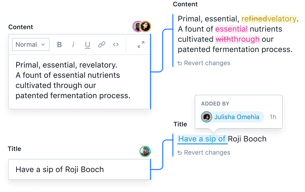
Sanity is a Composable Content Cloud that lets teams create amazing digital experiences at scale. It provides real-time collaboration, live multi-user editing, and track changes. Content creators, designers, and developers can come together while separating content from presentation

| Capabilities |
|
|---|---|
| Segment |
|
| Deployment | Cloud / SaaS / Web-Based |
| Support | 24/7 (Live rep), Chat, Email/Help Desk, FAQs/Forum, Knowledge Base, Phone Support |
| Training | Documentation |
| Languages | English |
Compare Sanity with other popular tools in the same category.
Customisation is the real power. Everything can be personalized to the business needs.
I couldn't find a way to reference objects inside Arrays
I use it as a headless CMS to couple with Gatsbyjs. So far it's been great.
The workflow process is intuitive. The documentation is sufficient. The pricing tiers are reasonable. The community adoption is high.
The navigation of their docs could be improved. There could be more information in their docs, to cover advanced use cases and customizations.
Allows us to build a CMS for client websites so they can manage their content.
Sanity has really nailed what a headless/composable CMS should be. It gives us all the features we could imagine wanting from our content layer, without ever getting in our way. The fact that the Studio can be embedded into our own Next.js application and customized at will using React opens up a world of opportunities to use this not only as a replacement for our old CMS (WordPress) but for all kinds of other content workflows we haven't even imagined yet. They're working hard to stay up-to-date with the latest features in Next.js with guides for using live previews in the App Router just landing, as well as the ability to use fetch which enables Next.js' cache features.
The docs and APIs can be a bit lacking when it comes to customization and we have already, on our first project, ended up having to do some hacky custom solutions to customize the Desk tool due to lack of options and APIs we require (for example, there's no way to set a default configuration of panes to always be open in the Editor). The pane-based structure can be confusing for non-technical users with the way that you may end up for example with two different preview panes open. There's also always one Publish button per pane which is also just confusing. This was another thing we had to do a messy hack to fix for our use cases (where we wanted a more Storyblok-like experience for our editors).
We have been looking for a headless CMS to replace WordPress for all of our agency's clients. It will allow us to stop worrying about managing servers and keeping WordPress up-to-date, and instead let us focus all development in one layer; Next.js. The fact that we can embed the Studio and host it on our own is a game changer. The CDN and Images workflow has finally given us a sensible workflow for responsive images. The Preview mode will save us unimaginable amounts of support hours since our customers can now just see what's going on.
Sanity makes it so much easier for my clients to add/edit content to their websites. It saves me the hassle from building an individual backend for each client. I just hook into sanity, and they can log in with a simple gmail account
My only issues with Sanity are the nuanced integrations with Next.js specifically. From version to version small things change and there aren't always previous implementations out there in the wild. Once you get past some of those speed bumps its smooth sailing!
Sanity prevents me from building indivualized backends which saves a load of time. Now each of my clients can hook into a similar back end that is user friendly instead of me hooking in mongodb and writing my own data management routes. This mitigates a huge chunk of work for me.
Sanity.io's infrastructure, based on JavaScript and React, seamlessly aligns with the Next.js environment, minimizing the learning curve and facilitating a familiar development experience. The scalability of the platform is remarkable, catering to the needs of both small-scale projects and large enterprise systems equally well.
For straightforward tasks, GROQ can feel overly verbose and complicated, and while it can handle complex, nested data structures, it can get unwieldy for larger data sets. So while it does offer power and flexibility, I've often found it more of a challenge than a convenience in my workflow.
Sanity allows me to define your own content types and structures with schemas in javascript. This lends me great flexability unlike a lot of other out of the box cms. This leads to better organization of my content and more efficient development workflows.
Clean and intuitive interface, good and throughout documentation with some video examples and tutorials, making it much more easy to start using the product. Query syntax is very powerful.
Getting started with Sanity CMS may have a steeper learning curve compared to simpler CMS solutions, but good docs and tutorial help. Compared to some other CMS options, can be more expensive, especially for larger projects or higher traffic websites.
Taking care of static contant and data, making development easier once you get used to using it. This makes developers more productive, cutting development costs.
sample data, examples to update, fetching data, integration with any frontend framework
if there are more video tutorials would be great
Put centralized data in one API. One single API point to quickly get data
Ease of use especially for someone using react and the flexibility to use in multiple platforms with little or no effort.c
you need to learn GROQ to be able to be productive. Setting up the assets is tedious as it depends on knowledge of GROQ.
It addresses all my content requirements in seamless way. I'm planning to build my entire learning platform using Sanity.
Sanity has a gorgeous embedded studio which fits in perfectly with any NextJS project.
The only drawback is the limited amount of free tokens you get.
For me, as a frontend developed I use it as a temporary backend solution.
I love how easy it is to develop a fully functioning cms with code. Also love how you can embed the studio into a nexts site
Sometimes the documentation could be better, especially around typescript examples
Acting as a coma for websites we build for clients