

Unclaimed: Are you working at Sanity?





Sanity Reviews: 4.7/5 — Highly Rated
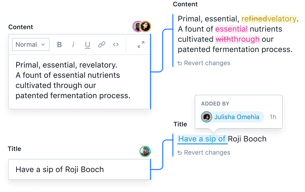
Sanity is a Composable Content Cloud that lets teams create amazing digital experiences at scale. It provides real-time collaboration, live multi-user editing, and track changes. Content creators, designers, and developers can come together while separating content from presentation

| Capabilities |
API
CLI
OSS
|
|---|---|
| Segment |
Small Business
Mid Market
Enterprise
|
| Deployment | Cloud / SaaS / Web-Based |
| Support | 24/7 (Live rep), Chat, Email/Help Desk, FAQs/Forum, Knowledge Base, Phone Support |
| Training | Documentation |
| Languages | English |

Compare Sanity with other popular tools in the same category.
It was easy to drop into my React project without any hassle. Easy to query and return data in the format I expected. Much easier to use than learning a new technology like Gatsby, etc.
I am trying to use their API to upload information to the CMS. It's well-documented, but I am having trouble setting it up correctly for my application. I likely need more time to understand it.
Our website needed a simple headless CMS to drop into an existing project. We were moving from developers entering information to marketing people, and it made the process very easy for them!
Great docs. Awesome community support. Well writtten, documented and feature rich NPM packages. Easy to setup, code both frontend and tailor Sanity to your specific wishes.
Nothing major to point out, but there is a a certain learning curve when dealing with portable text with high degree of customization. I would also like the UI to more easy to adjust than it is now. I also miss a "scheduled content" a la Contentful.
So to speak the CMS part of customers with very specific needs. Quick time to market, easy for external editors with all the features to get into. I use less them fidding with editor and more time writing beneficial code.
Content can be structured considering any type of content model. We were able to integrate our legacy eCommerce backend system logic into Sanity to make merchandising and content creation significantly easier.
You need to find the right partner to help you implement your company's business logic. Once you set up the foundation, Sanity can be learned by any React team, making Sanity a super powerful tool.
Overcome legacy system restrictions for content creation. We hold ourselves to the mission to Democratize the Frontend with Sanity. Creative minds should be empowered with a tailored UI and the right creation capability in a sandbox environment. We can do it all in Sanity, from within Sanity.
Seemless & intuitive developer experience. Grate community and docs
the ability to have a page layout widget.
As an SEO agency, keeping clients on track with content structure and continuity.
Highly customizable, yet easy to use CMS solution. Allows multiple team members with varying backgrounds to easily work in the same space with ease.
A bit of a learning gap for those that are more familiar with a "standard" CMS like Wordpress. Nonetheless, Sanity provides various learning resources and ample documentation to bridge this.
Sanity allows our team to produce unified content quickly. Instead of solving for one-off requests or updates, Sanity makes it simple to keep additions to our owned media aligned with design standards. It definitely helps support team members of varying development knowledge as well, making it easy for those with lesser experience to contribute to web updates.
The best parts of Sanity are the generous free tier and easy-to-use APIs. We were able to rapidly develop our product and not worry about managing databases and securing our backend. It was super easy to integrate with our existing tech stack.
The content studio is slow. Also, it becomes very difficult to review the changes to a document if it has had a lot of changes. Over the past few months, the experience has gotten better, but there's still a lot left to improve.
We have a lot of data that gets updated multiple times a day. Sanity gave us a straightforward and effortless way to collaborate between developers and content writers.
Sanity is quite flexible compared to other solutions I have used, in terms of being able to customise the experience when managing data, and there is also the possibility of creating custom elements to further customise the experience. The community developed add ons are quite useful and there is a good range for different use cases
The developer experience can be painful at times as some aspects don't have proper typescript support so it's a case of reading documentation and figuring out what the types should be manually to create custom types. However once you have a system for this to help with auto completions, the system is quite capable. Another issue is lack of i18n on the client side, however manual translation is possible but it is painful
I have developed some websites for some of my clients and sanity allowed me to get good looking and professional looking solutions with some advanced functionality in a short amount of time
It is super easy to learn, compared to some CMS it is so flexible.
Nothing really, cannot fault it. Would highly recommend.
I needed something super lightweight for brochure websites, this fits the bill perfectly
The Studio! Version controlling schema is never accessible, but Sanity has made it a seamless experience. It's a fast, easy to use application.
Sanity could tie GraphQL deployments into the Studio flow better. Also, there should be a better multi-developer experience since datasets are maxed at 6, so a dataset per developer isn't always viable. Multiple developers working on a single dataset often cause conflicts.
Being able to release code and schema at the same time. Using Contentful in the past revealed how much of a pain it can be to manually move content models around.
Sanity solves the challenge of content management by providing a structured and flexible platform. This benefits me by streamlining the organization and delivery of content, making it easier to manage, collaborate, and maintain consistency across projects.
I have no dislikes about Sanity I genuinely love the product and appreciate its features .
Sanity solves the challenge of content management by providing a structured and flexible platform.
I enjoy the built-in features that Sanity offers. I also like that the third-party ecosystem is fairly robust and many plugins can be found for customization
Custom use cases can be difficult to implement. Sometimes the documentation is lacking when it comes to this. Major version upgrades have been a major pain point for my team as we have many custom implementations that are completely unusable on newer Sanity versions.
Allowing our marketing team to easily manage site content through a good UI
Having complete control over the structured content models and flexibility to host Sanity Studio wherever.
The toolkit for building custom functionality and fields within Sanity Studio arere hard to work with.
Creating a website that can be driven by structured content via a customizable Headless CMS
I really like the flexibility and webhooks
I think that layout (UX) might be refreshed, especially fonts and those sliders.
It is much faster then other CMSs we used
Quickly building document schemas without needing to dive into complex UI for Sanity Studio allows me to focus on doing the headless implementations.
The concept of Scheduling API and Document events is great however falls short when they are fired before the Sanity CDN is rebuilt. Maybe the CDN could be on demand when not warmed to resolve the issue. Additionally, the WYSIWYG editor could perhaps be changed to a different 3rd party library that would allow the ability to construct tables maybe. Additionally from a development standpoint, being required to connect to the Sanity Content Lake for performing local development is a frustration as the development data sets count towards the quota of the overall plan.
Simplified editor experience for our non-technical users
The most I like it is a tool for engineers that can allow not-tech person work with it. I like it is not hosted on my end and I can care about content on my website.
I would like to see a dedicated person for standard frontend technology (gatsby in my example) that can maintain it daily - I don't mean tech side, but at least providing answers, planning everything with the tech team and showing it to the community. The last gatsby 5 update is a great example - https://github.com/sanity-io/gatsby-source-sanity/issues/192; we would like to know what the steps are for sanity support after that.
Similar to my 'what I like' answer - I can focus on the website's content than the whole backend, which doesn't get me to move forward. Also, the free plan is beneficial to a good start.
The easy setup, and how the structure of pages are setup for you
That the Studio does not have TS support for all features like the client for running GROQ, we had to hack our way around this
Sanity is solving the problem of gathering all content in one place, where it is easily accessable
Simple and Content First solution, focused on a clear path
Watch mode is not great; especially with the preview, I believe it should have an advanced interface exposing extra-fine tunning for some cases
How to manage huge content with a simple UI
The infrastructure as code model for building out your content models is extremely helpful. Less click, more coding, and ship faster. We are using Sanity more and more as we learn more about it.
GraphQL as a second class citizen. I would like to see better support, for example bidirectional queries for many-one/one-many. Currently you need to use GROQ to support many-one queries when you define one-many in your schema.
Building full-fledged CMSs to build out multiple sites across our company for a one-stop experience for our content editors. Thinking about our sites at scale has helped us to build better models overall.
I was using as a user only - not as a developer- but it was okay
unable to load up multiple images to the media folder and organize images into subfolders
I wasn't using it to solve problems - mostly as a CMS solution
It's not difficult to understand, pretty intuitive, helps me get my job done
Sometimes its glitchy when I try to publish things, and when I have it open for too long and try to go back to it in my tab it takes a long time to reload
I just use it to publish things to my company's website, so I dont really have any problems to solve

I really liked how easy it was to get a backend deployed and the built-in query language was nice. I don't have that much experience with hosted backend services but what I have seen so far I like.
I can't say that I've used it long enough to tell. Excited to keep working with Sanity though so time will tell how it will grow on me or what I dislike, ha!
Quick backend solution without all the heavy lifting.
As a content editor, it's saved me loads of time and headaches. It's smoother for delivery and guarantees a smoother relationship with our dev team.
Sometimes Sanity Studio's previewer lags behind.
Friction-free authoring experience. We're now embracing headless platforms - everything's more performant.

What I like the best with sanity is the possibility to customize each of my projects exactly how I want them to be. Both for myself as a developer and for the customer.
Because of the many possibilities, it also takes some time to learn how to use sanity. It is not for people who are new to building websites. It requires some experience. Also, compared to other brands, Sanity has less documentation from users that have solved problems that one might have.
Some of the benefits I've realized with sanity are the possibility to customize the admin page to the customer and to use groq as query language. It makes it easier for the developer to make requests from the api.
It's a simple platform that makes using it very easy and efficient. It always is reliable and never down.
I often find that there are lags and delays with seeing changes updated in Sanity.
Site updates. It's seamless and easy to use.
Everything is possible. Sometimes I think I've reached its limits, but then it turns out that there is a way to solve/implement things.
The docs can be overwhelming at first sight.
I use it as a backend for a take-away ordering app. Generous free tier makes this possible.
I found Sanity very intuitive to get started in, and extremely versatile. One can create a perfectly tailored backend for almost anything! Of course, Sanity happens to work especially well for popular JAMstack frameworks like NextJS and Gatsby. One thing that really stands out for Sanity vs other solutions has been a commitment to the developer's experience while still providing a wonderful contributor experience as well. Another thing that has set Sanity apart for me has been the outstanding community that is always supportive and helpful for developers of all skill levels.
Customizing the studio UI has been less intuitive for me than creating the schema, etc.... however, they have been making tremendous strides on that side of things lately, so this is becoming less and less of a downside!
Providing a singular source for content on website, newsletter, social, etc.... It's definitely made me more productive relative to building websites, but also makes it easier to scale and adapt as the design and use-cases change.
Flexibility. Studio customization with plugins, parts system & react components. GROQ is awesome. HTTP API is super cool. Plugins marketplace contains a lot of tools. In general I'm super happy with a way how can we create own features on top of Sanity. We had to implement a migration tool for operators for copying content from another dataset - I really like the way how plugins system works.
Referencing documents poor implementation (I see there is a new article "connected-content" I'll inspect it) Keep studio up-to-date when having custom parts - is a pain because of compatibility issues Parts-based customization appears not so cool when you want to change nonstandard parts because they contain a lot of imports - the case when "you need a banana, but you getting a gorilla and entire jungles". E.g. you can't simply provide your custom list item element, another example - when I wanted to create a custom object input that would contain standard components inside (I had to implement a behavior that now can be achieved with conditional fields) I finished with a lot of deep imports right from a package. some CLI tools aren't working. E.g. I can't simply clone a dataset with CLI (I'm on Linux - maybe it's the reason). Importing content from big datasets also not working - I can't import data from production at ones, have to divide it into small pieces by content types. But some content types have a big amount of documents so I can't import them as well.
We creating a pretty big CMS with content spread through a range of datasets, environments, and labels (label stands for US state). It contains a custom publishing flow when documents go through a series of environments before appearing on production. CMS users have custom roles. Labels implemented in a way when any document can be forked from a white label into its own label and being edited then. We're using custom read tokens with special filter settings in order to simplify frontend teams' life so they're consuming only needed filtered content for a specific env and label.
Sanity has excellent documentation and a great API, especially if you love GraphQL.
Learning GROQ seems like a unessecary because I haven't run into a reason why GraphQL hasn't worked.
We finally replaced WordPress to give Marketing complete content control.
The best is clarity of how you set up a banner, promotion, and promotion texts.
For my part not easy to see a overview for repeated schedules
Manual work is now scheduled instead.

Setting on up sanity was extremely simple, and intuitive. Being a new developer, Sanity was definitely one of the easier backend's to get working. Their free plan for deploying a live db is also amazing!
It was a bit difficult to find updated versions of their docs. I would have to use stackoverflow or youtube to find answers, rather than their own documentation. The docs are a bit outdated, but id love to see them more detailed and updated!
A very simple way to add content to the backend, which allows for my clients to modify them easily on their own.