

Unclaimed: Are you working at Storyblok?





Storyblok Reviews: 4.5/5 — Highly Rated
Storyblok is the world's pioneer headless CMS that works for both developers & business users. Built on the premise that traditional CMS makes it difficult to repurpose content for different platforms, Storyblok offers a unique fusion of visual editing tools and highly tailored content blocks built on top of its headless architecture that provides exceptional flexibility and speed for developers.

| Capabilities |
API
CLI
|
|---|---|
| Segment |
Small Business
Mid Market
Enterprise
|
| Deployment | Cloud / SaaS / Web-Based |
| Support | 24/7 (Live rep), Chat, Email/Help Desk, FAQs/Forum, Knowledge Base, Phone Support |
| Training | Documentation |
| Languages | English |

Compare Storyblok with other popular tools in the same category.
Ability to build complex templates for my websites with shareable components. It is very easy to implement.
Nothing from the top of my head. I have to admit I needed a tutorial from that finish dev in order to fully understand how to use Storyblok
Managing content while keeping i18n in check.
The interface is making Storyblok easy to use despite the huge quantity of options and possibilities
Some data can sometimes be painful to retrieve via the API and needs several API calls to fetch
The ability to get data easily via the API and create and edit content in an easy way with the website interface

The first thing that struck me about Storyblok was its clean and intuitive user interface. Navigating through the platform is a breeze, thanks to its well-thought-out design.
Currently, there are very limited 3rd party applications available but I would love if they will keep adding more.
Storyblok's architecture is designed for scalability, accommodating projects of varying sizes. Its modular content modeling approach enables users to adapt to changing project requirements without major overhauls.
How easy it is for the client to understand the CSM
The invoice process to cliens. I think it can inprove a lite bit.
As a gency. storyblok credibility is very important to our customers and which customer use Storyblock. The client feel that it is a platform they are willing to take on.
It's a really flexible, powerful content platform that really allows you to shape your content and then consume it however you wish. It's really easy to get started, has a free 'community tier and integrates really quickly and easily into most UI projects. I use it daily at the moment and will be using it moving forward for all my client projects where they need a fully-featured, yet flexible CMS solution. For example, I use Astro and Storyblok integrates in under 5 minutes with no fussing or faffing.
The built-in datasources could be more useful if they allowed for tiered key relations. For example, if you need something like a country > city relationship using the built-in Storyblok datasources, you'll struggle. But this isn't a database, it's a CMS. The main blocker sometimes is the pricing. The community (i.e. free) tier is really great and very generous, but after this it's a large jump to the entry level pricing tier. This is oftern overkill for smaller projects or for some clients.
As a Jamstack-oriented web developer, my main focus is on providing great content experiences to clients' end users. One of the best ways to do this is via a platform like Storyblok as it allows clients to focus on their content and allows me to focus on consuming that content using the best technical means appropriate for the project.
It's so simple to use, and we don't need to apply it 100% in our projects, we can customise it to fit the exact project needs. The visual editor is excellent, and something that several other headless solutions don't include, it makes it attractive for our clients who aren't super technical.
As it's designed to be completely component-based, we've had to build some specific components and Story types to handle things that perhaps would be OOTB in another CMS; for example redirections. But these workarounds are acceptable as the benefits we get from StoryBlok outweigh the occasional frustrations.
We want to offer beautiful static marketing sites to our clients, StoryBlok allows our engineers to write bespoke code, with components (Bloks) and the clients to have autonomy in their website without relying on us to make changes. Being headless, it allows us to build optimised sites without compromise.
For starters, its learning curve is initially gentle, allowing users to easily start implementing stuff from the very beginning. However, after using it for some time, you begin to discover the powerful features it offers, expanding the initial possibilities to a new level. I really liked the navigation approach for creating stories, the available plugins that enhance the capabilities of the system, and the ease of creating new plugins by myself. I also like the easy it is to configure different live preview environments, the webhooks functionality, the many approaches you can follow in regards to internationalisation, the flexibility on how to retrieve the content with its APIs. I've been instensly developing for customers using Storyblok for the last year, and both my experience and the feedback from my customer's have been great.
I'd love to have the possibility to define content outside the navigation tree. I don't like stuff like configurations stories to be "using" a route that could be used by the customer, potentially breaking the application. Besides that, I cannot thing of any big issue with it. Of course I'd change some little things, but in the end they are small details that are not affecting the day-to-day development with the platform.
It allows us to develop really fast based on the requirements given by the customer, making it easy for us to show results to the client in just weeks (if not days), and thanks to the live preview, it helps getting our customer feedback very soon, so we can improve our solution together.

Storyblok is very flexible in nature and this allows Storyblok to be perfect for lots of use cases. Content types and Nested Components allows complete control over the composition. Along with that Image Service, Management API and Apps are super helpful as well. For content editors, the Live preview helps a lot and they are able to make changes in no time.
The rate of feedback on Github issues and the feedback community could be increased.
Storyblok is helping us build compositions for any kind, be it Landing pages, website and in CMS as well. Storyblok image service is also amazing to scale assets as per the requirement.

The reason Storyblok is my favourite CMS is that it has both a great dev experience as well as content editing experience without making sacrifices when it comes to either. Their support is great as well!
Sometimes the tutorials for specific frameworks aren't perfect, but it's a minor issue. Other than that, no complaints here.
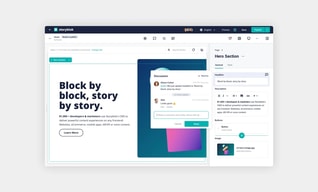
Allowing for a great content editing experience for non-technical people while still allowing us a lot of flexibility with how we set up and code the frontend. The visual editor is awesome!
The most helpful is the ease of use. I onboarded content managers really in minutes and mostly they needed not more support.
Some parts of the navigation is a bit different than in other apps, so it needs some learning curve, but if understood very clear.
We have several digital channels and want to create a unified content strategy for all these channels and a first step is to find a place for all contents and share them between each other.
Able to create new page to customize site centric to user.
Switching between preview themes can be tricky.
Customer can handle content and create page without our need of developpement.
Super easy to add in to any existing next.js project. Great support when something goes wrong. Lots of features being added in the years we have been using it.
It has got a lot better over the years we have been using it; however it would be nice to have support for more generic sitewide options pages.
Mostly next.js applications needing a headless CMS
The implementation of Storyblok is based around ATOMIC design principles which allows a component first approach and makes it easy to implement. The custom fields plugin which is part of the application allows you to build content from other APIs into the content of your page or Blok and makes it the perfect itegrations addon. Along with the Live Preview for each environment, Test, UAT or Prod, makes this the best in class!
Some more case studies and code based case studies would be great!
The seperation of the CMS is important to allow frontend developers to keep your website fresh. Storyblok is fast and very scalable!
Most helpful part of Storyblok is the layout and the ease at which we can navigate the back end of the website to make changes shown on the front end
Sometimes can be tricky importing and uploading assets to the asseet library and then adding them onto a specific page
We had issues with website layout and updates that this has now fixed for us

Versatile system. Rich with applications and functionalities. Easy to build and to update.
Nothing so far. With as much as I try, all is good.
Easy to manage.
With Storyblok, it's incredibly easy to amend content on the site, everything is organised and with a well-set up site, almost no team training is required. It's also incredibly easy to integrate all of your core applications.
I've not come across any downsides to Storyblok. I guess I wish we could integrate Bynder without having to upgrade.
Storyblok allows us to quickly and easily create content for our website and allows us as an internal marketing team to manage the whole site without having to rely on developers.
The reusability and the design system that Storyblok boasts integrates itself seamlessly into our way of working and our codebase. We've created more than one site using the same library of components and now simply seek improvements to the way that we're working with these components - and the spaces that utilise them. We use Storyblok every day as part of our work, whether it's developing a new feature or just creating a funky new page to show off the art of the possible. It's been so easy to create new content on the site that we find ourselves - even as developers - making fake content pages just to show off the work we've done and what can be acheived with it.
V2 fixed a lot of the quirks and problems that we'd previously noted. It's a much slicker experience. My least favourite part of Storyblok, however, is how the Releases app seems to be a bolt-on to the content creation process. There are still inherent bugs and quirks with getting it to slot nicely into our spaces. For our teams, it feels absolutely vital, so it'd be nice to see it get more of a focus.
It encourages the creation of reusable components that can be inserted within each other. This aligns with our development principles and ensures that we are not making everything bespoke, saving us time and also allowing the content teams to experiment more with what's available to us. That in turn leaves us with less pressure to guide them design principles.
From a developer perspective I really enjoy working with the technologies used. Libraries are available open-source and are always updated for use with various technologies. Support is quick, helpful and very engaged.
On major upgrades or launches of new libraries, documentation and source code sometimes don´t match, but that´s just a minor issue.
Providing an CMS with up-to-date APIs and technologies, supporting all our needs.
I recently had the opportunity to work with Storyblok for an ecommerce product MVP, and I must say that my experience with this platform has been nothing short of fantastic. Developer-friendly GraphQL API: The schema is well-documented and easy to understand, making it a breeze to query and manipulate data. I could retrieve exactly the data I needed without any over-fetching, which is crucial for optimizing performance. Intuitive UI and UX: Content editors and developers will appreciate the simplicity of the interface, making it easy for non-technical team members to manage content with minimal training. The real-time preview feature significantly streamlines the content creation process. You can see exactly how your content will appear on the live site as you edit it, which is a game-changer for developers working closely with content creators. This results in fewer iterations and a faster development cycle. Content localization and versioning: Storyblok's built-in support for content localization is a lifesaver, especially for ecommerce projects targeting international markets. The ability to manage content in multiple languages within the same project simplifies the process of creating a global presence. Furthermore, Storyblok's versioning system ensures that you can track changes, rollback if necessary, and maintain content consistency across various stages of development.
The GraphQL API documentation is not always up-to-date and this can be improved.
Storyblok simplifies content management for developers and non-technical team members. It streamlines the process of creating, editing, and organizing content, reducing the back-and-forth between developers and content creators.
Storyblok excels due to its framework-agnostic approach, offering seamless integration with any preferred framework. Whenever I encountered challenges, the proactive Storyblok team was immediately available on Discord to guide me towards a solution. Even as a novice developer, I effortlessly incorporated it into a system tailored for both SvelteKit and Storyblok. I consistently choose Storyblok for my projects, and the positive feedback from clients reinforces this decision. Furthermore, Storyblok is rich in features, boasting an array of data types (bloks) and an expanding suite of integrations, particularly its exemplary image service, which has notably optimized the website sizes I work on. I highly recommend Storyblok for its adaptability, support, and robust feature set.
I wish storyblok had a more visual approach to sharing blok-schemas across projects. Currently they offer a CLI but the entire approach is relatively hands-on. It's similar to copy and pasting files in a way, and I think this could be achieved with an inbuilt app-like approach of drag and drop.
I aimed to develop a system reminiscent of platforms like Webflow, where options and components are visually driven yet steered by my unique code. Storyblok empowers me to design and replicate a template that seamlessly integrates into every client project. This grants clients the speed and efficiency akin to low-code builders. However, it also provides the flexibility to tailor any specific design or development need. With just the initial version of my system, I'm already thrilled with the outcomes. Achieving such results without Storyblok or spending months crafting a less satisfying experience would be inconceivable.
Among Storyblok's best features are its visual editor, spaces, stories, folder organization system, and workflow setup. It also has active customer support and a large developer community. The documentation is also very well written to cater to developer and non-developer needs.
The only downside is the unavailability of mutate/write access on its GraphQL API and a slightly steep learning curve in understanding the platform and configuring things like SSL for live preview and other integration.
Storyblok provides a central hub to manage my content, allowing me to define roles that provide certain levels of access to content and also define a creation-to-publishing workflow. It also simplifies the task of content management with its component blocks, and visual editor.
Great preview feature that makes a difference comparing to other CMS platforms.
Minor bugs. I can live with them as they not break the overall experience.
When we were looking for a headless CMS solutions, there was nothing to compare with Storyblok reagarding flexibility, ease of use and the amazing preview feature that makes the introduction of new content much easier.
Block componentes definition and console simplicity
Pricing is to high for workspace........
Content administraton flexibility
Easy to understand and smooth. Barerly needed an introduction.
Nothing really. Every feature i need is there and the integration was easy.
Easy and smooth updates of our webpage. Easy to maintain a good design.
Storyblok is a fantastic CMS for Marketing and Content teams. The user interface is clean, very easy to use, and very intuitive. As a Product Designer myself, this is something I particularly appreciate. At the studio, we are big fans of the visual editor as it allows you to see the changes you’re doing in real time. This makes it very easy to build a page, adjust content, visuals, and components to get the exact results you need.
If you want to build something new on a page that hasn’t been developed (like a new block), you will need additional development support from a frontend developer. On the other hand, this means you are not restricted by any grid or pre-build layout, as you would find in other “web-builder” tool. You can go very custom when designing and developing something.
Storyblok provides a simple solution for our clients, usually non-technical users, such as content writers or digital marketing manager, who needs to build and maintain web pages. Again, the visual editor makes it effortless for them to review the page and see what it would look like exactly when published live.
It's a great CMS, easy to use. Very productive. Great free version, which is actually useable :)
Don't now any. Maybe a simulationius preview of different breakpoints at once?
Seperating content and development
The single screen view of all of the tools a content editor would need makes life so much easier. The preview allows editors to make good design choices but still allows devs to put constraints around those choices.
It is a struggle to find anything I don't like about Storyblok v2. If I was to be picky, I would say the focus tool on the images could do with a preview showing different ratios. Something similar to https://jonom.github.io/jquery-focuspoint/demos/helper/index.html.
Trying to find a way to rapidly publish content has become easier with Storyblok v2 and Gatsby Cloud Hosting. As I have a static site, publishing content is fast, almost instantaneous.
It is indeed effortless to use due to the available components. It is also very easy to learn or to teach it to teams who have no prior knowledge about design.
The version two of Storyblok had some issues which are now being fixed. Other than that I am content.
Instead of paying an agency to help us with the website we can train people with no prior knowledge in web design in just a few days. We are saving money.
The preview feature is by far the platform's most impressive and helpful facet. But just as helpful are the drag-and-sort block reorganization, as well as the copy and paste features. We've reduced content population and new page creation by approximately 75% with these tools alone.
One downside is that it's not open source. So if our team wants to suggest a feature enhancement, we have to work through Storyblok's support, as opposed to just developing it ourselves.
A headless CMS that works with modern web frameworks and makes it easy for Marketing to own content. This allows us to develop highly optimized and secure websites for our clients, and makes it simple for our clients to manage the content themselves.
Storyblok is an awesome headless cms for any headless frontend. I love to use it for my personal projects build on Nuxt.js. I also plan to sell storyblok projects to customers in the future!
I took me a while to get into it but since i figured out the basic functionalities i am having a total blast!
It is hosted at storyblok and the community plan is one of the best i have ever seen. It is fast, easy to use and easy to develop on. Also the media library is highly benefitial.