

Unclaimed: Are you working at Duda?
Duda Reviews: 4.7/5 — Highly Rated
Duda’s host of incredible features is perfectly suited to facilitate collaboration. Whether you intend to work with clients or want a platform designed for seamless team coordination, Duda makes it really easy for users to develop different pages at the same time. It also includes support for a multilingual site and features tools that make it more user-friendly for global audiences such as language-specific URLs based on where the viewer is located. It also features a drag-and-drop editor for ease of use and reliable backup and restores functionality. The basic plan starts at $19 monthly but signing up for annual plans offers more discounts.

| Capabilities |
API
|
|---|---|
| Segment |
Small Business
Mid Market
Enterprise
|
| Deployment | Cloud / SaaS / Web-Based, Mobile Android, Mobile iPad, Mobile iPhone |
| Support | 24/7 (Live rep), Chat, Email/Help Desk, FAQs/Forum, Knowledge Base, Phone Support |
| Training | Documentation |
| Languages | English |
Duda Pros and Cons
- Collaboration tools
- Drag-and-drop editor
- Backup and restore functionality
- Can be expensive
- Limited third-party integration

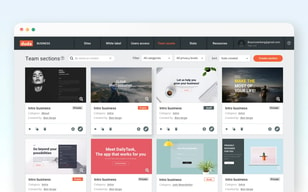
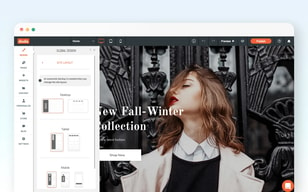






Duda is built for agencies rather than end users, and that is the whole point: multi-site management, client permissions, team seats, and white-labelling are the product. The pricing follows the same logic, which means the plan most people find first is not the one agencies actually need. Full white-labelling starts at $149 a month, and every site beyond your allowance adds $17.
- What it is: A website builder designed for agencies and web professionals building sites on behalf of clients.
- Best for: Agencies, freelancers with a client roster, and SaaS platforms embedding site building for their own customers.
- Pricing: Basic $19, Team $29, Agency $52, White Label $149 per month, with roughly 50% off annually. Custom is quote-based. Verified in July 2026.
- The honest catch: Additional sites cost $17 a month each, so an agency’s real bill is driven by client count rather than the plan price.
What Is Duda?
Duda occupies a different position from Squarespace, Wix, or Framer. Those tools sell to the person whose website it is. Duda sells to the person building websites for other people, and every design decision reflects that: client permissions that let a customer edit their own content without breaking the layout, team collaboration, multi-site dashboards, and a platform you can rebrand as your own.
That last capability is the reason large SaaS platforms embed Duda rather than building their own site builder. If your product needs to offer customers a website, Duda can be the engine with your branding on the front.
The independent ratings are strong: 4.6 out of 5 on G2 across 784 reviews and 4.5 on Capterra across 214. Reviewers praise the editing experience and turnaround speed, and the most common criticism is pricing structure.
How Duda Works
- Multi-site management. A dashboard for many client sites rather than one site’s settings, which is the core agency requirement.
- Client permissions. Customers can edit their own content within boundaries you set, which prevents the classic problem of a client dismantling their own layout.
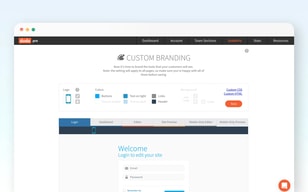
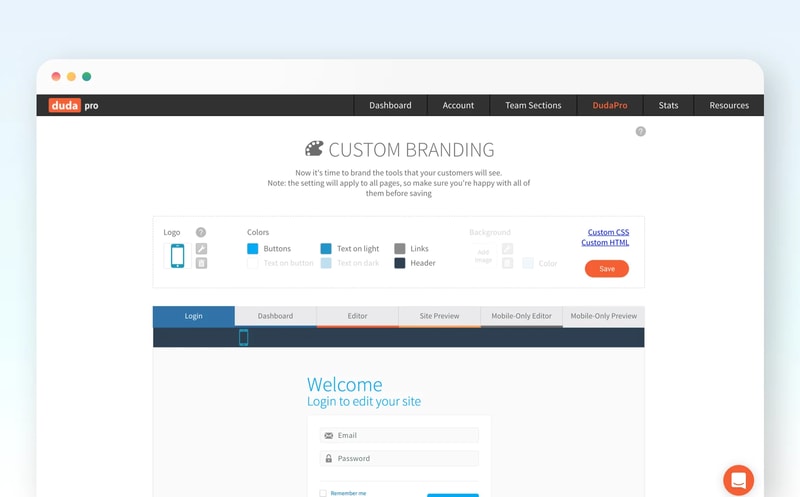
- White-labelling. From the White Label plan, the entire platform carries your branding: custom domain, login screen, client communication, and support portal.
- Team seats. Three team members on Team, six on Agency and White Label, unlimited on Custom.
- AI tooling. AI SEO and Building Assistants on every plan, AI Content Collection from Team, and an AI Connector using Model Context Protocol from Agency.
- Developer access. Code access from Team, and a custom widget builder from Agency.
Duda Pricing
Five tiers, and the meaningful variable is sites rather than features. Figures verified on Duda’s pricing page in July 2026.
| Plan | Monthly | Annual (per mo) | Sites | Team members |
|---|---|---|---|---|
| Basic | $19 | ~$9.50 | 1 | — |
| Team | $29 | ~$14.50 | 1 | 3 |
| Agency | $52 | ~$26 | 4 | 6 |
| White Label | $149 | ~$74.50 | 4 | 6 |
| Custom | Quote | — | Flexible | Unlimited |
Additional sites cost $17 per month, or $168 per year, on Team, Agency, and White Label.
The arithmetic an agency should do before choosing:
- Your bill is client count, not plan price. Agency at $52 includes four sites. A twenty-client agency pays $52 plus sixteen extra sites at $17, which is $324 a month, or considerably less on annual billing at $168 per site per year. The plan is the smaller half of the cost.
- Full white-labelling costs $149. That is 7.8 times the Basic plan, and it is the feature that lets you present the platform as your own. Agencies that want their brand on the client-facing experience are looking at the top published tier, not the one named “Agency”.
- Basic and Team include one site each. Despite Duda being agency software, the two cheapest plans are single-site. Team’s value is the three seats and code access, not capacity.
- Annual billing roughly halves the price. Promotions of 50% off yearly plans appear regularly, and the effective annual rates above reflect that. Check whether the discount is introductory or standing before committing.
- A 14-day trial with no credit card. Enough to build a real client site and judge the editor.
Who Should Use Duda
- Agencies with a client roster. The clearest case. Multi-site management, client permissions, and team seats exist for exactly this, and nothing consumer-focused matches it.
- Freelancers who maintain sites for others. Client editing boundaries prevent the support calls that follow a customer breaking their own page.
- SaaS platforms embedding site building. White-labelling and the API make Duda a component rather than a destination.
- Teams that value turnaround. Reviewers specifically praise how quickly sites can be produced.
It fits poorly for individuals building one site, where Squarespace or Framer cost less and look better, for design-led work where visual craft is the differentiator, and for agencies unwilling to pay $149 for the white-label experience they are implicitly promising clients.
Honest Pros and Cons
Strengths
- Purpose-built for agencies. Multi-site, permissions, and team management as first-class features rather than afterthoughts.
- Genuine white-labelling. Your branding across the platform, login, and client communication.
- Excellent ratings. 4.6 on G2 across 784 reviews and 4.5 on Capterra.
- Fast production. Reviewers repeatedly cite quick turnaround across many client sites.
- Client editing without breakage. Permissions that let customers update content safely.
- Modern AI tooling. Including an MCP connector, which is ahead of most competitors in this category.
Limitations
- Per-site pricing dominates the bill. $17 per additional site per month, which scales directly with your client count.
- White-labelling is the top published tier. $149 a month for the capability that defines agency use.
- The cheap plans are single-site. Basic and Team include one site each, which is odd for agency software.
- Pricing structure drives churn. Reviewers specifically mention leaving Duda over it, and it is the most common criticism.
- Client billing is limited. Reviewers want more control than the feature currently offers.
- Not a design-led tool. Competent and clean, but Framer and Webflow produce more distinctive work.
Duda Alternatives and How It Compares
- Webflow offers more design power and has its own agency tooling, at a steeper learning curve.
- Squarespace is better for single sites and better looking out of the box, with no meaningful multi-site management.
- Framer wins on design fidelity and loses on client management, and its per-editor pricing punishes teams.
- WordPress.com and WooCommerce are the alternative for agencies comfortable maintaining infrastructure.
- Wix has a separate agency programme worth comparing if you already know the editor.
For a broader survey see our guide to the best website builders.
The Verdict
Duda is one of the few website builders that understands agencies are a different customer from site owners, and it is genuinely good at serving them. Client permissions, multi-site dashboards, team seats, and white-labelling solve problems that consumer builders do not acknowledge, and a 4.6 rating across 784 G2 reviews suggests agencies find it works.
Model the cost on client count before comparing anything. The plan price is the smaller number: additional sites are $17 a month each, so a twenty-client agency on the Agency plan is paying well over $300 monthly, and the annual rate at $168 per site is the figure that actually matters. Reviewers who leave Duda almost always leave over this structure rather than the product.
The other decision is white-labelling. If you present the site builder to clients as part of your own service, the $149 White Label plan is what delivers that, not the $52 plan named “Agency”. That gap is worth confronting early, because discovering it after you have promised clients a branded experience is an expensive conversation. For agencies that accept both numbers, Duda is a strong and well-liked platform.
FAQ
How much does Duda cost in 2026?
Basic is $19 per month, Team $29, Agency $52, and White Label $149, with annual billing roughly halving those to about $9.50, $14.50, $26, and $74.50 per month. Custom is quote-based. Additional sites cost $17 per month or $168 per year on the Team plan and above.
How much does Duda cost for an agency with many clients?
Considerably more than the plan price. Agency at $52 per month includes four sites, and each additional site is $17 monthly or $168 annually. A twenty-client agency therefore pays roughly $324 per month on monthly billing, or substantially less annually. Client count, not plan tier, is the dominant cost.
Which Duda plan includes white-labelling?
The White Label plan at $149 per month. It provides a fully white-labelled platform including a custom domain, branded client communication, support portal, and login screen. The $52 Agency plan, despite its name, does not include full white-labelling, which catches out agencies that assume it does.
Is Duda good for a single website?
It works, but it is poor value. Basic at $19 includes one site and no team members, and consumer-focused builders like Squarespace or Framer produce better-looking results for similar money. Duda’s advantages are multi-site management, client permissions, and white-labelling, none of which apply to one personal or business site.
What is Duda best for?
Agencies and web professionals building and maintaining sites for clients, and SaaS platforms embedding a site builder under their own brand. It is the strongest option in this category for managing many sites and many client relationships, and the wrong choice for building one site well.

Compare Duda with other popular tools in the same category.
Self sustained, once you attach your domain that's it easy to implement, and has all the SEO features you would need for the most part. Very little web design experience needed.
Expensive. However, consider Amazon hosting and self sustained it's an okay price.
technical seo

The most helpful thing about duda - where do I start? - Terrific support team that is very responsive, helpful, and KNOWLEDGEABLE - Website builder is best of both worlds. You can drag and drop OR code - Awesome templates, great plugins, and MORE! - Easy integration.
Nothing - I love it! Duda has been a great asset to our business' website.
Our past website builder (WIX) was very limiting - Duda has answers to all our needs and it was great!
I really like DUDA because it's super easy to make a website from scratch, even if you only know the basics. There are lots of free features that make everything straightforward. The add-ons and widgets are always right on point.
I would like to have more tutorials I can watch. Especially for new features
It is easy to build and it works well on all browsers and also it is responsive and works with different devices
I love how easy Duda is to use! It's super user-friendly and the features make it easy to keep websites updates. There are lots of widgets to choose from to enhance your site and the chat feature for help is convenient.
It can be difficult to use some of the features.
We need a website for our organization and Duda makes that easy to have multiple sites under one account.
The functionalty and ease of use of the website editor, along with the prompt responses from the support team, especially Marko.
I had a minor issue with formatting, but this was quickly solved by support.
They allow our agency to build beautiful and functional websites.

I am using Duda for EIGHT YEARS NOW! What I love about Duda is the simplicity of the Duda dashboard, the Duda editor, and how to publish and unpublish the site. With their new rollout of features for the SEO part, I must say, it is easier to use now than ever! My role then was as a senior web developer, now I helped Duda agencies to scale using Duda. I built websites for them and it is always a breeze that you can build a site in a day! I think three to five years ago, there was no way that you could connect a spreadsheet or airtable to Duda. Now, you can and with an addition to an internal collection which is found inside of each site! It's a great built-in feature from them, the way you can connect widgets from the collections, and use it with Dynamic pages - you can create them and use them for multiple pages; You just need to connect your collection to it. I am happy as a freelance Duda web developer and it helped my business and my clients' business to move forward from other CMS!
My best skills in Duda involve developing widgets, so I think there should be a way to unpublish a widget. Having a list inside a list is not possible as of now, which is one of the things that sets me back for new widget development. While I love having new features, their Duda flex isn't very clear or easy to use and is sometimes buggy; for example, I click on a device and start working on it, then I hit the preview button, the spacing and paddings don't look the same as I wanted them to be It would be beneficial if their developer's documentation is updated and matches the current things, as sometimes I refer to it, and things do not add up.
Mostly tech stuff, where our clients want us to display information coming from a server or a spreadsheet.
The user interface is very easy to use. I really like the integrated apps. It allows my client to manage everything from their website's dashboard. Also, the chat support has been spot on. Any questions, I've had they have either shown me how to do something or taught me how to do a work around.
I would like the ability to provide different passwords for different dynamic pages. I would also like the ability to automatically grant access to individual courses/content, not just pages when a user signs up for a subscription.
It allows me to build solutions to problems quickly and effectively, not just websites. My clients also love the dashboard and intuitiveness of it.
Duda allows you to make beautiful websites quickly in the form of a drag and drop editor. Whether you are a newer designer or an experienced developer, Duda can scale with your skill level. You can do things you cannot in other drag and drop editors like Squarespace. There are several great integrations you can add to supercharge your site as well like Google Reviews, form submissions, visuals and more. Also, their customer support is second to none. I use the chat feature often for issues and everyone I have talked to is so friendly, responsive & helpful!
Things like the FLEX sections are definitely more experienced developers. I have difficulty navigating & understanding how to work those sections.
Duda alllows our team to build & manage HUNDREDS of websites at a time. We have never had an issue on Duda's side in terms of keeping the website up, on going support and new features. They are the only website builder I would trust with my agenycy's work.
Their support is bar none - always there to help. I've even receive assistance on editing changes as well!
Now with the changes in chat support, it takes a little longer to receive answers as most of the time, solutions are sent to a support ticket..
Before using Duda, we had issues maximizing SEO and finding tools to create user-friendly websites. Duda has changed the game for us.
duda has a very easy way to create websites with quality and efficiency with just a few clicks due to the standard layouts
lack of support when implementing user ideas
duda helps me create landing pages that work very well for my clients with agility and comfort
It's flexibly easy to use and adapt to whatever you want
I can't really think of anything to be fair
Speed of building a website
Duda offers an easy to use product with excellent and speedy support.
I have not run into any issues which would cause me to say there was something I didn't like
Other website builders have been challenging to use. Duda has helped increase my business.
Excellent website building software with many easy-to-use and practical features. Great platform from beginning to end... from building, connecting, hosting, etc. Large selection of nice templates, lots of useful widgets, simple to setup, design and host. Easy to use, easy to implement different features, good customer support, easy to integrate 3rd party scripts and apps. It's my go-to web building software and I use it every day in my business.
Needs to be updated for ADA compliance in the coding and in some of the widgets.
Makes building websites from start to finish fast, easy and flexible. Many nice templates, widgets, and features that allow me to build and maintain professional websites for many customers. I also like that I can easily provide editing access to my customers,and the built-in website statistics reporting is nice. So many other very useful features to mention here.

Really user-friendly, with a lot of function to create, modify, customise, monitor websites and handle customers. Great customer support. Indeed, one of my favourite products for my business.
It might bee good to add the chance to add or modify some functions related to websites back-end.
It is a very user friendly system my customer can use to perform small changes to websites on their own
The steps are so easy to get from zero to a fully functioning CMS website
A bigger choice of templates would be good
I build CMS websites for my clients and have found that DUDA is the best and easiest CMS to beuild professional looking website. It is so fast and efficient with huge functionality.
They focus on business needs and always investing to make the builder great for agencies to better help their clients.
There have been growing pains in the editor while upgrading the system. Stuff will glitch occasionally.
There are a lot of features for agencies to communicate with clients while building. Also, i like that they make it easy for clients to log in and have access to their back end.
I Love, love the templates. I had no idea what I was doing to build a website. The templates got me up and running... giving me time to tweek things as I learned more.
I wish there was online chat. Though the email responses have gotten faster, If there was at least a time during the day that I could online chat with my problem or even call on the phone it would be appreciated.
I needed a website for my business... I had NEVER made one and had absolutely NO idea how to do it. Duda had templates and learning centers that made it super easy to get in the game.
I have been using Duda for approximately 3 years for small business and non-profit websites and I absolutely LOVE it! What I love most is the customer focus and support. Duda clearly cares about their clients and they have an outstanding support system, something I feel is greatly lacking on competitor platforms. I also love that they are focused on always improving the platform and seek feedback and ideas from developers and agency owners.
There are a few areas where Duda still needs improvement, specifically with memberships and native e-commerce. What is fantastic, though, is that we can see what ideas have been submitted for improvement and we can tell if those ideas are in line for being implemented, something I love about Duda.
Duda provides an easy-to-update and reliable platform that my clients love, which results in more business coming my way! I am a huge proponent of websites being EASY for small businesses and non-profits and love that I can provide that to my clients.
Simplicity in Agency Setup: Duda makes the process of establishing an agency very simple, allowing users like me to effortlessly provide stunning and functional websites to small and medium-sized businesses. Ease of Website Building: Its user-friendly interface makes website creation a breeze, enabling me to craft visually appealing and practical sites without unnecessary complexity. Client Empowerment through User-Friendly Tools: Teaching clients how to navigate and utilize the platform is seamless, empowering them to manage and update their websites with ease, fostering a sense of control and independence. Feature-Rich Delight: Customers are thrilled with the diverse array of features offered by Duda, enhancing their websites and elevating their online presence. Customer Support: The customer support is great. Every time I reach out with an issue it is resolved quickly.
User Support Documentation: The support documentation provided by Duda might lack depth or clarity in certain areas, making it challenging for users like me to find comprehensive solutions to specific issues. Marketing Materials' Clarity: Some marketing materials may lack clear direction or target audience identification, resulting in confusion by me as I am trying to generate materials to sell the product. Many other "agency-in-a-box" systems have more comprehensive slide presentations so someone like me does not have to recreate the wheel. Glossing Over Certain Features: At times, certain crucial features or functionalities might be glossed over in tutorials or guides, leading to gaps in understanding for users who seek in-depth knowledge or application of these features.
Duda is helping to solve the issue of quick implementation of websites for my Agency Customers. I like that I can create a business that allows me to build a residual business by charging for hosting and support.
Gosto da facilidade em se utilizar a ferramenta. Não sou designer nem programador, mesmo assim consegui um bom resultado através da Duda.
Acho que poderiam oferecer suporte via chat para todos os pacotes comercializados.
Com a Duda, tenho liberdade para criar landing pages de forma independente. Sem precisar contratar especialistas.
Most issues that you run into can be solved by looking in the support section of the editor. That is great when you are on a time crunch.
I haven't had any issues that I couldn't fix, which tells me that it was a user error! :)
I have a nice platform to build professional sites for my clients and great templates to start with.
CMS and Flex environment, resources, Duda University
Relatively limited library, but, custom widgets will help there. Want more custom CSS widgets and capabilities standard.
Web design, system integrations, appointment scheduling, landing pages, CRM. Efficient management platform. Flexible design tools create reliable, attractive websites.
Usability. The duda platform not only performs well, but is incredibly easy to use.
There are some features I'd like to see added. And customer service can be lacking, depending on when you call in. Otherwise it's been a great few years using the Duda products.
We're a marketing agency that builds sites on the Duda platform, so no real problems we're solving. Benefits: happy customers.

I have had the best experience with their customer service, namely Zyra Villanueva. She has helped me navigate some challenging issues I was having (not Duda's fault) and she did it with grace, kindness and never quit trying... ultimatley we got it all worked out. I have had other experiences with thier custmner service that was also excellent.. I love this platform and all the features.. I have build a lot of websites on other platforms but Duda is the best all around in my opinion. It is so easy to use, implementation is simple, and it is so easy to integrate other features.. Duda is WONDERFUL!
Price menu is confusing at first but that may just be me..
Duda has simplified the entire process for me.. What took several hours now takes 30 minutes or less.
Duda is the most customizable site builder for the prices I've seen. I'm not a developer but if you know your way around site builders, Duda is easily the best.
there's no option to customize for dark mode
Duda is allowing me to build my landing page the way I want. There's just enough ability to customize while keeping it fairly beginner friendly.
Duda's CMS is the perfect solution for agencies looking to provide their clients with an intuitive and user-friendly platform for content management. The platform boasts an elegant and streamlined interface, making it a breeze for even the least tech-savvy clients to manage their websites. And, if they ever run into any issues, Duda's top-notch customer support is always ready to jump in and lend a hand. With seamless integration capabilities, Duda is a one-stop-shop for all your clients' website needs. In short, it's the crème de la crème of CMS solutions! It is easy to implement from an agency perpective - but also from the client side too. Our agency has been a proud Duda partner since 2019 and we use it everyday for our client sites.
I'd love to see Duda lean even more into SEO - providing better solutions for a more robust digital marketing approach. I'd also love to see Duda start to integrate AI to help clean up content and integrate new things.
Duda's CMS is the ultimate budget-friendly solution for agencies who want to provide their clients with high-quality websites without breaking the bank. With its simple and intuitive interface, agencies can quickly and easily build visually stunning, user-friendly websites that are both functional and cost-effective. It allows agencies to offer their clients a range of options without the need for a large dev team, making it a highly efficient and profitable option for agencies of all sizes.
Customer support was super helpful when I had an issue with some settings redirecting the domain. We've got a pro web team that does our initial builds, and it's great for them, and equally great for me to go in and make smaller changes to sites, even without being an expert myself in web development.
Some of the features (mainly design elements) aren't quite as intuitive and take a little bit of effort to figure out, but nothing major.
Our web development team is able to create sites for our clients, and I'm able to go in, thanks to Duda, and make simple, ongoing updates for clients for a smooth experience and quick service.
The ability to either be Simple or complex
SOmetimes a bit buggy when posting blogs.
Integration with Social Media
Easy to manage Integrated plugins and app Strong and secure Fast server Backups, SSL, SEO and more Web support is also great !
It is more pricy than a regular web hosting / Wordpress
Create a website needs many hours in development. With Duda, it's faster so for smaller clients needs, it is a great option.
User friendly platform with attractive website templates
Not much to dislike really! Except for phone support contact not readily available
Subscription changes for clients changing or upgrading their sites