

Unclaimed: Are you working at Help Scout?
Help Scout Reviews: 4.4/5 — Solid Choice

| Capabilities |
API
|
|---|---|
| Segment |
Small Business
Mid Market
Enterprise
|
| Deployment | Cloud / SaaS / Web-Based, Mobile Android, Mobile iPad, Mobile iPhone |
| Support | 24/7 (Live rep), Chat, Email/Help Desk, FAQs/Forum, Knowledge Base, Phone Support |
| Training | Documentation |
| Languages | English |






Help Scout’s Pro plan is the only one with SSO/SAML and HIPAA compliance, and it carries a minimum of ten users at $75 each. An eight-person team pays $750 a month — $93.75 per actual person. Standard caps at 25 users and Plus at 50, so the ladder pushes you upward as you grow while the top rung imposes a floor from below. Working out which plan you need means checking both the ceiling above you and the minimum beneath.
- What it is: A shared inbox and help desk platform with knowledge base, live chat and AI assistance.
- Best for: Support teams of 10 to 50 who want a clean shared inbox rather than a ticketing system.
- Pricing: Standard $25, Plus $45, Pro $75 per user per month on annual billing. Verified July 2026.
- The honest catch: Extra inboxes cost $10 a month each beyond the included allowance.
What Is Help Scout?
Help Scout is a customer support platform built around a shared inbox rather than a ticket queue — email, live chat, Instagram, Messenger and WhatsApp in one place, with a knowledge base, proactive messages, analytics and an AI inbox assistant. It connects to more than 100 platforms.

There is a free plan — one inbox, up to five users, 100 contacts a month, ten saved replies and ten tags — and three paid tiers. A “contact” is defined as someone who received a reply or had their question resolved by the AI assistant, with multiple conversations counting once.
Light users are a useful wrinkle: teammates who can view conversations and collaborate without occupying a full seat. Plus includes 5 (maximum 25) and Pro includes 15 (maximum 50).
How Help Scout Works
- Priced per user, with both ceilings and a floor.
- Standard caps at 25 users, Plus at 50, Pro unlimited.
- Pro requires a minimum of ten users.
- Inboxes are metered — extras cost $10 a month each.
- Light users collaborate without a full seat.
- Annual billing saves exactly 16.7% on every tier.
Help Scout Pricing
Captured from Help Scout’s pricing page in July 2026 in US dollars, reading both billing toggles.
| Plan | Annual | Monthly | Saving | Users | Inboxes | Light users |
|---|---|---|---|---|---|---|
| Free | $0 | $0 | — | Up to 5 | 1 | — |
| Standard | $25 | $30 | 16.7% | Up to 25 | 2 | — |
| Plus | $45 | $54 | 16.7% | Up to 50 | 5 | 5 (max 25) |
| Pro | $75 | $90 | 16.7% | Unlimited, min 10 | 10 | 15 (max 50) |
Also: additional inboxes $10 per month each · AI Answers sold as an add-on · Free plan limited to 100 contacts a month
| Team size | Standard | Plus | Pro |
|---|---|---|---|
| 8 users | $200 | $360 | $750 |
| 15 users | $375 | $675 | $1,125 |
| 30 users | Not available | $1,350 | $2,250 |
| 60 users | Not available | Not available | $4,500 |

What actually decides your cost:
- Pro’s ten-user minimum is the sharpest clause. SSO/SAML and HIPAA compliance exist only on Pro, so a regulated eight-person team has no route to either without paying for ten seats — $750 a month, or $93.75 per person actually using it. Below about six users the effective per-head cost becomes punishing.
- The user ceilings push you up before you are ready. Standard stops at 25 users and Plus at 50. A team growing from 25 to 26 moves from $625 to $1,170 a month — an 87% jump for one extra person — because the rate goes from $25 to $45 across every seat, not just the new one.
- Light users are the mitigation. Plus includes five and Pro fifteen, with maximums of 25 and 50, letting colleagues read and collaborate without a full seat. For an engineering team that occasionally comments on support threads, that is the difference between a $45 seat and nothing.
- Inboxes are a second meter. Two included on Standard, five on Plus, ten on Pro, and $10 a month for each additional one. Maximums are 20 on Standard, 50 on Plus and unlimited on Pro. A business running one inbox per brand or region should count them before choosing.
- The annual discount is exactly 16.7% on all three tiers — $30 to $25, $54 to $45, $90 to $75. That is precisely two months free, applied uniformly, with no “up to” hedging.
- The free plan is a real evaluation tier. One inbox, five users and 100 contacts a month, with ten saved replies and ten tags. Enough to run a genuine trial with actual customers rather than a sandbox.
Who Should Use Help Scout
- Support teams of 10 to 50. The clearest case — Plus at $45 covers the range without hitting either boundary.
- Teams that dislike ticketing systems. The shared inbox model reads like email rather than a queue.
- Companies with collaborators outside support. Light users bring in engineers and product people cheaply.
- Multi-channel operations. Email, chat, Instagram, Messenger and WhatsApp in one inbox.
It fits poorly for small teams needing SSO or HIPAA, given Pro’s ten-seat floor; for teams sitting just above 25 or 50 users, where the ceilings force an expensive step; and for businesses running many inboxes, which are charged separately.
Honest Pros and Cons
Strengths
- A genuinely usable free plan with five users and 100 contacts a month.
- Light users let non-support colleagues collaborate without a seat.
- Exactly 16.7% off on annual billing across all three tiers.
- Unlimited contacts on every paid plan.
- WhatsApp, Instagram and Messenger included from Standard.
- 100-plus integrations available.
Limitations
- Pro imposes a ten-user minimum — $750 a month.
- SSO/SAML and HIPAA are Pro-only.
- Standard caps at 25 users, Plus at 50.
- Crossing a ceiling reprices every seat, not just the new one.
- Additional inboxes cost $10 a month each.
- AI Answers is a paid add-on rather than included.
Help Scout Alternatives and How It Compares
- Freshdesk is the closest competitor on price with a broader ticketing feature set.
- Zoho Desk is considerably cheaper and integrates with the wider Zoho suite.
- HubSpot Service Hub suits teams already inside HubSpot’s platform.
- Gorgias specialises in ecommerce support.
- Zendesk is the enterprise incumbent, with deeper configuration and higher cost.
- Intercom and Front compete on conversational support and shared inbox respectively.
For a broader survey, browse our help desk directory.
The Verdict
Help Scout’s appeal is that it does not feel like a ticketing system. The shared inbox reads like email, which is why support teams who dislike Zendesk tend to end up here, and the channel coverage — email, live chat, Instagram, Messenger and WhatsApp from the $25 tier — is broad for the price. Light users deserve particular credit: letting engineers and product managers read and comment on conversations without occupying a $45 seat solves a real problem that most competitors answer by charging full price.
The pricing has boundaries in both directions and both are worth checking against your headcount. Pro carries a minimum of ten users, and Pro is the only plan with SSO/SAML and HIPAA compliance — so a regulated team of eight pays $750 a month for ten seats, an effective $93.75 per person. Meanwhile Standard caps at 25 users and Plus at 50, and crossing a ceiling reprices every seat rather than just the new one: going from 25 to 26 people takes you from $625 to $1,170 a month, an 87% increase for one hire.
Two smaller things. Additional inboxes cost $10 a month each beyond the two, five or ten included, so a company running an inbox per brand or region should count them into the comparison. And the annual discount is exactly 16.7% on every tier — $30 to $25, $54 to $45, $90 to $75 — which is a clean two-months-free with none of the “up to” framing that has been common across this month’s reviews. The free plan, with five users and 100 contacts a month, is generous enough to test properly on real customers before any of this matters.
FAQ
How much does Help Scout cost?
Captured in July 2026 in US dollars. On annual billing: Standard $25 per user per month, Plus $45 and Pro $75. On monthly billing those are $30, $54 and $90. There is also a free plan covering one inbox, up to five users and 100 contacts per month. Additional inboxes cost $10 per month each beyond the included allowance.
Does Help Scout have a minimum number of users?
On the Pro plan, yes — ten users. Since Pro is the only tier offering SSO/SAML and HIPAA compliance, smaller teams needing either must pay for ten seats regardless of headcount, making the minimum spend $750 a month on annual billing. Standard and Plus have no minimum but cap at 25 and 50 users respectively.
What are Help Scout light users?
Teammates who can view conversations and collaborate without occupying a full user seat. Plus includes five light users with a maximum of 25, and Pro includes fifteen with a maximum of 50. They are useful for engineers, product managers or account staff who need visibility into support threads but do not handle customers directly.
What happens when my team outgrows a Help Scout plan?
You move up a tier, and the new rate applies to every seat. Standard is limited to 25 users and Plus to 50, so a team going from 25 to 26 people shifts from $625 to $1,170 per month — the increase reflects all 26 seats repricing from $25 to $45, not just the additional person.
How much does Help Scout’s annual billing save?
Exactly 16.7% on all three paid tiers — Standard falls from $30 to $25, Plus from $54 to $45, and Pro from $90 to $75. That is a straightforward two months free applied uniformly, with the same percentage on every plan rather than the “up to” framing many vendors use.

Compare Help Scout with other popular tools in the same category.

As a content manager, I use HelpScout every day to field incoming guest post and linkbuilding requests for our five blogs. I love how easy it is to keep track of ongoing conversations and flag spammy inquiries so I don't have to keep dealing with them. Ain't nobody got time for that!
The only thing I don't like is how the interface automatically redirects me to a different ticket once I've responded to a ticket. It would be nice if I could just stay on the same page.
Like I said, HelpScout is great for flagging spammy inquiries. It's a time-saver, because I don't have to keep dealing with the same spammy message senders over and over again.

It gives you 3 options for messages so that you can control when an email is no longer 'active' so you won't accidently forget an email. It also allows you to add a note to emails which means you can discuss with colleagues how to respond to the email without accidentally emailing the customer. I also love that you can assign emails between team members.
The only issue i have is when an email has been assigned it moves into the folder of the person you've assigned it to (which is good) BUT when the customer replies, the reply goes to the person (and not the group inbox) so it is easy to miss, especially if the person isn't working that day. We try to reply to all emails within 24 hours, and this issue can add a delay to our replies (as we don't always notice).
You can discuss how to respond to the email by adding a 'note' to the email, and it's easy to manage action required emails, and quickly ignore any advertising emails.
- Easy to understand and integrate into existing workflows - Provides a personal and human-feeling experience for customers. - Very smooth from start to finish. - No unnecessary clutter. - They're a certified B Corporation which means they meet the highest standards of verified social and environmental performance, public transparency, and legal accountability to balance profit and purpose.
- If you turn on their "Force Google Sign-on" feature, you lose the ability to add users manually. It's not a big deal, but you're not told this when enabling it. - I'd love for Help Scout to allow our team to respond to conversations via Slack without requiring them to log into the website. I've been told this is on the roadmap and is something we look forward to using. - There is no full-page contact form -- the only public form available is the sidebar app/beacon, which depends on javascript to load. This limits its utility on platforms like Google Sites.
We use Help Scout for two main functions: 1) volunteer management, support, and recruitment and 2) for data/tool related requests from staff and our partners. While two very different use cases, Help Scout has worked flawlessly.

Helpscout has a clean and simple user interface that is elegantly integrated with our large set of documentation, website chat support, and integrations with third-party apps like Slack and easy digital downloads which we use for licensing or software as well as our CRM one page. Managing inbound tickets is a snap as it's easy for anyone to jump on answer and pass tickets on to someone else to help finish up.
The only minus I will give helpscout is that they don't have native app support for live website chat. I suspect they might be working on this but other iOS and android chat support apps are way ahead of the game.
We Use HelpScout to help our publisher customers implement and troubleshoot our software if needed. We can track Bug reports with tagging as well as feature requests. It's simple and just works.
I love that all is in a specific order, I can find something in just few seconds, and have control about every team.
Maybe, sometimes is a minor bug that makes it slow, but just for a few moments.
It is so quickly for responding to our customers, and review all the last items of the same or new thing.
Helpscout is a great tool to provide the best customer service possible to interact with clients while sharing the email with your team. The feedback feature is also quite helpful!
At this moment there isn't much to dislike about helpscout.
Being able to work with my team in an efficient manner while keeping the line of communication to one person on the outside, helps make problem-solving for customers very efficient.
HelpScout's support team is INCREDIBLE! If you have any questions about the software, a support business process, or anything at all, they will go to the ends of the Earth to assist you. Their software is very user-friendly and easy to use and has some really great features. It also creates a very light and friendly support experience for the end user.
HelpScout's Docs text editor (where you are writing your knowledgebase articles) is horrendous. This is extremely frustrating because there are dozens of free Text Editor APIs on the market, and our engineering team is implemented one in our product in less than 30 minutes of engineering time that works perfectly. So while they come out with great new features, they are not fixing a core and essential element of a Help Desk software suite, despite it being an extremely low-effort fix. This is infuriating and frustrating to the point that we have considered switching to far worse HelpDesk software (basically any other on the market) because HelpScout's text editor is so poor. However, all of the other upsides, especially HelpScout's amazing team, have so far kept me from doing so. I am hoping this is fixed soon :)
We use HelpScout to offer email support and a knowledge base from our software product. Our entire support team utilizes it daily, and it is extremely powerful and efficient. The benefits have been running an efficient support department (and offering self-service) to our end users.
The data that Helpscout tracks on the emails is of great use to our work because it helps on focus on how to take care of tickets more efficiently for ourselves but also our customers.
Sometimes customers will reply with edits to a previous email on the chain, and those edits are not easily viewable in the system, but hidden in the "show original message" function.
We manage websites for our clients, and we mainly use HelpScout for them to email in and have us make changes to the sites or answer their questions. We can track data to help us determine the best ways to go about answering the tickets and solving them, but the tagging system and workflow system also allow us to keep the inbox well organizes.
The best part of Help Scout is that it works, and I know I'm supporting a great company by using their service. On the occasions when something isn't going right and I think it's a bug and not me, I contact customer service and their top quality support team (they are a support platform after all) helps show me how to make things work the way I want to and it's very predictably my own user error, not a bug. Help Scout provides the best resources in their weekly digest of any company. I unsubscribe from every repeating email except Help Scout's. Their B Corp status and the amount of care they put into being good on top of being a good business is admirable.
The inbox search function isn't ideal but is acceptable.
Customer Support team management. Having one inbox receiving support emails and assigning/distributing to the team. Saved Replies and Automated Workflows help us manage our inbox with CRM-like assistance!
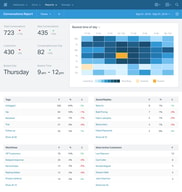
I like how you can create a separate Inbox for different channels like Support, Tech Support, Sales for different emails. This way, you can collaborate with all Agents and assign the tickets. I also like Reports that show the 360-degree performance of my team and individuals.
You cannot manage to reply to social media messages efficiently. I also noticed some glitches in the iOS App. Those are the things I don't like.
We were looking for a tool that can manage our multiple channels in a single place to get reports to decide KPIs for all agents effectively. Using Help Scout, we overcome this challenge, and everyone in our team is happy with the product.
Help Scout is easy for our team to use, helps us provide better support to our customers quicker, and is a tool that we enjoy, not only one we're forced to use.
While we could do a little more with their API than we are right now, it would be nice to surface additional customer data on the conversation list itself without having to go into a conversation to see it.
Help Scout helps us provide excellent support to our customers, understand where our customers are at in their journey, and provides our customers a searchable knowledge base that integrates with our software product.
I like how all of my coworkers can work together on one email so that our customers can receive the best answer possible.
The only thing I do not like about Help Scout is sometimes emails received within help scout do not come in formatted correctly, but the email will be formatted correctly in other inboxes such as gmail and outlook.
We are solving the problem of answering customers in a more timely manner due to all associates having access to all of the customer support inboxes.
The best shared inbox software we have used. Makes customer service easy.
I can't think of anything I would like to see differently.
Shared email
The ability to customize almost everything. The free beacon and knowledge base is my favorite. It lets my customers communicate live with the team and answer their own questions.
Nothing! I cannot think of anything I would change about the platform or the support services.
Helpscout helped us migrate multiple mailboxes, create a site bot for live chat/communications, and allowed us to have an easily Integrable knowledge base.
Holiday playlist, virgin Piña coladas, and historical references. Great job.
The OK rating is not really ok, it makes the general score lover and it should be neutral or just leave great and bad. Really too many questions here to add a great review. have not really read at the end
Customer service. The program is great.
Email management is a breeze with the ability to set-up workflows, assign team members, and observe a variety of metrics about how work gets done by the team and team members. The support is my favorite part. Any tool this complex that can serve a variety of businesses needs means you will inevitably need support. I've thrown all manner of questions at the Help Scouts Staff. Due to my technical background, I can get just technical enough to confuse myself and I've certainly over-explained myself in an email to them. They are able to decipher my madness and usually provide three or more options while welcoming more of my madness. Their customer service is 2nd to None.
The search tool is the "if I have to complain about something..." option. An update implemented about 3-6 months ago (COVID 19-TIME-WARP POSSIBLE) made the search feature a great deal faster, reliable, and accurate. It still has difficulty with more complex searches with generic search criteria, but I do not envy the task of filtering through the massive amount of information for phrases like "product return" that can match a multitude of emails.
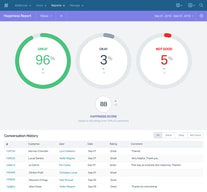
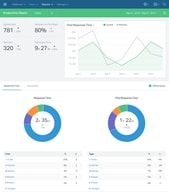
Finding inefficiencies is the biggest benefit. Whether it is an unnecessary number of email replies or discovering where an employee is struggling, the metrics are beyond beneficial. I've been able to discover where an agent's knowledge gaps exist based upon the amount of time between them opening and closing an email or how many replies they've sent. The happiness scores also allow us to fine-tune some emails that are technically flawless but require greater consideration of a customer's interpretation. Also, being able to quickly route, tag, note, and forward emails based upon specific criteria through workflows means I have time to manage, lead, and train my team instead of the work! After all, isn't that what we want SkyNet to do?
Multi-functional tool that has all the features needed to build an Operations team. Simple to use and user-friendly enough that our off shore Ops team in India can use it daily to complete tasks & stay connected.
- Email formatting - Formatting for text
- Emails/Communication - Using separate/multiple tools - Metrics/Reporting - Organization - Wiki articles
Very well designed, keeping all the key features very simple to understand and accessible. Easy to train team members to use it. Also the account manager at HS is very helpful with onboarding training and etc process.
Polish: Still need to make a few enhancements that all pages and forms are mobile optimized. For example, once the customer click on a feedback link, that landing page is not mobile optimized. Also, the iOS app should have more features like edit Subject Line, Customer Info, etc.
Implement a help ticket system beyond email. HS does exactly that. It improves our internal efficiency and external customer support effect.
Help Scout allows us to help solve issues with our users quickly and efficiently via email and chat support, and the widget which we've embedded both in the signup process of our app for patients and inside of our clinic staff web portal. We use the Knowledge Base feature as well and have made two separate knowledge bases – one for patients and one for clinic staff. We use them to onboard new clinic users and as a self-help option for both clinic staff and patients. I personally find the reporting feature in Help Scout useful. The happiness report is a great feature for boosting morale among the customer service team because we can see user feedback and ratings on our support (which is always good, thankfully!).
I honestly can't think of anything I dislike about using Help Scout.
Before using Help Scout, we were just using Gmail for user support and it was difficult to keep track of the progress of each query. Now that we're using Help Scout, we have several automated rules set that sort the queries into different categories such as patient, clinic staff, which clinic they're from, and the kind of issue they're facing. We also have some custom workflows where we can sort emails into patient and clinic feature requests and improvement suggestions for our platform, which is helpful from a product management perspective. Help Scout has also been our first attempt at having user help centres (knowledge bases), which have been helpful in training new clinic staff as well as giving somewhere for patients to learn about the features of the app.
Helpscout is not only a company that consistently surprises us by having a solution to our needs, but they are an inspiration in the way they run their own business. From customer service skills, remote work or even email templates, we gain so much from this relationship.
Android app doesn't yet include helpdesk articles. Wish conversation editor had a few more styling options.
Helpscout reduces support requests, helps us handle the ones we get efficiently and even helps us sell the product. We've saved tons of time, delighted our customers and gained insights on how to improve.
I love that you get so much included in the price but also the products offered are of high quality and an asset to the business - knowledge base, live chat with beacons, the email management system itself, plus all the ways you can organize and sort your incoming messages.
Some features are still being developed (and the team lets you know this), which would make the flow easier, but this is seriously nitpicking considering updates are added all the time.
We've expanded to live chat, we've grown a public Knowledge Base (self-solving problems - yasss), and we have started automated responses to help members better resolve their problems and connect faster. We've also realized how useful having team members and pooled emails can be to expediting work - traffic cop helps us prevent double-replying, which was an issue with our Gmail inbox. Basically, we're on a whole other level!
The interface is clean and easy to use. The hot keys make responding and closing quick and easy.
Would like a better way to see the full list of tickets from someone without having to toggle completely out of the inbox into search.
We are answering emails to an info@ inbox and so we see a lot of emails with questions and also problems. Help Scout makes it so easy to categorize the wide range of issues into different groups for easy assigning.
The saved replies feature is my favorite feature.
I dislike that when I forward a message to another address the message reappears in my inbox as active.
I am solving the problem of having too much volume to get through by using saved replies to answer questions that are most popular.
Helpscout offers a beautifully simplistic UI that takes most users 10 minutes to master. With the help of a couple of integrations all of our inbound communications (email, text, voicemail, Facebook, WhatsApp) seamlessly appear as tickets for our customer care team to process. Transferring to the relatively recent addition of native live chat was a no-brainer of a decision... in-fact, I'd be hard pressed to think of a time we wouldn't adopt any new additions HelpScout bring... they are simply that good. As our business has grown it has been invaluable to be using a service that is so easily scalable (add a new user in less than 5 minutes). And, if something does not go quite right, you'll be pleased to know that they practice as they preach - their customer service is second to none.
Nothing... no, honestly. Even the cost is reasonable - we have 100% confidence that we are using a (THE) leader in the class.
Before using Helpscout our customer care team would have 4/5 open browser tabs to effectively complete their day-to-day tasks. This is now just 2. Combined with the mobile App we have the confidence that we ready for any challenge.
Keeps track of old emails from customers in one spot.
Maybe a better spam filter that starts to recognize spam better.
Keeps track of older messages that can get lost in the shuffle of email.
The flexibility and all-round functionality. HelpScout has done everything we wanted and more. As a help desk it is incredibly versatile. Their beacon is cleverly thought out and easily customizable. I found the integration with Hubspot particularly useful. Plus their support team has been beyond excellent at answering my numerous queries.
When you use the docs, you need to set up a page using CSS. It's a little frustrating that there is no visual builder. But it's such a minor detail I wouldn't let it deter you away.
We can track our conversations, create saved responses, have an internal helpdesk, learn what customers are most searching for in chat, execute automated workflows to separate and tag our various audiences, and generally save oodles of time.
The product was designed with a specific workflow in mind, and while that may feel restricting to those who need an immense amount of customization, it "just works" if you buy into the philosophy.
I wish there was a better way to view a customer/organization to see the overall health and other parameters that might help understand specific trends in support. There are reports, tags and searches, but they don't give the overview in a way that is smooth and digestible.
Help Scout has enabled our team to move from prototype to effectively supporting hundreds of users across multiple products. It was so effective that we also shifted our hiring process to move to Help Scout as well.
We've been with Help Scout for three years and it's great to see how they've developed during that time. Not only have their products improved, but it's great to see their approach to doing business in a meaningful way come more to the forefront over time. A company whose products match our needs exactly and whose values are those of a company we can be proud to partner with.
Nothing at all. Just using up all my required characters here.
Great customer ticketing system. Great chat. Easily solve tickets across multiple teams.
Help Scout makes teamwork a breeze. It's easy for team members to work together and seamlessly pick up where another has left off.
Complaining about Help Scout is like complaining that you don't like the color of the car you won in a contest: you still won the car! Anytime I've ever had a complaint about Help Scout, they've fixed it in a future update.
Rather than have their own individual inboxes, Help Scout provides shared inboxes for each of my employees. If one is sick, out of the office, or otherwise busy, it only takes a moment for another employee to get the full history of a conversation and pick up right where the previous employee left off. Such easy collaboration is only the beginning. Helpscout is easy to set up and start running and those benefits are immediately apparent. After having used it for years, I can attest to the other strengths of Help Scout: Teams: set up and manage teams inside of Help Scout. Don't have just one person that can handle a situation, but instead a group? Assign it to all of them at once. Folders: Quickly organize folders of information or tickets in your inbox Workflows: Create basic automations that go hand-in-hand with teams and folders. Automatically tag emails based on certain keywords, funnel to the proper teams, create follow-up systems, and more. We've used our workflows extensively to track customer issues so we can stay on top of an issue and check in with the customer after it's complete. Saved Replies: With just a few clicks, send a well-worded reply to a customer with automatically populated data. Saves enormous amounts of time. Extensive metrics and reporting: In conjunction with our own internal reporting, Help Scout helped us realize years ago that we were missing high sales times when we needed to have representatives available to help customers. Docs, Beacon, and More: Help Scout provides a wide arrange of other tools: Docs to help provide data to users, either internally or externally; Beacon to help chat with customers, provided targeted replies, and more; Integrations with other software to improve the flow of information; and so much more.
How can you pick? We don't usually review software on this site, but we liked Help Scout so much that we wanted to share. We have tried a lot of different Help Desk apps, and Help Scout is our favorite by far.
They don't have any social media integrations, so you have to roll your own solution for that. If you want to use Beacon, you need to be using their docs solution, which are a little sterile looking compared to our homegrown documentation.
Human interaction is the most important thing about support. Help Scout doesn't bog us down with metrics and KPIs - it lets us have human interactions with our users.