

Unclaimed: Are you working at Sanity?






Sanity Reviews: 4.7/5 — Highly Rated
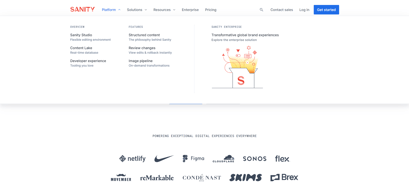
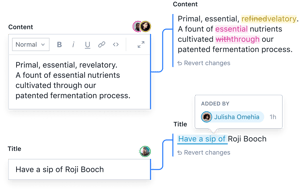
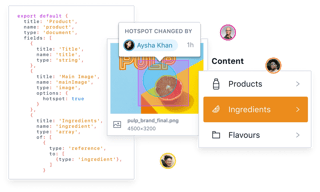
Sanity is a Composable Content Cloud that lets teams create amazing digital experiences at scale. It provides real-time collaboration, live multi-user editing, and track changes. Content creators, designers, and developers can come together while separating content from presentation

| Capabilities |
API
CLI
OSS
|
|---|---|
| Segment |
Small Business
Mid Market
Enterprise
|
| Deployment | Cloud / SaaS / Web-Based |
| Support | 24/7 (Live rep), Chat, Email/Help Desk, FAQs/Forum, Knowledge Base, Phone Support |
| Training | Documentation |
| Languages | English |
Compare Sanity with other popular tools in the same category.

The flexibility and customization provided. The separation of concerns between content and marketing channels.
The content, while stored in a portable text format, is really only accessible through sanity, the content is also not self-hostable, it's entirely hosted through sanitys cdn.
Easy to use backend for non-technical staff while still satisfying developers.

I like that I can build out my studio myself and deploy it.
Documentation is lacking in what I consider "common" use-cases like pagination. Furthermore, only having three people on the free tier that aren't admin kind of sucks, and the next tier up is PRICY.
Not really any "problems" that I am solving with Sanity; I am just using it for my CMS.
Truyly powerful CMS that can be customised to suit different organisational needs. An intuitive CMS that a wide range of staff with varying technical know how can pick up.
The amount of time and effort required to set up the backend properly.
Allow modules to be designed in a custom way, and website content to be editable by many people in one place.
It's intuitive, clean, and professional-looking.
It takes a second to get used to, adoption was a little slow at first.
We needed an internal CMS to easy publish articles from our newsletter to our website.
Flexibility. Ease of development - using standard Javascript and Typescript Good community and support
Documentation could be a little better Can slow down a bit with large datasets
We rebuilt both our legacy websites using Sanity as the CMS. It allowed us the flexibility to add any new feature we could imagine without too much fuss.

The ease of setting up Sanity as a developer has to be one of my favorite things. And that also makes it very customizable and resuable. That allows for the customer to implement and create websites which are highly tailored for their needs.
Although their documentation is very good, i feel like their support could be better.
We chose Sanity because it helps us solve our CMS needs and managing web content for both us and our clients.
Sanity is super easy to get set up, Studio looks great with pretty much no config, the CMS can do pretty much anything you'd want a CMS to do.
There are a couple of things I find questionable about the dev experience when working with Sanity Studio, including: - Typescript support is still not great. Instead of using best-practice type declarations for your fields, e.g. being allowed to code something like `const myDocument: SanityDocument = {[document fields here]}, the best we can do is use the `defineType` helper function, which barely helps out with auto-complete and all of the VS Code IDE integrations which are honestly one of the biggest benefits of using Typescript in the first place. - Tight coupling between different parts of the code in the form of specifying relationships between fields / documents using *strings* instead of actual variable references—this makes it difficult to keep code DRY and easy to change - Lots of weirdness when it comes to setting up environment variables, with different behaviors for different sanity environments. E.g. when the studio instance is set up to be in a "production" environment, certain environment variables get inserted via global string search and replace. This causes headaches when debugging environment variables when e.g. working with setting up CI/CD. - Sanity isn't great at naming things. Most components have multiple "official" names from Sanity, which makes it really hard to keep track of things and understand their differences. See the graphic at this link: https://www.sanity.io/docs/schemas-and-forms#b997982b2053, where every single component in that diagram has two different names. The docs also aren't crystal clear on a couple of choice points, e.g. what the differences are between the almost-identical "defineType" and "defineField" are, and names like "StructureBuilder" and "documentNodeResolver" are not at all understandable without going through the docs. There are better names for all of these, and I wish sanity would have taken the opportunity to get a fresh start when they made the huge changes between V2 and V3.
Sanity helps our non-tech business people make changes on the website without engineering help.
I like its flexibility and opportunity for improvements. Its easy to navigate, has great customer support and is frequently used by a lot of people in our team.
The Media Library limitations. How difficult it can be to enable change, and requiring a developer to build custom elements. It doesn't allow for me to build much, without developers.
Sanity is yet to be implemented correctly, but will allow us to have a Headless CMS.
I love how I can have live previews of the website as content updates are being completed in the CMS.
Sometimes it takes multiple clicks to get to where I need to be. It would be great to have an expanded view of all of the fields.
Live preview during content input.

After switching from Contentful to Sanity.io, I can confidently say that the move was a game-changer. The key differentiator? Sanity.io's unparalleled schema flexibility. Sanity.io's intuitive interface and customizable content models allowed me to effortlessly adapt the system to my specific needs. The platform's structured content model not only streamlined content creation but also provided the flexibility to build dynamic applications with interconnected data – a level of versatility that Contentful couldn't match.
One downside of Sanity.io is that the documentation could benefit from more extensive schema examples to further assist users in mastering the platform's flexibility. Also, it's not really a downside. GROQ query is something you need to learn to query Sanity data. If they used something already existing on the market for fetching data, it would be easier for the newcomers to onboard.
Decopling data from the webapp logic, while making it easy to modify data.
Pretty much a perfect solution to admin your data. Having ability to tweak and customize studio without any issue is a huge plus. Most importantly is a groq language which is so convinient and ease to use that I hardly want to go back to my old setup. Using Sanity with Next JS and so far so good.
Not good performance of the studio. It's understandable that studio data loads all content every time you open it page, but it takes 2-3 seconds each transition which can be anoing. And the most frustrating thing is manual dereferincing each asset and document. You requested a data? You probably need a data right? No, we have somthing better! Here is a reference to what you need :(
Remove worrying about setuping custom server and content management

With the page builder pattern and a little bit of training for your client, you can give them the power to customise their website ongoing
Organising content types is a bit of a pain
Headless cms
The user experience for the end-user is completely customisable, allowing me to cater it to different clients. Integration into many modern front-end web platforms is extremely simple with full control over dataset.
I wish there was a way of being able to see where resources are being utilised, such as being able to see common requests that are utilising heavy amounts of API requests, or storage files which occupy the most space. This would make it much easier to supply better observability to clients' websites about their usage, and reduce cloud costs.
It forces a very data-centic approach to thinking about how your content should be organised, which provides a lot of flexibility when it comes to implementing it into other systems.
I appreciate Sanitys flexibility and defining schemas in Typescript. Overall the experience has just been really smooth and streamlined, but still allowing enabling extra features through the plugin library or by writing your own.
There is some weird issues with Sanity sending duplicate items in an array, or extra null values etc. in arrays. So I definedly recommend doing a sanity check for your Sanity data with Typebox or some other library after downloading it.
We are using Sanity to provide educational material for our users and to create a guided learning journey throughout our application. It allows our health professionals to directly modify content in our application without the hazzle of going through coders first.
I like how easy it is to model content and data structures with the Sanity Studio editor and schema. I've been able to develop content types and add related documents which are easy to query using the GROQ query language. You can also use the API to access these data documents and add any transformations you might need.
The schema format is something you have to write and can take some time to learn. While this isn't necessarily a difficult learning curve, it can take some time to ramp up.
I've mostly been setting up landing page regions to be dynamically editable. I've also had success with a form builder interface that supports multiple steps and form field types.
Simple Uiser interface and the compatibility of integeration with other front end techs. Moreover the documentations. Hatsoff for that. The query language that has been used by Sanity is a excellent option for me.
As a developer I use the sanity for backend purpose , I have been using Sanity for past several months. I found implementing slug or redirecting inner pages in pure HTML CSS became a bit hard.
As a front end developer I am facing a lots and lots of issue regarding the backend area and I am not into the backend techs . But Sanity helped me to get rid of that issue.
I like the very huge options of customizations and the incredible user experience and learning curve that is soft.
It's diffucult to say something to improve, it's a very nice tool.
It's a difficult task to enrich media content from Spotify, but with Sanity we can do that with minimal effort and allowing an interface where content manager can handle with.
The most valuable part of Sanity is the flexibility to control your content and shape it to your business requirements. We've used Stapi before, and Sanity is much more powerful and easier for both our developers and non-digital team members.
Although Sanity is powerful, the editing workspace's UX could be prettier. I find that the dark mode is a little bit too dark for my preferences. The API webhooks are nice, but I would like to see a log of when they are triggered.
Sanity is a great CMS system that allows different teams (Development and Digital content team) to work asynchronously so there are fewer blockers in our pipeline.
Sanity CMS boasts an intuitive and well-designed user interface that makes content management a breeze. The clean and modern interface allows for easy navigation and quick access to essential features. The dashboard provides a comprehensive overview of the content structure, making it simple to organize and manage large amounts of data. The drag-and-drop functionality for assets and rich text editing makes content creation a smooth process.
Sanity CMS offers both free and paid plans, with the latter providing additional features and resources. For small businesses or individuals on a tight budget, the cost of the paid plans may be a consideration. The pricing structure of Sanity CMS might not be as accessible for those with limited financial resources.
As an agency looking for headless soloutions and previously a mainly wordpress development agency it gives us far more flexibility and creativity and options for our pitches and ultimatley our clients
Easy to set up, customizable and works well with my tech stack!
Block editor could use an upgrade from a UI standpoint
Running a blog
I like that you can access the studio directly inside the localhost.
The client is not yet supported in the fetch of NextJS. You cant get decoupled requests with the client unless you use the http.
Right now, I can dynamically render components with Sanity.
It is more flexible and everything is on the hands of developer they can build cms as per their requirements..
documentation is kind of full of complexity it should be simple and clear...
Content for multilingual in my site to show different type of reviews and so on...
I love how you can customise and get the data you want in the structure you decide. It's amazing having contol over everyting in your own config. So many possibilities going forward!
For a beginner, it's tough. The desk tool is excellent but very difficult to customise to display the correct information in the right way for your content creators. A few more articles or help tutorials will resolve this, I believe. The current articles on the Sanity site show really great code but not what it generates at the front end. A big shout out to the Slack community for help with this issue I faced who made it easier to understand.
Abstracting away from WordPress as it is becoming expensive to customise our site through the third party we have been using. We are currently constrained on the number of pages; Sanity will hopefully solve this for us moving forward.
The ability to extend the csm functionalities by implementings custom react inputs
I would like the ability to connect to the sanity API from a client, introspect the sanity schema and autogenerate ts type definitions. I will use this types to implement a validation schema with zod, on a bulk updater tool that we are building!
We have the static content on sanity to use on our frontend and also the information of our shopify products

I am passionate about content architecture, and to be honest, when I first saw the Studio, my initial reaction was "ok...that's it?" Despite appreciating the minimalist and clean design, I wasn't immediately impressed. However, I soon realized that I was completely wrong. Once I familiarized myself with the product, my opinion changed. The product is very developer-oriented, and I appreciate how easy it is to set up content models. Additionally, the extensive customization options allow for a tailored experience for each customer. The Structure Builder is particularly impressive, allowing for seamless organization of content models into dedicated views. This is a feature I couldn't imagine using my current tools. The ability to extend the behavior of the Studio through plugins is remarkable. With the new version of the Studio, it is possible to integrate the application directly into your project (e.g. Next.js), which opens up new possibilities.
I do not have extensive experience with the product just yet, and I am unable to highlight specific aspects that I dislike. However, I believe that a better media manager out of the box would greatly benefit the product, even if there is already a plugin available for this purpose. A 'bulk action' feature would be useful for handling tasks such as archiving, deleting, or publishing multiple documents at once. Sometimes, I have found it challenging to find examples when trying more complex customizations. However, it's possible that this difficulty is specific to me and my personal experience.
Currently, I am using Sanity to experiment with its features, especially in the area of customizations/plugins. Without a doubt, the ease and freedom of creating models is something that has impressed me a lot. Additionally, the Portable Text feature is very powerful and goes beyond a simple WYSIWYG editor.

The content management worked like a charm with React and Netlify, and the schema creation was clear cut.
I'm still experimenting but so far so goid
Not having to add to hard code everything is always a bonus.

I like the way we can structure the content in sanity and it's having a great user experience and our client are using this and they are really happy to manage content in studio.
I part which I don't like about the sanity studio is there is not so much customization you can do with the studio. I remember I was working on the localization and I wanted to show a dropdown at the top of the header which should have the list of all the languages and content editor can select the language from the top and all the content should be filtered out based upon the language he picks but I didn't find any solution around this and in the end, I had to go with a different approach. That would be a great feature if sanity allows to create and filter all the content based upon the global value. We could use the global value to filter out the content and also for creating we can use the global value as initialValue for some fields. Kind of the context provider which can be set using hooks and context should be accessible at any place whether it's a schema or structure.
We are using sanity to build the small website in which the content is frequently adding and also before going live we can show the preview of the website based upon that content.

The UI of the CMS is really nice and its nice and easy to build page builders.
Groq and the querying. Surely you would be able to generate your querys as you write the schemas??
A reasonable priced headless CMS
It's easy to get up and running. The UI isn't littered with things I don't need and I get a pretty good experience managing my documents. The fact there is an API I can use with Node has made it easy for me to manipulate data locally and import/export to my dataset.
Sometimes the UI is a little "Clunky". It can take a moment for it to catch up with what you're doing. I often create my documents outside and paste them in for this reason. I also need to keep reminding myself to keep a data backup. I would hope if I wanted to migrate to another service, it wouldn't be too hard. But, this is a general CMS struggle.
It makes me think about the content I want to manage and the relationships between different types of content. The "Vision" plugin provides a great playground to get a good idea of your content and its relationships without poking around in the dark.

A super flexible tool with a future-proof mindset. Sanity changed how we think about content organisation and powered our approach to projects. The sanity team and the community is helpful and reactive (pun intended). The free plan is good enough to kickstart projects, which is a super green flag.
There aren't many downsides I can think of... If I had to pick something, I'd say that some of our clients and non-tech team members needed a little bit of a tour to use it well, but to be fair, that's really nitpicking.
Sanity helps us to work with a flexible approach to content organization. It's easy to set up and opens up many new possibilities regarding our content management.