

Unclaimed: Are you working at Adobe Lightroom?
Adobe Lightroom Reviews: 4.5/5 — Highly Rated
Designed specifically for photo editing, Adobe Lighting is one of the most popular tools in the market used by professional photographers. Similar to photoshop, it’s considered a gold standard in editing, with a host of pre-sets available to help transform images in minutes. The platform is straightforward, and easy to use and makes it very easy to edit images using sliders, gradient, and brush adjustment tools. The platform is customizable and comes with numerous intelligence features such as facial detection that helps organize images easily.

| Capabilities |
AI
API
|
|---|---|
| Segment |
Small Business
Mid Market
Enterprise
|
| Deployment | Cloud / SaaS / Web-Based, Desktop Mac, Desktop Windows, Mobile Android, Mobile iPad, Mobile iPhone |
| Support | 24/7 (Live rep), Chat, Email/Help Desk, FAQs/Forum, Knowledge Base, Phone Support |
| Training | Documentation |
| Languages | English |
Adobe Lightroom Pros and Cons
- Convenient, customizable, and easy to use environment
- Blurring and fixing tools
- Pre-sets and filters available
- Camera and lens-based corrections
- Brush and gradient adjustments
- Fewer options than Photoshop
- No layers and blending modes

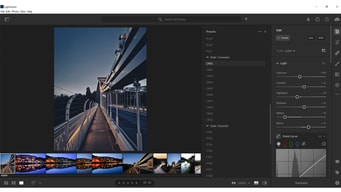






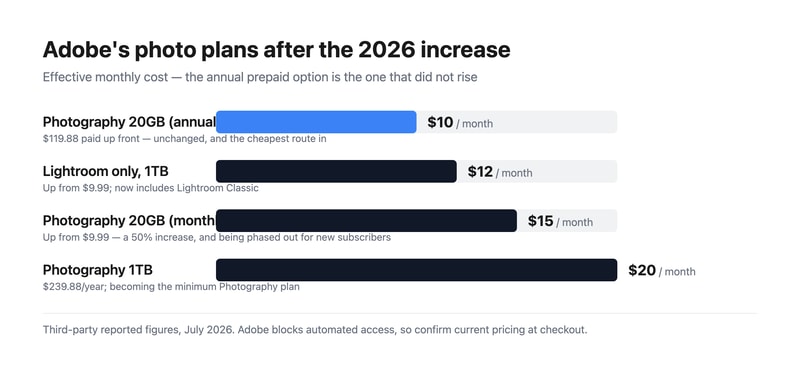
Adobe Lightroom remains the standard for photo editing and cataloguing, and Adobe just raised the monthly Photography Plan from $9.99 to $14.99 — a 50% increase. The annual prepaid option at $119.88 was not raised, which means the same plan now costs either $9.99 or $14.99 a month depending purely on how you choose to pay. That single detail is worth more to most readers than any feature comparison.
- What it is: Professional photo editing and cataloguing software built around non-destructive edits, presets, and library management.
- Best for: Photographers processing volume, where cataloguing and batch editing matter as much as the edits themselves.
- Pricing: Photography 20GB reported at $14.99/mo monthly or $119.88/year prepaid. Lightroom-only 1TB $11.99/mo. Photography 1TB $19.99/mo. Verified via third parties in July 2026.
- The honest catch: The cheap 20GB plan is being phased out for new subscribers, making the $19.99 1TB plan the effective entry point going forward.
What Is Adobe Lightroom?
Lightroom is two products sharing a name, and the distinction matters when you buy. Lightroom Classic is the desktop-first application built around a local catalogue, and it remains what most working photographers use. Lightroom (sometimes called Lightroom CC) is the cloud-native version that syncs across desktop, mobile, and web. Recent plan changes have blurred this: the Lightroom-only subscription now includes Lightroom Classic, which it previously did not.
The core proposition has not changed in years, because it does not need to. Lightroom handles non-destructive raw processing, meaning your original files are never altered and every adjustment is revocable indefinitely. Around that sits the catalogue — keywording, ratings, collections, and search across a library of hundreds of thousands of images — which is the part photographers find hardest to leave.
Its enduring advantage is batch work. Editing one photograph well is something many applications do. Applying a consistent treatment across four hundred photographs from a wedding, then finding a specific frame two years later, is where Lightroom’s design pays off and where the cheaper alternatives are still meaningfully behind.
How Lightroom Works
- Non-destructive editing. Adjustments are stored as instructions, leaving the original raw file untouched.
- Catalogue and keywording. The organizational layer, and the main reason long-term users stay.
- Presets and batch processing. Apply a look across hundreds of images, then refine individually.
- Masking and AI selection. Subject, sky, and object selection have improved substantially in recent releases.
- Cloud sync. Available on the cloud-native version, with storage as the metered dimension.
- Photoshop pairing. The Photography Plan bundles both, and round-tripping between them is seamless.
Adobe Lightroom Pricing
Adobe blocks automated access from our infrastructure, so figures are third-party reported for July 2026.
| Plan | Reported price | Storage | Includes |
|---|---|---|---|
| Photography (annual prepaid) | $119.88/year (~$9.99/mo) | 20 GB | Lightroom, Lightroom Classic, Photoshop |
| Lightroom single app | $11.99/mo (was $9.99) | 1 TB | Lightroom and Lightroom Classic |
| Photography (monthly) | $14.99/mo (was $9.99) | 20 GB | Lightroom, Lightroom Classic, Photoshop |
| Photography 1TB | $19.99/mo ($239.88/year) | 1 TB | Lightroom, Lightroom Classic, Photoshop |
What actually decides your cost:
- The billing term now matters more than the plan. The monthly Photography Plan rose 50% to $14.99 while the annual prepaid stayed at $119.88. Paying up front is roughly $60 a year cheaper for identical software. If you are going to use Lightroom for a year, prepaying is close to a free $60.
- The 20GB plan is being retired for new subscribers. The 1TB Photography Plan at $19.99 is becoming the minimum available. Existing subscribers on 20GB should think carefully before cancelling, because coming back may cost double.
- The Lightroom-only plan got better and more expensive. Up to $11.99 from $9.99, but it now includes Lightroom Classic and 1TB of storage. For a photographer who genuinely does not use Photoshop, this is a reasonable deal.
- Storage is the real upgrade trigger. 20GB is very little for raw files. Anyone shooting regularly and syncing to the cloud will exhaust it, which is precisely why the 1TB tiers exist.
- There is no perpetual licence. Stop paying and you lose editing access, though your original files and exported images remain yours. This remains the most-cited objection to the whole model.
Who Should Use Lightroom
- Photographers processing volume. The clearest case. Batch editing and cataloguing across thousands of images is what this software is uniquely good at.
- Anyone shooting raw. Raw processing quality and the non-destructive workflow are genuinely excellent.
- Photographers who also need Photoshop. The Photography Plan bundles both, which is far cheaper than the single-app Photoshop subscription alone.
- People with large existing catalogues. The switching cost is real, and the catalogue is usually why staying is the rational choice.
It fits poorly for casual photo editing, where free tools and phone applications are entirely sufficient; for anyone who objects to subscriptions on principle, since no perpetual licence exists; and for photographers wanting to own their software outright, where Skylum Luminar Neo and Corel PaintShop Pro offer one-off purchases.
Honest Pros and Cons
Strengths
- Best-in-class cataloguing. Nothing else manages a large photo library as well, and this is the real moat.
- Excellent raw processing. Consistently strong across camera systems.
- Genuinely powerful batch editing. Where the time savings actually come from.
- Photoshop included on the Photography Plan. Very good value if you need both.
- Strong AI masking. Subject and sky selection have improved markedly.
- Industry standard. Presets, tutorials, and workflows are built around it, which lowers the cost of learning.
Limitations
- A 50% increase on the monthly plan. From $9.99 to $14.99, which is a substantial rise for existing users caught on monthly billing.
- The cheap 20GB plan is being phased out. Pushing new subscribers toward $19.99.
- No perpetual licence. Access ends when payment does.
- 20GB is impractical for raw workflows. The entry storage tier is small enough to feel like a funnel.
- The Lightroom versus Lightroom Classic split confuses buyers. Two products, one name, different workflows.
- Lightroom Classic is resource-hungry. Large catalogues demand real hardware.
Adobe Lightroom Alternatives and How It Compares
- Skylum Luminar Neo is the leading subscription-free alternative, with strong AI editing and a one-off purchase option, though its cataloguing is weaker.
- Adobe Photoshop is the companion rather than the competitor — pixel-level work against Lightroom’s catalogue and raw processing.
- Adobe Photoshop Elements is Adobe’s buy-once option, though since the 2025 version it is a three-year term licence rather than a perpetual one.
- Corel PaintShop Pro and CorelDRAW Graphics Suite offer perpetual licences for editing and design respectively.
- Canva covers quick social and marketing edits, and is not a raw workflow tool at all.
- Capture One is the serious professional alternative, particularly favoured for tethered studio work and colour handling.
For a broader survey, browse our photo editing directory.
The Verdict
Lightroom is still the right answer for most photographers, and the reason is the catalogue rather than the editing. Plenty of applications process a raw file beautifully. Very few let you apply a consistent look to four hundred images, then locate one specific frame from three years ago by keyword in seconds. That capability compounds with library size, which is exactly why photographers who have used it for years rarely leave.
The pricing deserves clear-eyed attention this year. A 50% rise on the monthly Photography Plan, from $9.99 to $14.99, is a significant increase for a mature product. But the annual prepaid option held at $119.88, so the practical advice is simple and worth acting on: if you intend to use Lightroom for a year, prepay and save roughly $60 for identical software. Paying monthly is now the expensive choice for no benefit other than flexibility.
The strategic change is the retirement of the 20GB plan for new subscribers, which makes $19.99 the effective entry price going forward. If you are currently on a 20GB plan, that is a reason to keep it rather than cancel and return later. And if the subscription model itself is the objection, this is a good moment to look seriously at Luminar Neo — the gap in editing quality has narrowed considerably, even if the gap in cataloguing has not. Note that Adobe’s own Photoshop Elements is no longer a true escape from time-limited licensing: since the 2025 version it expires three years after activation.
FAQ
How much does Adobe Lightroom cost in 2026?
Reported figures put the Photography Plan with 20GB at $14.99 per month billed monthly, or $119.88 per year prepaid — an effective $9.99 a month. The Lightroom-only plan with 1TB is $11.99 monthly, and the Photography Plan with 1TB is $19.99 monthly or $239.88 annually. Adobe blocks automated access from our infrastructure, so confirm current pricing at checkout.
Did Adobe raise Lightroom’s price?
Yes. The monthly Photography Plan rose from $9.99 to $14.99, a 50% increase, and the Lightroom single-app plan rose from $9.99 to $11.99 while gaining Lightroom Classic and 1TB of storage. Notably, the annual prepaid Photography Plan stayed at $119.88, so prepaying for the year avoids the increase entirely and saves roughly $60 against monthly billing.
What is the difference between Lightroom and Lightroom Classic?
Lightroom Classic is the desktop-first application built around a local catalogue, and it is what most professional photographers use. Lightroom is the cloud-native version that syncs across desktop, mobile, and web. They share editing capabilities but differ substantially in workflow and file management. Recent plan changes mean the Lightroom-only subscription now includes Classic as well, which removes what used to be a common purchasing mistake.
Can I buy Lightroom outright instead of subscribing?
No. Adobe sells Lightroom only by subscription, and editing access ends when payment stops, although your original files and any exported images remain yours. If a perpetual licence matters, Skylum Luminar Neo and Corel PaintShop Pro are the leading alternatives. Adobe Photoshop Elements is a one-off purchase but no longer perpetual — since the 2025 version its licence expires three years after activation.
What is Lightroom best for?
Photographers working at volume who need cataloguing and batch editing as much as image adjustment — weddings, events, commercial shoots, and any workflow involving hundreds of raw files at a time. It is more than most casual users need, and its subscription-only model makes it a poor fit for anyone who edits occasionally or wants to own their software.

Compare Adobe Lightroom with other popular tools in the same category.
Lightroom does pretty much everything that a photographer could possibly need out of a software editing program. I have the ability to manipulate photos to my vision with ease. There are so many different features that allow me to create the look that I am going for. It is the only editing software I can ever see myself using as a photographer.
The only thing I ever disliked about Lightroom is that the clone stamping tool is not up to par with the one that Adobe has in Photoshop. For more complex spot removal, I always end up needing to open the photo into Photoshop to fix it. It would be nice if in the future they would upgrade their clone/heal tool to match the quality of the one existing in PS.
It helps me create the best possible photographs for my clients and the organizational abilities that exist in the software keep everything nice and neat for me when I need to go back and pull photos from past shoots for clients.
It’s a quick alternative if you don’t have the time for photoshop.
It is limiting with what you can do to edit a photo.
Not that many.
the one piece of go-to-software to be used for any photographer that works in projects and large batches of images. fully integrated with photoshop for additional editing
the way lightroom handles and 'stores' files could be more transparent, there are times that the organization of files/projects/folders gets cluttered up, there could be enhancements on this level (organization of multiple .lrcat projects in an easy viewable and accessible place
photography assets organization and management, as well as editing (with the integration of photoshop) and delivery of images to clients (exporting features)
very intuitive and easy to use interface with great editing options
slow on some platforms, photo rendering take a lot of cpu
delivery of photos

Lightroom provides an easy-to-use interface and a convenient library function allowing for non-destructive editing of RAW files. The cloud integration makes it easy to use across multiple devices with one integrated image catalog. The program provides extensive RAW editing and processing capabilities.
Compared to Lightroom Classic, the interface is somewhat less intuitive and some features are removed. While the cloud system is beneficial, for some use cases, the older Classic version is preferable.
Photoshop Lightroom helps me keep my image library organized and accessible from my laptop and desktop while preserving the original RAW files. The interface is efficient for processing large numbers of photos quickly. It makes my editing faster than using an editing-only program like Photoshop and I don't have to worry about keeping track of individual files. This makes me more organized and productive as a photographer.
That you can add depth and quality to pictures and videos without having to go through the hoops of photoshop
I really think it's overall a great product
Again, just optimizing things for marketing materials
Easy to find and use different features. Shortcuts are easy to use too. Options to use different file formats.
Use in mobile operating systems is difficult
Design and draft marketing/communication materials

What I like most is that it has tools that are specifically suited to working with photographs and it's very easy to learn compared to Photoshop or Indesign. When you edit a photograph, it's not destroyed but you can go back to any editing point without losing anything. It doesn't occupy much space on the hard disk and also allows you to organize your photos in a comfortable and functional way.
I like everything. I can say that I don't like the price, since Adobe products are usually expensive, but they're worth it if you work with design.
In my work I manage many images and I use different software according to the purpose I'm looking for. Photoshop Lightroom allows me not only to edit the photographs, but also to organize them, which speeds up and improves my work.
I like how quickly and easily I can edit photos within the tool and how it integrates with Photoshop for more complex edits.
I'm a little confused about the differences between Lightroom CC (cloud version) and classic and I hope Adobe merges the two while keeping the functionality of the desktop version.
Managing and editing photos. Allows enhancement of photos used in training content.
Once you get this software down. You cant imagine how you edited photos before lightroom. You can upload all of your photos into lightroom. And with simple short cut keys (Z -for keep photo or X for reject photo (on macs) and quickly go through all the photos and get rid of the bad ones and keep the good ones. After you do that just click the filter button and selected the rejected filter and select all of the bad photos and delete! Just like that. So simple. Plus when you are editing a large amount of photos, like several hundred (weddings, events, engagement shots) you can apply certain present/effects to the photos and copy and paste the same style onto the next photo. So you dont have to keep redoing the adjustments. All in all, incredible software for editing photos and saving lots of time. I dont know a better software. Unless you want to pay through the nose for it. Then I'm sure there are more expensive software out there but I havent used them. This is perfect for a photographer on any level.
Changing from classic to the new lightroom was hard. It was a completely different layout and many of my photgrpaher friends were upset about it. But once you get the hang of it, it's even better. So I cant say it's much of a complaint more of a learning curve that comes with all new software updates.
Saving time and money for me and the client. Something that used to take days to go through all of the photos now has shorten my time exponentially. It gives high quality edits for a reasonable price.
Lightroom is very easy to learn and contains the basics for those who only want them but also contains additional professional tools and functions to achieve a perfect level of photo editing.
A bit hard to learn at first for newer usuers. However, once learned the program becomes very familiar and recognizable.
Lightroom allows for the professional editing and presentation of our products to social media platforms, online messageboarss, and our website.
I love the ease of use for beginners like myself. You are able make any photo look professional! Also, it automatically syncs up to a cloud base you will never lose it.
There was not much that I disliked about it, however, it was difficult to use strictly just the mousepad on my MacBook to adjust the different settings. A mouse is needed for more precise editing.
This program has allowed me to make any photo look profession whether it is for advertising or personal reasons.
I love how easy it is to do edits in this program.
Nothing, I really like Adobe Lightroom.
Editing photos for marketing and advertising purposes.
Photoshop Lightroom has great presets to help get me started with my photo editing. Loading in new presets or creating my own presets is pretty easy as well!
I could have used more tutorials that would help me understand all the ins-and-outs of the program. I had to sort it out myself, which sometimes works to my advantage. But I could have learned a lot faster if I'd received some training.
We didn't have funds for a professional photographer, so as I implemented basic photography principles Photoshop Lightroom allowed me to edit photos with a professional look with my finished projects.
Ease of use for changing exposure, improving my photos.
I still need to go into photography for a few types of edits, but you can't beat lightroom for overall enhancements.
Exposure.
Lightroom makes photo editing simple and enjoyable! I look forward to transforming my photos with Lightroom every time I open the application.
Some features take awhile to learn how to use.
I use Lightroom to give photos a matching aesthetic to promote my company's service across social media platforms.
It transforms the picture without damaging resolution. It has tons of features to work with. A photographers best friend.
It’s a heavy software. It might slow down the computer or you might need a bit advanced machine for it.
I have used it to edit all my captures and three of them went to exhibition.
Generally Lightroom is easier to use than the full PhotoShop. I tend to use it when I need to edit quickly.
I wish there were more quick editing features. It requires several steps to do any editing at all.
It's great for quick photo editing. I handle a lot of book design and it's great for doing multiple photos at one time
The intuitive design of the application is flawless. I can edit pictures in a quick and easy fashion
There are not a lot of features like photoshop and Lightroom classic.
My clients from my photography business are getting photos at a high quality level that would be impossible without Lightroom
I love how user friendly and customizable they make the editing experience. I think that some people may feel overwhelmed by the extent of control you have over the post-processing, but I think it gives me freedom. There is nothing you can't do with your photos in lightroom. The HSL is where I spend most of my editing and I think it's amazing. I also love the brush tools. People underestimate how much a simple brush tool can total alter the look of a photo and I love that features so much.
I wish there was an easier way to work between lightroom and photoshop. I think there are times I would like to "layer" some of the edits. And there is no seamless way to work between the two and I think alot of other photogs would appreciate a link or workspace that allowed you to flow between the two for special effects and what not.
I use this program mainly for personal use, but I do use it for business sometimes. It makes batch editing an absolute dream. I take a lot of photos of our business and being able to edit similar lighting situations all at once rather than one by one is an incredible time saver and stress reliever.
Lightroom is my go-to tool for projects that don’t require complex pixel manipulation. It’s much easier to use and learn than photoshop, so it’s good for quick edits.
It’s not nearly as powerful as photoshop, so if you have complex edits it probably isn’t the right tool. There are less tools included making it good for mostly simple edits.
My team and I use Lightroom to quickly improve photos for both print and digital. It can completely change the vibe of the content we create.
Lightroom makes editing photos as easy as taking the pictures themselves. The intuitive interface makes it easy to jump right into the program with little to no training. The quality of the tools is fantastic and really allows you to get exactly what it is that you are looking for in a given shot.
There isn't much to dislike, other than the lack of tools for detailed retouching. The integration with photoshop solves this problem, however, so it isn't as much of a dislike as a minor annoyance to have to switch between programs. However, the integration is implemented flawlessly.
All of our photography needs.
I love that after I have already made an amazing photo that I can use presets to Basically mimic what I already did to a previous photo captured similarly.
The only thing I dislike about Lightroom CC is there is no red eye tool.
The benefits that Lightroom provides is that a business is more likely to have a color theme for their brand because Lightroom’s presets
I love the way you can organize and sort photos in Lightroom. After shooting a wedding and you have 2,000 pics, it's a godsend to have a way to check mark those you like and discard those you don't Also, the presets and ability to add some personal presets, makes continuity so easy!
I do wish there was a way to do more than just red eye as far as editing, it's nice to not always have to open up photoshop, but some little clone option would be nice, to keep from having to open up another program.
Lightroom helps bring organization to the many photos I take. It also makes it easy to share them with the staff that need them.
I like how the interface isn't overwhelmingly technical but can be used to accomplish highly detailed tasks if needed.
Well, gosh... I don't know if I've found much negative. Some of the editing tools aren't as robust as they are in Photoshop so at times I need to switch over to do one thing that Lightroom can't.
It is great for getting content graded, fixed, tweaked, etc, ... quickly and then out to the masses.
Lightroom takes care of all our photo editing needs without the confusing features of the classic Adobe Photoshop. The preset options were very convenient for beginners.
The mobile app is very limited compared to the desktop app. It would be nice to have full features on the mobile app as well so we can work from our iPads.
Helped us make quick edits to photos such as coloration, lighting, and so forth instantly. We used these images for advertising purposes.

I've been an Adobe Lightroom user since it was first announced in 2007. Before that, organizing digital photos had been a hit-and-miss collection of cataloging and editing tools. Lightroom integrated the catalog (asset management) feature and added many of the basic tools photographers needed for correcting images, without needing an external editor. In the last 12 years Lightroom has gotten more powerful and for a great majority of my images is all the image manipulation I ever use.
The recent split between the desktop version (Lightroom Classic CC) and the cloud-based version (Lightroom CC) is unnecessary for pros using the software. The online version does not offer the cataloging and categorization features needed to manage large libraries. Import of RAW photos could be faster.
Cataloging over 115,000 images, many used repeatedly, with excellent tagging and search capabilities. Included editing tools are almost always powerful enough to manipulate images for client output and review.
This is very easy to use for professional level photo editing done quickly.
Nothing to dislike, this program is fantastic.
Quick and easy photo editing.
I like to maintain control of how my photo files are organized on my disks and LR lets me keep that organization. I do like that I can move files/folders around in LR and it will make the change on my disk as well. Keyboard shortcuts make it incredibly easy to switch views in LR and apply ratings.
I wish you could choose to have your entire library uploaded and available via the cloud, even if just for viewing, so I could show my photos on a TV, computer or other smart device. You currently have to create a collection of photos, and then you can sync that collection with the cloud to do this. I'd prefer it to be a setting I choose to automatically sync my full catalog.
LR makes it easy for me to catalog my travel, landscape and family portrait photography, creating edits and applying keywording.
Program provides lots of editing capabilities and is easy to learn!
Nothing - it’s the ideal program short of needing to hop up to Photoshop capabilities.
Editing is a breeze and so quick with custom presets!