

Unclaimed: Are you working at Drip?






Drip Reviews: 4.4/5 — Solid Choice



| Capabilities |
API
|
|---|---|
| Segment |
Small Business
Mid Market
Enterprise
|
| Deployment | Cloud / SaaS / Web-Based |
| Support | 24/7 (Live rep), Chat, Email/Help Desk, FAQs/Forum, Knowledge Base, Phone Support |
| Training | Documentation |
| Languages | English |
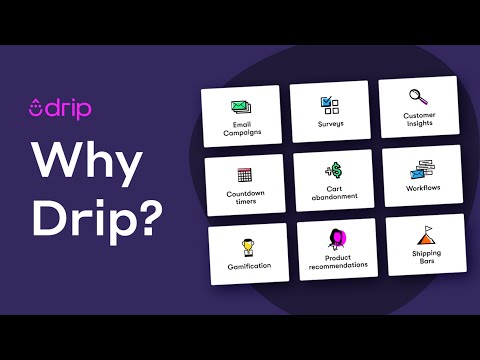
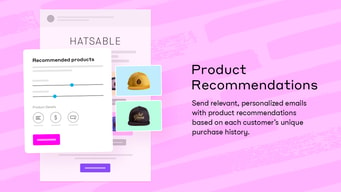
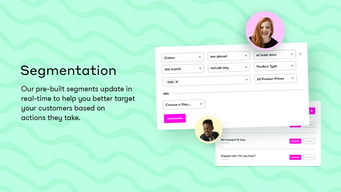
Drip has one plan. Not a cheap tier and an expensive tier — one plan, with every feature unlocked, priced solely by how many people are on your list. At 2,500 contacts that is $39 a month including unlimited email sends, 50 workflows, dynamic segments, onsite campaigns, and the API. In a category built on gating automation behind upgrades, that is a genuinely different structure and the main reason to consider it.
- What it is: An ecommerce-focused marketing automation platform combining email, onsite campaigns, and behavioural workflows.
- Best for: Ecommerce stores that want serious automation without decoding a feature matrix.
- Pricing: One plan scaling with list size. $39/month at 2,500 contacts, published to 100,000, custom above. Verified July 2026.
- The honest catch: There is no free tier at all — only a 14-day trial — and no cheap entry point for a small list.
What Is Drip?
Drip positions itself as ecommerce marketing automation rather than email marketing, and the distinction shows in what it prioritises: behavioural triggers based on what someone browsed or bought, onsite campaigns like popups and forms, revenue attribution per workflow, and a visual builder designed around purchase behaviour rather than newsletter sends.
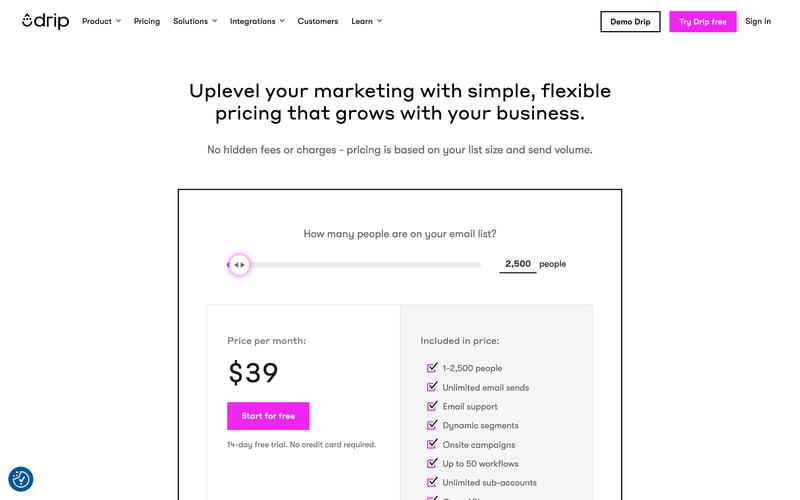
The pricing model follows from that focus. Rather than separating a basic tier from an automation tier, Drip gives everyone everything and charges by list size. Its own page states it plainly: no hidden fees, pricing based on list size and send volume. For a store owner who has been caught by a competitor’s “automation requires the next plan up” wall, that is an immediately legible proposition.
The trade-off is that there is no cheap way in. Where MailerLite and Kit offer free tiers and Brevo starts very low, Drip’s entry point is $39 with a 14-day trial and nothing beneath it.
How Drip Works
- One plan, priced by list size. No tiers, no feature gates, no upgrade path to decode.
- Unlimited email sends at any list size, so frequency costs nothing.
- Up to 50 workflows included, which is generous for a mid-market store.
- Onsite campaigns. Popups, forms, and on-site behaviour capture rather than email alone.
- Behavioural triggers and revenue tracking. Automations driven by browse and purchase data, with revenue attributed per workflow.
- Unlimited sub-accounts and an open API, included at every list size.
Drip Pricing
Captured from Drip’s pricing page in July 2026. The page uses a slider rather than published tiers.
| List size | Price | Included |
|---|---|---|
| Up to 2,500 | $39/month | Unlimited sends, dynamic segments, onsite campaigns, 50 workflows, sub-accounts, API |
| Above 2,500 | Scales with the slider | Same feature set at every size |
| Above 100,000 | Custom | Quoted |
What matters about this structure:
- You are choosing a list size, not a plan. Every feature is available at $39, which removes the most common failure in this category — discovering that the automation you bought the tool for sits two tiers up. Compare that to Constant Contact, where segmentation and automation are tier-gated, or Kit, whose free plan permits one automation.
- Unlimited sends means frequency is free. As with Zoho Campaigns, only list size costs money, so a store emailing several times a week is not penalised. That is the right shape for ecommerce, where triggered flows fire constantly.
- There is no free tier. A 14-day trial with up to 2,500 contacts, then $39. For a store with 300 subscribers testing the waters, that is a real barrier, and several competitors will let you start at nothing.
- $39 is not cheap for a small list. At 2,500 contacts you are paying roughly what Constant Contact charges at 5,000. The value case is the feature set, not the rate — if you will not use workflows, onsite campaigns, and revenue tracking, you are overpaying.
- 50 workflows is the one real ceiling. Generous for most stores, but worth checking if you run highly segmented flows.
- Pricing above 100,000 contacts is quoted. Published rates stop there.
Who Should Use Drip
- Ecommerce stores running triggered flows. The clearest case — abandoned cart, browse abandonment, post-purchase, win-back — where behavioural data drives the automation.
- Teams burned by feature gating. If you have paid for an email tool and then discovered automation costs more, Drip’s structure is the direct answer.
- Stores that email frequently. Unlimited sends make cadence free.
- Agencies managing multiple stores. Unlimited sub-accounts are included at every level.
It fits poorly for newsletters and content businesses, where Kit’s creator tooling and free tier suit better; for very small lists, where $39 with no free option is hard to justify; and for businesses needing only broadcast email, where MailerLite or Brevo cost a fraction.
Honest Pros and Cons
Strengths
- No feature gating whatsoever. Everything included at every list size — the standout characteristic.
- Unlimited email sends. Frequency costs nothing.
- Genuinely good ecommerce automation. Behavioural triggers and per-workflow revenue attribution.
- Onsite campaigns included. Popups and forms rather than email alone.
- Unlimited sub-accounts. Useful for agencies and multi-store operators.
- Simple to evaluate. One number to compare, which is rare here.
Limitations
- No free tier. A 14-day trial and then $39, where competitors offer permanent free plans.
- Expensive for small lists. $39 at 2,500 contacts is above the category norm on rate alone.
- 50-workflow ceiling. Generous, but a real limit for heavily segmented operations.
- Ecommerce-shaped. Less suited to publishers, creators, and B2B nurture.
- Pricing above 100,000 is quoted. No published figure at the top end.
- Trial limits sends, so a full evaluation of deliverability at volume is not possible in 14 days.
Drip Alternatives and How It Compares
- Klaviyo is the ecommerce market leader with deeper store integration and reporting, at higher cost as lists grow.
- Omnisend targets the same ecommerce automation market and offers a free tier.
- ActiveCampaign goes further on B2B and complex behavioural automation, with tier-gated features.
- Kit is the creator-focused alternative, free to 10,000 subscribers with commerce built in.
- MailerLite and Brevo are considerably cheaper for straightforward email.
- Zoho Campaigns shares the unlimited-send model at a much lower price, with weaker ecommerce automation.
For a broader survey, browse our marketing automation directory.
The Verdict
Drip’s pricing is the most honest structure in this category, and that is worth more than it sounds. Feature gating is the standard way email platforms extract upgrades — automation on the next tier, segmentation on the one above, a send cap to push you along — and it makes genuine comparison exhausting. Drip removes all of it. There is one plan, everything is in it, and the only variable is how many people you are emailing. If you have ever bought an email tool and then found the automation you needed behind a paywall, that structure alone justifies a look.
The cost of that simplicity is that there is no shallow end. At $39 for 2,500 contacts with no free tier and a 14-day trial, Drip is more expensive per subscriber than most of the category at small list sizes — you are paying for a full automation platform whether or not you use it. That makes the decision unusually clear-cut: if you will genuinely use behavioural workflows, onsite campaigns, and revenue attribution, the rate is fair and the absence of gating is a real advantage. If you mainly send broadcasts, MailerLite, Brevo, or Zoho Campaigns will do that for a fraction and you should not be here.
The fit question is ecommerce. Drip’s automation is built around browse and purchase behaviour, and its revenue tracking answers the question stores care about — which flow made money. For a Shopify or WooCommerce store running abandoned cart and post-purchase sequences, that focus is exactly right, and Klaviyo is the main comparison worth running. For a newsletter, a creator business, or B2B nurture, the same money buys a better-fitting tool elsewhere.
FAQ
How much does Drip cost?
Drip has a single plan priced by list size, starting at $39 per month for up to 2,500 contacts and scaling upward via a slider, with published rates to 100,000 subscribers and custom pricing above that. Every feature is included at every list size — unlimited email sends, dynamic segments, onsite campaigns, up to 50 workflows, unlimited sub-accounts, and API access. A 14-day free trial is available with no credit card required.
Does Drip have a free plan?
No. Drip offers a 14-day free trial covering up to 2,500 contacts with limited sends, but there is no free-forever tier. This is a meaningful difference from Kit, which is free to 10,000 subscribers, and from MailerLite and Omnisend, which both offer permanent free plans. For a very small list, Drip’s $39 entry point is a genuine barrier.
Does Drip gate features behind higher tiers?
No, and this is its defining characteristic. There is one plan, and automation, segmentation, onsite campaigns, workflows, sub-accounts, and API access are all included regardless of list size. Price changes only with the number of contacts. That removes the most common frustration in email marketing software, where the automation people actually want sits one or two tiers above the advertised price.
Is Drip better than Klaviyo?
They compete directly for ecommerce automation. Klaviyo has deeper store integration, more sophisticated reporting, and a larger ecosystem, and is generally the stronger product at scale — with costs that rise accordingly. Drip is simpler to evaluate and price, includes everything from the entry point, and suits stores that want capable automation without a complex plan structure. For larger stores Klaviyo usually wins; for mid-market stores wanting predictability, Drip is a legitimate choice.
What is Drip best for?
Ecommerce stores running behavioural automation — abandoned cart, browse abandonment, post-purchase, and win-back flows — that want every feature available without decoding a tier structure. Unlimited sends make frequent emailing free, and revenue attribution per workflow answers the question stores care about. It is a weaker fit for newsletters, creator businesses, very small lists, and anyone needing only broadcast email.

Compare Drip with other popular tools in the same category.
Ease of use and results. With their Automated Marketing system, we now send the right email, with the right message, at the right time to the right subscriber. It also helps us create synergies between the emails we are sending to our subscribers and the ads we are showing to our Social Media audiences. We immediately implement the Welcome On-boarding Campaigns (with a 60-day series of ±10 emails), Blueprint (Shareable) Automated Workflows & Rules (shopping cart & category abandonment, Facebook Lead Generations & Custom Audience integration, etc.) and initial Lead Scoring.
I ran into an issue with Drip and Shopify, where Spam email addresses were sneaking through. The staff at Drip had a solution at hand and that solved the issue.
Getting right email, with the right message, at the right time to the right subscriber. Automated email marketing is such a time saver! Converting abandoned shopping carts!

The ease with which I can create campaigns and broadcasts. The way everything is set up just makes sense. I love that they've recently added a workflow feature, so creating funnels gets even easier. I've contacted customer service a couple of times and they've always helped me really well - they're quick to reply and I actually feel like I'm talking to a human being instead of a computer. They really try and help you and are quick to come up with solutions.
It's a little hard to connect with some other apps, but most of the time I just use Zapier to connect Drip with whatever I want and that works really well. It's also hard to re-add an unsubscribed user when they've bought something with you, but customer service always helps me out with that.
I'm much more connected to my audience, I'm sending automated e-mail sequences, which saves me a lot of work. And I get a quick overview of my income and the way my e-mail marketing has contributed to that. It's also very easy to find loyal customers in the statistics - so I can target those specifically.

Drip's 'Shopper API' and deep integration with Shopify, WooCommerce and Magento is exceptional. It allows us to target any conceivable customer segment based on their shopping activity and geography. Their ROI reporting is outstanding.
There is very to dislike. The only area for improvement would be in improving formatting of emails in Outlook but that's largely a Microsoft issue and one that all email marketing tools have to deal with
Growing ecommerce customer life time value. Typically the cost of acquisition in ecommerce is very high. Drip allows us to maximize LTV by implementing automated and personalized growth campaigns.
I love how modern and easy to use Drip is. It integrates seamlessly with my shop.
Customer service is slower than I’d like.
I can create custom experiences for my customers and increase shop sales via email.
It’s easy to segment your audience and creat workflows
No app and the interface is not mobile responsive
Auto responding and issuing reminders and signups for a webinar
Everything in Drip is fairly intuitive and easy to follow. I love that I don't have to hire help to get small things done.
None to report right now. It does everything I need it to do.
Better follow-up with prospects and clients. Easy to kick off new marketing initiatives.
I like Drip's Custom Dynamic Content feature.
The support team was slow at times. Also if you use the live chat, you can't click away or you will lose your chat history and place in line.
Customer support is slow at times. Custom Dynamic content is great.

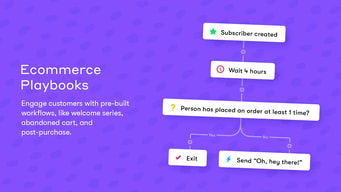
The visual workflows allow me to see the flow that the subscriber will go through. This makes it easier to think about a specific case or set of actions and know exactly what will happen next. Imagining this stuff is just too overwhelming, you need to see it.
The pricing tiers are pretty steep between levels. The difference between 2499 and 2500 subscriberes is almost double. That is not ideal for small businesses with smaller lists just starting out.
The automation rules and visual workflows allow you to have specific segmenting and to send very targted emails. This is something that MailChimp was not able to achieve. I needed something better. The improvements with allowing more split testing are also a huge benefit to figure out what your audience is interested and to get more click throughs in every email. Additionally, you can easily exclude subscribers by adding tags and recognize the path of actions that they have taken to have a very clear view of their journey
Their customer care team and reps always go above and beyond to help. They're constantly releasing updates and their dashboards are so user-friendly and are great for screen-shotting and sharing in presentations.
They integrate really well with some platforms, like Shopify, and not as great with others. The more use use their preferred integrations, the better it is.
Revenue attribution to email has been greatly simplified. We're growing our email list and keeping various types of subscribers engaged and moving toward purchase.
The format for typing emails and creating engaging messages that help convert is super easy to use and fun to get creative with.
Really nothing. It's low on tech-jargon so I can handle it. That would be the only thing, but it's not!
oh man, the best thing is that I can use drip to sell tickets to people in specific cities around the world. That's clutch. I can target a campaign for people only in X city to say, "hey, we're coming your way, buy a ticket!" I'm a musician, in case that helps to clarify.
It's easy to create automated workflows.
multiple accounts at times can be a bit a mess.
Great email writing and workflow creation. As well as client contact organisation.
I have always been a little skeptic when it comes to email marketing platforms similar to Drip however in just a few days I was hooked and building campaigns, browser abandonment campaigns, lead magnets, and post-experience follow-ups to gain more customer reviews about our business. Drip is a very reliable and user-friendly platform. With little background in email marketing platform experience I was concerned about whether or not I was going to be able fully utilize the software to maximize our return on investment and increase our sales. However, with a little bit of trial and error plus the help from internal FAQ and tutorials I was able to get a much better feel for the software. Over the past few months we have seen our funnels increase tremendously with more customers working their way through each of our campaigns and one-time broadcasts. The lead magnet was a great tool for us to increase our email database as well.
Up until this point I do not have anything that I dislike.
Our biggest problem Drip is solving is upselling our additional services available to customers that they may not be aware of at the time they book online. This has worked out very well from the beginning and we are starting to see more traction as more guests are entered into the funnel. I have been very happy with the way our reviews have increased tremendously from the email campaigns we have been sending after guests leave.
I use their support chat regularly. The support staff is fantastic and knowledgeable
I wish their native plugin for Woocommerce was better. We rely on a third-party tool
We use Drip as a repository for customer info and an amazing email platform.
The Platform is very successful at delivering emails to our intended audiences and has so many options to draft email campaigns and broadcasts.
The only thing I struggled with at first was figuring out how to use the tags, but I spoke with a rep and he walked me through everything. Now I totally understand and use tags daily.
I am solving the issue that most email campaign services struggle with, and it is that the emails always get sent to the audiences spam folder. with Drip.com, I got my IT team to ensure this won't happen and my delivery rate and click rate are through the roof.

First of all, Drip is easy to use and has a friendly interface. It has all of the bells and whistles but it's not overwhelming. I can also easily see the sales that came in that were both Drip attributed and non-Drip attributed, as Drip syncs seamlessly with all of the major e-commerce platforms (I use both Shopify and WooCommerce with Drip).
I would like to see a little integration with some WordPress tools, such as Thrive Themes (specifically Thrive Leads), which I used for my core sites. But there is a simple workaround that I use to capture Drip leads.
I'm building an engaged audience using Drip, and the options for automation and segmentation are second to none. I also love the ease of integration with Shopify and WooCommerce.

The visual nature of workflows makes it really easy to see the journey people will take.
The email builder (inclduing the visual builder) still lags behind Mailchimp and klaviyo. An upgraded email builder would, in my mind, put drip.com miles ahead of the competition.
We are an agency and we can easily manage access to clients' accounts. We manage multiple accounts with one login and we can build, monitor, and optimize complex automated workflows for clients. This has led to an increase in revenue for nearly every single one of our clients.
Focus on ecommerce for new features, revenue reporting, event-based automations, robust integrations
Lack of POS integrations, difficult to track offline conversions, can't store contacts without email addresses. no native SMS functionality
Sending messages at scale with, deep segmentation has been powerful. Paired with PieSync, I prefer to segment based on custom field data, which PieSync beautifully pushes back into Pipedrive and my other apps. I don't use it with this company for revenue objectives, at the moment, but plan to explore ways to monetize marketing automation in this role.

Drip has advanced functionality which is impressive. It’s easy to use and tech support has been fast and thorough.
I’d love more flexibly on campaign settings and how these relate to unsubscribes. So the first email can be transactional in a campaign and then it can switch to commercial.
Drip let’s me look after customers and potential customers with personalised communication which converts. AB testing is brilliant. Workflows And automations are so clever!
Easy to use user interface with dark mode, easy and visual automation builders.
Forms could have more functionality and tags should have an option to be organized as it can get messy with 100+ tags.
Drip is a great CRM for what we need at the moment. Integrates with all our tools for membership site and works great. It’s easy to use and fast.
The depth of automation but ease of use.
I haven't seen an easy way to send one off emails to a list.
Being able to automatically respond to users while building new lists is amazing. The compatibility with other software that I use to integrate is great.

The user-friendly interface is attractive and easy to use. It's simple to add new people and set up broadcasts.
The navigation is a little counter-intuitive. I also wish that lists of my People were by their first name and not email.
Managing my large list of social media followers who've opted into my email content. I book clients from messages sent to my Drip list!
Super easy to organise my contacts and communicate with them. Love the Shopify integration.
Chat support has gone for the lower level accounts.
Organising all my contacts and communicating with them effectively depending on what stage they are in their customer journey.
Customer management including adding emails (whether single addresses, a list of addresses, or a spreadsheet) is super easy and it tracks who's unsubscribed in the past, etc. If you accidentally delete one or more, they're not permanently blocked (this is why I left my last provider).
It took me a hot minute to realize that their terminology was different than what I was used to and I do wish there were more simple custom tools for setting up drip campaigns that would be relevant to our business.
I'm reaching my customers more and engaging with them more. They've been more responsive to surveys, specials, and more.
I love that Drip has so much capability and I love how it simplifies the funnel process with the straight-forward and easy to follow workflows and rules to connect things together.
Since Drip does have limits in its integrations, it can make doing some things more difficult. It would be really great, for example, if Drip had even more capabilities within integrations, such as specific PayPal purchases, and if it had more integrations.
I am helping writers overcome block and struggles with their work to not only complete books but publish successfully. This is so rewarding for me. Other benefits include automation for my business, customizing my audiences, and gaining new clients.
Drip is intuitive and easy to navigate even for less techy people like me.
I don't have any complaints at this time
Much easier targeted marketing
What a fantastic & powerful tool that's also user friendly at a competitive price. After trying several different providers I'm sticking with Drip.
I don't like the way they organise the 'people' with tags. I preferred adding people to different lists like in Mailchimp.
I use Shopify & thanks to the powerful Shopify integration I've cut my app costs & requirements.
I love how easy it is to create visually beautiful email campaigns and broadcasts, to target specific parts of my audience and assign tags to customers based on their activity. It has changed the game for our email marketing!
I haven't run into any downsides - so far so good.
It has changed the way we use email marketing. Before we were just kind of shooting in the dark, now we can specifically target certain customers based on their behaviors, products they've viewed, we can assign tags, see what email content interests them. It has increased the revenue we make from our email marketing.

With the automations and workflows available to me because of Drip, I make more money with my email campaigns than I ever have before.
There aren't that many email templates to use.
Building a relationship with my customers is easier than ever. I can easily segment and retarget customers based on their behavior with my emails AND with my Shopify store. I can easily give my customers what they want and need.
Love the easy interface and the way in which I can customise my EDM based on my customer's journey. I particularly like being able to have multiple sign up forms for one list (this lets me offer early access lists and multiple lead magnets).
I sometimes have trouble with customers not receiving emails but that is getting better.
Multiple sign up forms lets me offer lots of different lead magnets for my customers and further segment them based on their interests.
I like that I can get help by chat or email quickly.
I dislike that I can’t see all of my contacts on the screen (preview only).
I am a solo entrepreneur. Drip’s workflows save me hours of time every week.