

Unclaimed: Are you working at Drip?






Drip Reviews: 4.4/5 — Solid Choice



| Capabilities |
API
|
|---|---|
| Segment |
Small Business
Mid Market
Enterprise
|
| Deployment | Cloud / SaaS / Web-Based |
| Support | 24/7 (Live rep), Chat, Email/Help Desk, FAQs/Forum, Knowledge Base, Phone Support |
| Training | Documentation |
| Languages | English |
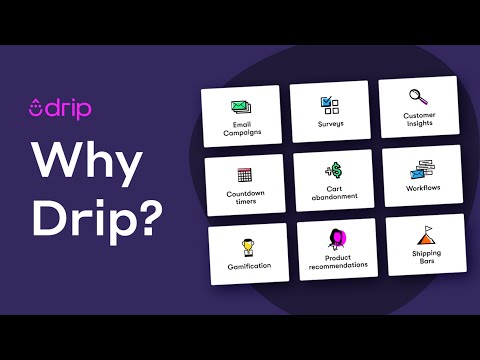

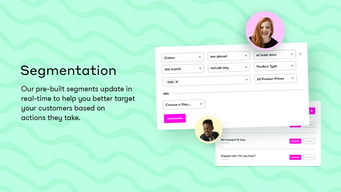
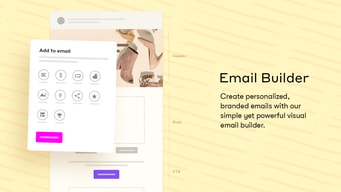
Drip has one plan. Not a cheap tier and an expensive tier — one plan, with every feature unlocked, priced solely by how many people are on your list. At 2,500 contacts that is $39 a month including unlimited email sends, 50 workflows, dynamic segments, onsite campaigns, and the API. In a category built on gating automation behind upgrades, that is a genuinely different structure and the main reason to consider it.
- What it is: An ecommerce-focused marketing automation platform combining email, onsite campaigns, and behavioural workflows.
- Best for: Ecommerce stores that want serious automation without decoding a feature matrix.
- Pricing: One plan scaling with list size. $39/month at 2,500 contacts, published to 100,000, custom above. Verified July 2026.
- The honest catch: There is no free tier at all — only a 14-day trial — and no cheap entry point for a small list.
What Is Drip?
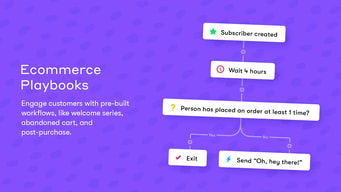
Drip positions itself as ecommerce marketing automation rather than email marketing, and the distinction shows in what it prioritises: behavioural triggers based on what someone browsed or bought, onsite campaigns like popups and forms, revenue attribution per workflow, and a visual builder designed around purchase behaviour rather than newsletter sends.
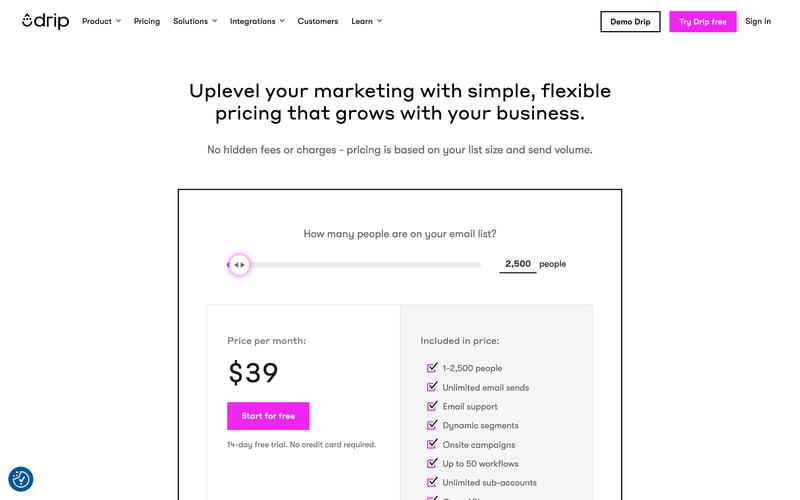
The pricing model follows from that focus. Rather than separating a basic tier from an automation tier, Drip gives everyone everything and charges by list size. Its own page states it plainly: no hidden fees, pricing based on list size and send volume. For a store owner who has been caught by a competitor’s “automation requires the next plan up” wall, that is an immediately legible proposition.
The trade-off is that there is no cheap way in. Where MailerLite and Kit offer free tiers and Brevo starts very low, Drip’s entry point is $39 with a 14-day trial and nothing beneath it.
How Drip Works
- One plan, priced by list size. No tiers, no feature gates, no upgrade path to decode.
- Unlimited email sends at any list size, so frequency costs nothing.
- Up to 50 workflows included, which is generous for a mid-market store.
- Onsite campaigns. Popups, forms, and on-site behaviour capture rather than email alone.
- Behavioural triggers and revenue tracking. Automations driven by browse and purchase data, with revenue attributed per workflow.
- Unlimited sub-accounts and an open API, included at every list size.
Drip Pricing
Captured from Drip’s pricing page in July 2026. The page uses a slider rather than published tiers.
| List size | Price | Included |
|---|---|---|
| Up to 2,500 | $39/month | Unlimited sends, dynamic segments, onsite campaigns, 50 workflows, sub-accounts, API |
| Above 2,500 | Scales with the slider | Same feature set at every size |
| Above 100,000 | Custom | Quoted |
What matters about this structure:
- You are choosing a list size, not a plan. Every feature is available at $39, which removes the most common failure in this category — discovering that the automation you bought the tool for sits two tiers up. Compare that to Constant Contact, where segmentation and automation are tier-gated, or Kit, whose free plan permits one automation.
- Unlimited sends means frequency is free. As with Zoho Campaigns, only list size costs money, so a store emailing several times a week is not penalised. That is the right shape for ecommerce, where triggered flows fire constantly.
- There is no free tier. A 14-day trial with up to 2,500 contacts, then $39. For a store with 300 subscribers testing the waters, that is a real barrier, and several competitors will let you start at nothing.
- $39 is not cheap for a small list. At 2,500 contacts you are paying roughly what Constant Contact charges at 5,000. The value case is the feature set, not the rate — if you will not use workflows, onsite campaigns, and revenue tracking, you are overpaying.
- 50 workflows is the one real ceiling. Generous for most stores, but worth checking if you run highly segmented flows.
- Pricing above 100,000 contacts is quoted. Published rates stop there.
Who Should Use Drip
- Ecommerce stores running triggered flows. The clearest case — abandoned cart, browse abandonment, post-purchase, win-back — where behavioural data drives the automation.
- Teams burned by feature gating. If you have paid for an email tool and then discovered automation costs more, Drip’s structure is the direct answer.
- Stores that email frequently. Unlimited sends make cadence free.
- Agencies managing multiple stores. Unlimited sub-accounts are included at every level.
It fits poorly for newsletters and content businesses, where Kit’s creator tooling and free tier suit better; for very small lists, where $39 with no free option is hard to justify; and for businesses needing only broadcast email, where MailerLite or Brevo cost a fraction.
Honest Pros and Cons
Strengths
- No feature gating whatsoever. Everything included at every list size — the standout characteristic.
- Unlimited email sends. Frequency costs nothing.
- Genuinely good ecommerce automation. Behavioural triggers and per-workflow revenue attribution.
- Onsite campaigns included. Popups and forms rather than email alone.
- Unlimited sub-accounts. Useful for agencies and multi-store operators.
- Simple to evaluate. One number to compare, which is rare here.
Limitations
- No free tier. A 14-day trial and then $39, where competitors offer permanent free plans.
- Expensive for small lists. $39 at 2,500 contacts is above the category norm on rate alone.
- 50-workflow ceiling. Generous, but a real limit for heavily segmented operations.
- Ecommerce-shaped. Less suited to publishers, creators, and B2B nurture.
- Pricing above 100,000 is quoted. No published figure at the top end.
- Trial limits sends, so a full evaluation of deliverability at volume is not possible in 14 days.
Drip Alternatives and How It Compares
- Klaviyo is the ecommerce market leader with deeper store integration and reporting, at higher cost as lists grow.
- Omnisend targets the same ecommerce automation market and offers a free tier.
- ActiveCampaign goes further on B2B and complex behavioural automation, with tier-gated features.
- Kit is the creator-focused alternative, free to 10,000 subscribers with commerce built in.
- MailerLite and Brevo are considerably cheaper for straightforward email.
- Zoho Campaigns shares the unlimited-send model at a much lower price, with weaker ecommerce automation.
For a broader survey, browse our marketing automation directory.
The Verdict
Drip’s pricing is the most honest structure in this category, and that is worth more than it sounds. Feature gating is the standard way email platforms extract upgrades — automation on the next tier, segmentation on the one above, a send cap to push you along — and it makes genuine comparison exhausting. Drip removes all of it. There is one plan, everything is in it, and the only variable is how many people you are emailing. If you have ever bought an email tool and then found the automation you needed behind a paywall, that structure alone justifies a look.
The cost of that simplicity is that there is no shallow end. At $39 for 2,500 contacts with no free tier and a 14-day trial, Drip is more expensive per subscriber than most of the category at small list sizes — you are paying for a full automation platform whether or not you use it. That makes the decision unusually clear-cut: if you will genuinely use behavioural workflows, onsite campaigns, and revenue attribution, the rate is fair and the absence of gating is a real advantage. If you mainly send broadcasts, MailerLite, Brevo, or Zoho Campaigns will do that for a fraction and you should not be here.
The fit question is ecommerce. Drip’s automation is built around browse and purchase behaviour, and its revenue tracking answers the question stores care about — which flow made money. For a Shopify or WooCommerce store running abandoned cart and post-purchase sequences, that focus is exactly right, and Klaviyo is the main comparison worth running. For a newsletter, a creator business, or B2B nurture, the same money buys a better-fitting tool elsewhere.
FAQ
How much does Drip cost?
Drip has a single plan priced by list size, starting at $39 per month for up to 2,500 contacts and scaling upward via a slider, with published rates to 100,000 subscribers and custom pricing above that. Every feature is included at every list size — unlimited email sends, dynamic segments, onsite campaigns, up to 50 workflows, unlimited sub-accounts, and API access. A 14-day free trial is available with no credit card required.
Does Drip have a free plan?
No. Drip offers a 14-day free trial covering up to 2,500 contacts with limited sends, but there is no free-forever tier. This is a meaningful difference from Kit, which is free to 10,000 subscribers, and from MailerLite and Omnisend, which both offer permanent free plans. For a very small list, Drip’s $39 entry point is a genuine barrier.
Does Drip gate features behind higher tiers?
No, and this is its defining characteristic. There is one plan, and automation, segmentation, onsite campaigns, workflows, sub-accounts, and API access are all included regardless of list size. Price changes only with the number of contacts. That removes the most common frustration in email marketing software, where the automation people actually want sits one or two tiers above the advertised price.
Is Drip better than Klaviyo?
They compete directly for ecommerce automation. Klaviyo has deeper store integration, more sophisticated reporting, and a larger ecosystem, and is generally the stronger product at scale — with costs that rise accordingly. Drip is simpler to evaluate and price, includes everything from the entry point, and suits stores that want capable automation without a complex plan structure. For larger stores Klaviyo usually wins; for mid-market stores wanting predictability, Drip is a legitimate choice.
What is Drip best for?
Ecommerce stores running behavioural automation — abandoned cart, browse abandonment, post-purchase, and win-back flows — that want every feature available without decoding a tier structure. Unlimited sends make frequent emailing free, and revenue attribution per workflow answers the question stores care about. It is a weaker fit for newsletters, creator businesses, very small lists, and anyone needing only broadcast email.

Compare Drip with other popular tools in the same category.
I love the workflow and visual campaign builder. Loved the support too. I'm not a newbie when it comes to email marketing and marketing automation software tools but at first I had some issues with the implementing proper tracking and the Javascript codes of Drip. After going back and forth with their support team, I was able to resolve the issues. They've answered all my questions quickly and helped me resolve the issues I was having. I was finally able to track visitors and get details of the actions they've taken on my website. I have integrated several 3rd party tools and the API works perfectly.
I wish that there was more integrations to some third party tools that I use like Thrivecart. Although Drip had Zapier integration, I can't integrate it into my shopping just yet. Hopefully this will be added soon.
I want to send targeted and engaging messages. But the challenge is that not all subscribers are created equally. The only way to know where they are in my sales funnel is to know the "actions" and "engagement" they've taken on my website. And Drip helped me track and solved that with their email marketing automation system.
The email segmeneting is one of its amazing and very helpful feature. The AI tools of it make you to easily compose and schedule the emails. Hence it includes a lot of layouts and templates for emailing and campaigning, which make the work less time consuming and producing the most effective and attractive advertising data. The integration and collaboration feature of it is very smooth and easy to perform for communicating and connecting with multiple applications and websites. The application provides large number of advanced technical features which make your work so intuitive and delight to implement and complete. Will help you to design and compose email for your work and business requirements. According to the working standard and workflow qaulity the price of the software is valuable and affordable for all, it is best working automated tool for small and medium sized organisations for making there work targetive. The thing that I liked about it was its free version which make the users to experience it fully for deciding weather to go for this software or not.
When successfully registered on this platform no email or confirmation notification is send via mail or others. The learning curve for new users is quite complex and not that much straightforeward than other software. Sometimes the bugs are also experienced which make the working of the platform quite unfortunate and slower.
For E-marketing it is the best tool, this has made me work so easily and being able to track all my campaigns an dmarketing stuff all at one place. The applications AI tools has made the work automated and faster. Easy and helping to generated and create best and good and professional looking templates designs.
Automation saves us a lot of time. Without it, we wouldn't have the number of leads and interest we have
1. The fact that when registering a user to a campaign it must send him an email 2. In automation, not possible to move elements (like actions, decisions...) around. So if I add a new decision point to a flow, I need to write all the elements below it again in the "yes" or "no" path instead of just moving it
Automation of leads generation and collecting information from users. Drip is the entry point to several flows we have that later integrate with other systems like Google Forms or our SaaS product

One of my favorite things about Drip is the email segmentation and tagging tools. Drip is the most accessible and intuitive software for us to create automated email sequences. The templates, ease of use, and integrations with all the other platforms and software we use to make it valuable to us. Customer service is friendly, competent, prompt, and responsive. I like how many things you can do if you are willing to invest the time and effort. Integration is easy with many shopping carts and other applications, and segmentation is very advanced. The way this segmentation works in conjunction with email workflows helps make it easy to create automated emails at every step of the checkout process. The email editor is straightforward, and templates give you enough to start. As a result, we have been able to automate an almost entirely manual process.
Learning how to set up funnels is not the most straightforward. However, especially if you are new to email marketing, Drip's support team and chat are elementary to use and will guide you through every step. They also offer video training and training webinars.
If you've used any email autoresponder systems in the past, you know that they can be very complicated and that getting the most out of the methods usually requires some behind-the-scenes hacking. Drips is a refreshing alternative! Drip integrates with just about everything and is easy to use. Drips is the marketing software I dreamed of when I started my job; it is the best email and marketing automation platform. I am a fan of marketing automation. Drip allows you to add just about any other type of marketing layer, like surveys, text massaging, and even Facebook integration, to name a few. Overall, it has been a game changer for our digital goods e-commerce business. Instead of just sending emails every couple of months to our entire audience, we can now send people through specific sequences of emails with relative ease. I have moved all my clients to Drip from 2 other platforms, and we are seeing better results. If you're considering email and marketing automation software for your business, check out Drip.

When it comes to setting up automation, Drip has so many features that it takes some time to get used to.
The worst aspect of this software is its price. They have some great features, but when we compare them to other software, The price could have been better.
Excellent integrations with ecommerce platforms such as Shopify, as well as pre-built automations for ecommerce stores. Drip allows you to automatically resend broadcasts to people who did not open their email the first time.
Being able to schedule emails ahead of time. Also being able to select customers based on our websites criteria. We can use the fancy templates or just make regular looking emails fairly easily.
It is hard to figure out sometimes. Especially when there are numerical values replacing name values. While their tech people are very friendly and helpful, unless you are very adventurous it is not necessarily intuitive.
Definitly an improvement over the whole mergemail business with Outlook. Being able to schedule for upcoming delivery notices or a newsletter with photos (which is very easy and tidy to do) It takes all sorts of problems off our plate. Especially if people want to unsubscribe it is painless for them and all sorted by drip at our end. So we only have to focus on what we want to say to people. They also offer extensive marketing tools for testing markets. We don't use these as our business is largely word of mouth or via website so we haven't explored these avenues yet. We are able to keep in touch with our customers easily and maintain our customer database easily as well

Ease to use and understand. Drag and drop flow chart. Relevant reporting
Deliverbilty issue Other channels are missing except email
Using drip campaigns for our business it worked well but didn't get the results

Drip's ability to segment consumers automatically is incredible if you sell various types of products and clients. When things changed for us, we migrated to Drip, but we also needed something substantial for our click and brick as our business grew. I appreciate that you can set up events depending on specific behaviors, such as when a subscriber visits a particular page on your website. The Facebook custom audience integration is convenient. It has helped us improve our social media targeting strategy.
The email builder is becoming better, but it still needs some work. One needs to mailbox test it because it won't save you from yourself. If you choose the "constrain image" box in some email clients, for example, the images will be skewed, therefore don't check that box!
Drip helped us solve issues we didn't even realize we had. For example, before a team member takes a leave of absence, we can use Drip to automate most of our social and email marketing, which means things won't be as unpleasant for the team. We couldn't do that before, and we'd have had to leave money on the table while they were out (we're a small business).

Easy to use, great reporting and follow up. Good customer support. Nice looking emails that's easy to modify and adjust. Very nice display on desktop and mobile devices. Monthly reporting email from Drip helps to keep us informed on how our marketing campaigns are performing. Drip is always adding features to the platform and they do a good job keeping you informed.
Takes a while to 'get' the workflows and use them efficiently. Learning curve for new employees can be time consuming.
We use Broadcast emails, Welcome Series emails and Shopping Cart Abandonment emails. We use the Shopify connector to connect our website with Drip. Pretty straight forward to connect and the form feature looks good.
I like the persistence of the Drip support team, especially from Alleli. She worked with my issue with careful dedication and investigation. Her attitude in solving the problem is worth mentioning here.
The support time zone. I'm based in GMT+7, and the Drip support team seems to me in the UTC time zone, and to get a response from them, it takes a little bit of time. I wish they could have a support team in GMT time zone, so the issue will be resolved much faster. Thank You.
Billing issue of my credit card and Drip auto monthly charge.
Designing an email template with drip is fantastic. We can create unique responsive HTML email templates using their Drag and Drop features. You don't need any HTML coding skills.
Drip pricings. It starts at $19 per month and goes up to $1500 for 100K subscribers. It becomes a little difficult for a small-scale business whose subscriber base is more.
Since I am not an HTML expert, but yes, I am still able to design beautiful responsive email templates using drip drag and drop features. We are using these email templates in our Email marketing campaigns. We can now easily create templates and use them in our automation programs.

There maintenance team and there innovations on product development
They should develop more case studies on real time usage
Hi realized automation of marketing and nurturing leads from drip. Makes me over come with additional resources for email marketer and lead nurturing team

The Drag and Drop feature for building email templates is excellent as compare to other tools. we can design email templates without any coding skill. They had more than 100+ prebuild mobile responsive email templates. It is an advance marketing automation tool where we can create customer journey in easy steps.
The only dislike about Drip is their Analytics and Report. They must introduce some advanced features to track audience activity
Excellent Email template builder. Easy to create customer journey and sequence mail.
With Drip, i have been able to relate well with clients, by sending automated outbound emails for marketing.
It's not possible to re edit workforce and its also hectic to connect with WooCommerce.
Email Marketing has improved sales in our entire organization. Workflow automation is another thing that I like too.

There are many features that I like about this software so I will proceed to list them: 1. I can handle large data, this is very good because our company is very large and wide. 2. The interface is amazing, it also has the dark mode that I think is great. 3. I can handle it in a very easy way. 4. It is very easy to handle the part of marketing by mail through this software, it is only two simple steps. 5. The workflow is very broad. 6. There is customization, it is a feature that I love because I like to give my projects my personal touch. 7. Integration with WooCommerce, it makes my work easier. 8. I can attach photos and prices to company projects through email marketing.
The only thing I don't like about Drip is that I can't re-edit the workflows and it's not fully synced with WooCommerce.
The company has had many benefits thanks to Drip, with its workflow function I can keep track of the information of all clients, I also use drip to remind my work team about the company projects that we have to complete. In addition, the sale of our products has been increasing thanks to the personalized emails we send through Drip and its synchronization with Shopify.
The drag-and-drop templates are very intuitive. I find it very easy to create marketing campaigns using Drip
Analytics take time to appear after an email is sent making reporting somehow difficult
With a click of a button we are able to reach more customers and keep them engaged with our sales team. We have cut printing and mailing costs.
Drip is an automated solution for creating visual email marketing campaigns, the power of this software is in its multiple drip functions such as automated workflows which has an automatic response generator that saves you a lot of time, targeted campaigns with which you can send specific emails to each of the subscribers so marketing campaigns are much faster. It has a lot of integrations with third parties and an interface that although not very artistic is very easy to understand
The image library is very scarce is not what you would expect from a software like Drip, it does not have many templates to create advertising emails, it needs the segmentation function is not very good and it does not have enough distribution options, the analysis follow-ups still require great improvements and the technical support takes a long time to generate a response
The problems we have solved with Drip are several started by the creation of visual email marketing campaigns since we were not very well integrated into this advertising model but we have found in Drip the necessary tools to succeed such as a visual application that has a visual workflow generator where the user can design in detail the path of the customer, targeted campaigns with which you can send mass emails to a specific group which increases the chances of making a sale
I love the way it works so well with my e-commerce site. I know exactly what I have earned from my store and how much of this has been attributed to drip funnels and broadcasts.
It took a while to get my head around it
Understanding the customer journey and having the clearest ever segment process of any CPM I've used.
Drip is a full-featured email tool. The power and features are unbelievable. And yet it's also simple to use. It is elegant and does exactly what you need.
The only negative with Drip is that it costs — but it's worth it considering what you get.
I was looking for a platform that I could use for email drip campaigns and email newsletters. Drip could do everything I wanted, and it seemed more elegant and easy to use than anything else I looked at.

I love the reporting - DRIP shows you dollars contributed from your mail campaign which gives you something measurable.
I wish it was more customizable without having to do HTML. Sometimes my campaign emails turn out weird with the way it is setup. Also DRIP can be quite complicated to setup
Problems solved are email campaigns that are shoppable . I love that
It’s automatic working behind the scenes
There is a glitch that just happened today in my abandoned cart workflow but thankfully my marketing consultant figured it out
More conversions to sales
I love how simple it is to visually create automated workflows.
It has been a little slow to add modern features such as a visual builder and native text messaging, but they eventually do, and they do it very well.
Drip helps me connect with leads, nourish them to become customers, and then strengthen the customer relationship in an automated way.
Excellent segmentation, tagging, workflows, and customization of individual emails. A pretty good visual builder (although I hope they continue to make improvements here).
Would love to see them add more CRM features and add more views into the customer journey. We are considering Drip for another big project right now, and the lack of robustness in the CRM department is a sticking point.
We use it as an automated email tool, especially around customer registrations. We are considering using it to scale a sales engine that would send around ~10,000 personalized emails a month.
Workflow automations are excellent for simple to complex automation Drip is easy and intuitive to use Great documentation and customer service The new dark mode is a great quality of life feature Designing emails is quick and easy, especially with templates Simple things like searchable form fields are everywhere, unlike some alternatives and competitors Using Drip feels quick and snappy; I'm never waiting for Drip to catch up to me
There's no way to add custom url parameters to links. It's restricted to only utm parameters (source, medium, campaign, and content) It's a little confusing that emails can be sent off as a "one off email" in a workflow or a campaign, which are separate from each other
Currently: Purchase confirmations and followups, relationship building We will definitely expand our use with the business!
Easy to manage email subscriber list and see activity
I find the dashboard a bit confusing but is easier as time goes one
Reaching customers with information about company products and industry news

The visual workflow builder is one of the best I have ever seen. It is easy to use and you can get used to in in minutes.
Drip is easy to start but has a longer learning curve to master. I still didn't mastered everything that could be done with it.
Full sync between our Wordpress WooCommerce store. I can see everything from a birds-eye view and can also go deep in data and personalization if needed. We build and add more and more automations as our business grows and this can be solved with Drip without writing code or involve a developer.
I liked all the amazing features drip has to offer in regards to email marketing and funnels.
I dont like some of the difficulties I have with integration. Also it is a little pricey.
I am able to grow my email list exponentially. I can also integrate with Shopify which is super helpful to make extra sales.
The email creator for Drip is great, very drag and drop and customizable. The automation and workflows are also excellent. Drip really helps you visualize testing campaigns what's happening in a customer's journey.
I wish Drip had better analytics. They allow you to export and give good overall statistics, but it's very lacking in regards to creating clusters and deeper analytics.
Creating workflows for customers to go down through. Plus Drip's templates for workflows (like the abandoned cart one) are very good.
I love that we can automate emails to market to our current customers who book online, or even submit their email on our website! Everything just happens! They are automatically added to a workflow and we receive reports each month showing how much our online bookings are increasing! We can track our revenue generated through Drip right on our dashboard.
The only downside is that we have 2 separate monthly subscription fees: 1 for Sunstone and 1 for Drip. But it isn't enough to turn us away!
With the FareHarbor integration from Sunstone Digital we have been able to set filters and flows that allow us to target and reach specific groups which we could not do previously through platforms such as MailChimp. We have also recently discovered the addition of Drip SMS, which we previously had to subscribe separately to SlickText. Looking forward to incorporating that.

I like the clean UI and analytics. It's very refreshing to see simplicity on my dashboard.
I dislike that there is no drag & drop feature for the Workflows.
Currently, I am able to send abandoned cart email campaigns & Win-Back campaigns and our e-commerce form widget is yielding good option results for us.