
Unclaimed: Are you working at HubSpot CRM?
HubSpot CRM Reviews — Pricing, Features & The Honest Take
Hubspot CRM was originally developed as marketing software, but it has since evolved to become an all-in-one platform that empowers businesses to automate, organize, and monitor every stage of internal interaction and customer engagement. The software also allows users to nurture customers by developing buyer personas and giving companies insight into unique pain points that they can address. Additionally, the software can also facilitate team visibility, conversion tracking, live chat, and chatbot workflows, streamline sales pipelines, and send customer satisfaction surveys.

| Capabilities |
AI
API
|
|---|---|
| Segment |
Small Business
Mid Market
Enterprise
|
| Deployment | Cloud / SaaS / Web-Based, Mobile Android, Mobile iPad, Mobile iPhone |
| Support | 24/7 (Live rep), Chat, Email/Help Desk, FAQs/Forum, Knowledge Base, Phone Support |
| Training | Documentation |
| Languages | English |
HubSpot CRM Pros and Cons
- HubSpot is a real all-in-one CRM solution
- It has great supplemental content
- You get email marketing support and social media scheduling features
- Offers a free version
- Squeaky-clean integration
- HubSpot does not have an e-commerce platform
- It is expensive considering all the features you’re getting
- The user experience can be overwhelming for some folks
- Pricing plans are complex and get expensive quickly
- The all-encompassing features can be tricky to harness

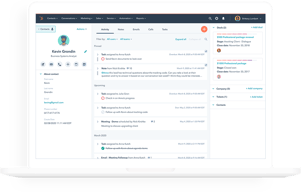


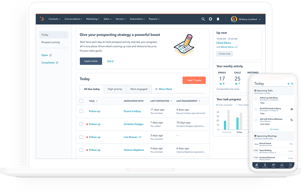
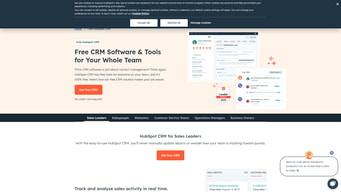






HubSpot CRM is free for up to two users with no time limit, and the paid Starter bundle costs the same per seat as buying any single Hub on its own. That second fact is the most useful thing in HubSpot’s pricing: at $7 per seat you get Marketing, Sales, Service, Content, and Data Hub Starter together, for the same price as Sales Hub Starter alone. If you are buying one Hub at Starter level, you are leaving four on the table.
- What it is: A CRM platform built on HubSpot’s Smart CRM, with contact and deal management shared across its marketing, sales, service, content, and data products.
- Best for: Small teams starting their first CRM, and growing businesses that want marketing and sales working from one contact record.
- Pricing: Free for up to 2 users. Starter Customer Platform from $7 per seat per month on annual commitment, discounted from $20. Verified in July 2026.
- The honest catch: The $7 is promotional and requires an annual commitment, and marketing contacts beyond the included 1,000 are sold in blocks from around $50 per month.
What Is HubSpot CRM?

HubSpot CRM is the foundation the rest of HubSpot sits on. Contacts, companies, deals, and tickets live in a single database called Smart CRM, and each Hub adds functionality on top of that shared record rather than maintaining its own copy. If marketing sends an email and sales logs a call, both appear on the same contact.
The free CRM is what most people encounter first, and it deserves its reputation. Contact and deal management, email tracking, meeting scheduling, forms, live chat, and basic reporting, free for two users, with no expiry and no card required. HubSpot has sustained that offer for over a decade, and it remains the strongest free CRM available.
Where it gets interesting commercially is the Starter tier, which HubSpot now sells as a bundle rather than per product. That structure is covered below, because it changes the right purchase for most small teams.
The independent ratings are strong across a very large base: roughly 4.5 out of 5 on Capterra and 4.4 on G2 across more than 12,000 reviews for the sales product, with ease of use the most-cited strength and pricing the most-cited weakness.
How HubSpot CRM Works
- Smart CRM as the shared record. One contact database across every Hub, which is HubSpot’s central architectural advantage over assembling separate tools.
- Free tools across all five areas. Marketing, sales, service, content, and data tools each have a free tier, all reading the same records.
- Starter bundles everything. The Starter Customer Platform includes Marketing, Sales, Service, Content, and Data Hub Starter for a single per-seat price.
- Marketing contacts as a separate meter. Marketing Hub prices on contacts you actively market to, distinct from total contacts stored. Starter includes 1,000.
- HubSpot Credits. A consumption currency powering AI agents and features, with allowances per tier.
- Ecosystem. A large app marketplace and an unusually deep pool of agencies and consultants who know the platform.
HubSpot CRM Pricing
Two tiers matter for most readers, and the arithmetic between them is worth doing carefully. Figures verified in USD on HubSpot’s CRM pricing page in July 2026.

| Plan | Price | What you get |
|---|---|---|
| Free | $0 | Up to 2 users, free marketing, sales, service, content, data and revenue tools, no card required |
| Starter Customer Platform | From $7/seat/mo | All five Starter Hubs, 1,000 marketing contacts, 500 HubSpot Credits |
What to understand before buying:
- The bundle costs the same as one Hub. Sales Hub Starter alone is also around $7 per seat. The Starter Customer Platform at the same price adds Marketing, Service, Content, and Data Hub Starter. There is no scenario where buying a single Starter Hub makes sense over the bundle.
- The $7 is promotional. The underlying list price is $20 per seat. HubSpot currently discounts to $7 on annual commitment, or around $10 month-to-month. Assume $20 when modelling renewal, not $7.
- Annual commitment applies at the lowest rate. The $7 price requires committing for a year and paying upfront.
- Marketing contacts are the classic cost driver. Starter includes 1,000 marketing contacts, with additional blocks of 1,000 sold from roughly $50 per month. For a business with a large list this becomes the dominant line item, and it is priced separately from CRM seats.
- Professional is a different conversation. Above Starter, HubSpot’s per-seat prices rise sharply and carry mandatory onboarding fees. We cover that in our HubSpot Sales Hub review.
Who Should Use HubSpot CRM
- Anyone starting their first CRM. The free tier removes every barrier to entry, and two seats covers a founder and one colleague.
- Small teams wanting marketing and sales aligned. The shared contact record is the genuine architectural benefit, and at $7 per seat it is inexpensive to obtain.
- Businesses with small marketing lists. Under 1,000 marketing contacts, Starter is excellent value.
- Non-technical teams. Ease of use is HubSpot’s most consistently praised quality, and CRM adoption is usually the hard part.
It fits poorly for businesses with large marketing lists, where contact pricing compounds quickly, for teams that need Professional features but not the ecosystem, where Pipedrive or Zoho deliver more for less, and for high-volume outbound sales, where specialist tools have deeper sequencing and dialing.
Honest Pros and Cons
Strengths
- The best free CRM available. Two users, no expiry, genuinely functional rather than a trial.
- The Starter bundle is unusually good value. Five Starter Hubs for the price of one, currently at $7 per seat.
- One shared contact record. Removes the integration problem between marketing and sales entirely.
- Excellent ease of use. The most-cited strength across thousands of reviews, and the reason adoption succeeds.
- A very large ecosystem. App marketplace, documentation, and an extensive partner network.
- Clear upgrade path. You can start free and grow without migrating platforms.
Limitations
- The $7 price is promotional. List price is $20 per seat, so model renewal at the higher figure.
- Annual commitment for the best rate. Month-to-month costs more.
- Marketing contacts are metered separately. Blocks of 1,000 from around $50 per month, which becomes the largest cost for list-heavy businesses.
- The free tier caps at two users. A real constraint that arrives quickly for growing teams.
- Costs climb steeply above Starter. Professional pricing plus mandatory onboarding fees make the next step a serious decision.
- AI features consume credits. Metered on top of seat pricing, and hard to forecast.
HubSpot CRM Alternatives and How It Compares
- Pipedrive is purpose-built for sales pipelines and better value if you do not need marketing tooling.
- Freshsales includes built-in telephony at $9 per user, which HubSpot does not match at that price.
- monday CRM offers deeper customization for non-standard sales processes, with a three-seat minimum.
- Zoho CRM undercuts HubSpot at comparable depth inside a broader suite.
- Salesflare automates data entry more thoroughly for small B2B teams.
For a broader survey see our guides to the best CRM software and the best free CRM software.
The Verdict
HubSpot CRM is the easiest recommendation in this category for anyone who has never used a CRM. The free tier is genuinely free and genuinely useful, the interface is the reason teams actually adopt it, and the shared contact record across marketing and sales is a real architectural advantage rather than a marketing claim.
Buy the bundle, not the Hub. The Starter Customer Platform at around $7 per seat includes Marketing, Sales, Service, Content, and Data Hub Starter, and a single Starter Hub costs roughly the same on its own. Anyone purchasing one Hub at Starter level is paying full price for a fifth of the product, and that is the clearest saving available in HubSpot’s pricing.
Two cautions for planning. The $7 rate is a promotion against a $20 list price and requires an annual commitment, so budget renewals at the higher number. And if you have a marketing list of any size, price the marketing contacts before anything else, because blocks of 1,000 from around $50 per month will dwarf your seat costs long before you reach Professional. Handle both and HubSpot is excellent value at the small end, which is exactly where it intends to win.
FAQ
Is HubSpot CRM really free?
Yes. The free plan supports up to 2 users with no time limit and no credit card, and includes contact and deal management, email tracking, meeting scheduling, forms, live chat, and basic reporting across marketing, sales, service, content, and data tools. The two-user cap is the main constraint, and it is the reason most teams eventually upgrade.
How much does HubSpot CRM cost after the free plan?
The Starter Customer Platform starts at around $7 per seat per month on an annual commitment, discounted from a $20 list price, or roughly $10 month-to-month. That price includes all five Starter Hubs plus 1,000 marketing contacts and 500 HubSpot Credits. Additional marketing contacts are sold in blocks of 1,000 from about $50 per month.
Should I buy a single HubSpot Hub or the Starter bundle?
The bundle, in almost every case. Sales Hub Starter on its own costs roughly the same per seat as the Starter Customer Platform, which includes Marketing, Sales, Service, Content, and Data Hub Starter together. Buying a single Starter Hub means paying the same money for substantially less product.
What are marketing contacts and why do they matter?
Marketing contacts are the people you actively market to, counted separately from total contacts stored in the CRM. Starter includes 1,000, with more sold in blocks of 1,000 from around $50 per month. For businesses with sizeable lists this becomes the largest single cost in a HubSpot subscription, often exceeding seat costs, so price it before committing.
What is HubSpot CRM best for?
Small teams adopting a CRM for the first time, and growing businesses that want marketing and sales operating from one shared contact record. It is strongest at the free and Starter levels, where the value is genuinely hard to match, and becomes a more considered purchase above that.

Compare HubSpot CRM with other popular tools in the same category.
Sorry, no reviews are available for this product yet.
Be the first one to review HubSpot CRM !