

Unclaimed: Are you working at Bubble?
Bubble Reviews: 4.5/5 — Highly Rated
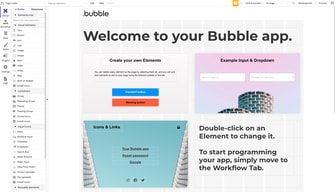
Bubble is a known leader in the no-code movement that offers a powerful point-and-click web editor and a cloud-hosing platform that lets users create customized web applications and workflows. From prototypes to complex marketplaces, SaaS products, and more, Bubble can help build and launch businesses easily.

| Capabilities |
API
|
|---|---|
| Segment |
Small Business
Mid Market
Enterprise
|
| Deployment | Cloud / SaaS / Web-Based |
| Support | 24/7 (Live rep), Chat, Email/Help Desk, FAQs/Forum, Knowledge Base, Phone Support |
| Training | Documentation |
| Languages | English |







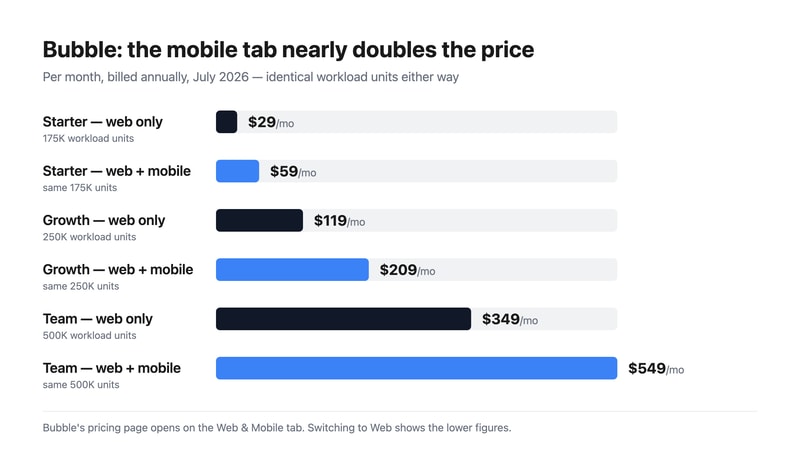
Bubble’s pricing page opens on the Web & Mobile tab and shows Starter at $59 a month. Switch to the Web tab and the same plan is $29. Identical workload units, identical editors, identical everything except the ability to ship a native mobile app. If you are building a web app — which is what most Bubble users build — your entry price is $29 and the number on the page when you land is roughly double it.
- What it is: A visual no-code development platform for building full web and mobile applications with a database, logic, and API layer.
- Best for: Founders and small teams building a real product without engineers, not just a website.
- Pricing: Free, then Starter $29, Growth $119, Team $349 per month (web, billed annually). Add mobile and those become $59, $209, $549. Verified July 2026.
- The honest catch: Starter gives you one app editor. A second person on the project costs $119.
What Is Bubble?
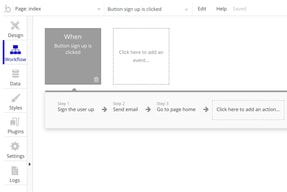
Bubble is not a website builder, and the distinction matters when you are comparing prices. Wix and Webflow produce pages; Bubble produces applications. You get a database, a visual workflow engine for logic, an API connector, user authentication, and version control — the components of a software product rather than a brochure. That is why its costs look high against site builders and reasonable against developer salaries.
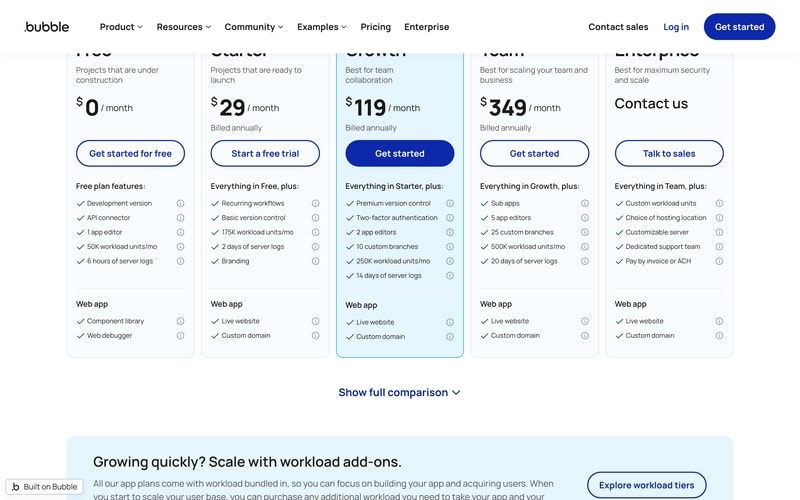
The 2026 product covers both web and native mobile from the same editor, with mobile builds, live app versions, and over-the-air updates managed inside the platform. That capability is the reason the pricing page now has three tabs — Web & Mobile, Web, and Mobile — and the reason the default tab shows the highest figures.
How Bubble Works
- Priced per app, not per seat. One subscription covers the application; editors are capped by tier.
- Workload units are the usage meter. 50K a month free, 175K on Starter, 250K on Growth, 500K on Team.
- Editors are the real gate. 1 on Free and Starter, 2 on Growth, 5 on Team.
- The free plan cannot go live. No custom domain and no live website — it is a development sandbox.
- Server log retention ladders steeply. 6 hours, 2 days, 14 days, then 20 days.
- Extra workload is sold as an add-on rather than forcing a tier upgrade.
Bubble Pricing
Captured from Bubble’s pricing page in July 2026 in US dollars with annual billing selected. Bubble advertises saving up to 20% annually, so monthly billing costs more.
| Plan | Web | Web + mobile | Workload units/mo | App editors |
|---|---|---|---|---|
| Free | $0 | $0 | 50K | 1 |
| Starter | $29 | $59 | 175K | 1 |
| Growth | $119 | $209 | 250K | 2 |
| Team | $349 | $549 | 500K | 5 |
| Enterprise | Quoted | Quoted | Custom | Custom |
What actually decides your plan:
- Check which tab you are reading. The mobile premium is $30 on Starter, $90 on Growth, and $200 on Team — a 103%, 76%, and 57% increase respectively for capability you may never use. Nothing else changes between the two columns. If your product is a web app, price it from the Web tab and ignore the landing figures entirely.
- The upgrade trigger is a second person, not more traffic. Starter includes one app editor. The moment a co-founder, contractor, or designer needs to open the editor, you are on Growth at $119 — a fourfold jump driven by a seat rather than by usage.
- Capacity gets more expensive as you climb, not cheaper. On the web tab, Starter works out at roughly $17 per 100,000 workload units, Growth at about $48, and Team at about $70. That inversion tells you plainly what the upper tiers sell: version control, branches, two-factor authentication, sub-apps, and collaboration. You are not buying volume, so do not upgrade expecting it.
- Buy workload rather than tiers if usage is the problem. Bubble sells workload add-ons on every plan specifically so you do not have to move up for capacity. Given the per-unit arithmetic above, that is usually the cheaper path.
- The free plan cannot ship. No live website and no custom domain, which makes it a genuine build-and-learn environment but not a soft launch. Your first live deployment costs $29.
- Two days of server logs on Starter is tight. A bug reported on Monday about Friday’s behaviour is already unreachable. Growth’s 14 days is the first realistic debugging window for a live product.
Who Should Use Bubble
- Non-technical founders building a real product. The clearest case, and the one Bubble is genuinely good at — database, logic, auth, and payments without an engineer.
- Teams validating before they hire. Building the first version in Bubble is dramatically cheaper than a development contract, and the result is a working application rather than a prototype.
- Internal tools and marketplaces. Multi-user apps with permissions and workflows sit squarely in Bubble’s strengths.
- Solo builders on a budget. $29 a month for a live, custom-domain web application is difficult to beat.
It fits poorly for simple marketing sites, where Webflow, Framer, or Wix are cheaper and faster; for storefronts, where Shopify does in an afternoon what Bubble takes weeks to approximate; and for anything expected to reach very high traffic, where the workload meter becomes the dominant cost.
Honest Pros and Cons
Strengths
- Genuinely full-stack. Database, workflows, API connector, and authentication in one visual environment.
- Web and native mobile from one editor, with OTA updates handled by the platform.
- A free tier you can actually build in, rather than a two-week trial.
- Workload add-ons exist, so growth does not force a tier jump.
- Large ecosystem. A substantial plugin marketplace, template library, and agency network.
- Real version control — branches and premium version control from Growth.
Limitations
- The default pricing tab overstates the web price. $59 shown against $29 actual.
- One editor on Starter. Collaboration costs $119, a fourfold step.
- Workload units are hard to forecast before you have built and load-tested the app.
- Per-unit capacity worsens with each tier, so upgrades buy governance rather than headroom.
- Two days of log retention on Starter, which is short for a production application.
- Lock-in is total. There is no meaningful export — a Bubble app runs on Bubble permanently.
Bubble Alternatives and How It Compares
- Softr and Glide build apps on top of an existing Airtable or Notion base, far simpler but far less capable.
- FlutterFlow and Adalo are the mobile-first alternatives, with FlutterFlow producing exportable Flutter code — the direct answer to Bubble’s lock-in.
- Retool targets internal tools connected to existing databases rather than greenfield consumer products.
- Webflow and Framer win decisively on marketing sites and lose decisively on application logic.
- Make and Zapier automate between tools rather than building the tool.
For a broader survey, browse our no-code development platforms directory.
The Verdict
Bubble remains the most capable no-code platform for building an actual application, and the gap between it and the app-on-a-spreadsheet tools is wide. A database, a visual logic engine, an API connector, authentication, and native mobile builds in one place is a genuine software stack, and for a founder without engineers it compresses months and tens of thousands of dollars into a subscription. Judged against a development contract rather than against Wix, the pricing is modest.
Read the pricing page carefully, because it does not open on the number most buyers want. The default Web & Mobile tab shows Starter at $59; the Web tab shows the same plan at $29, with identical workload units, identical editors, and identical everything but native app publishing. The mobile premium runs from 57% to 103% depending on tier. If you are building for the browser, switch tabs before you compare Bubble against anything else, because the comparison you make on the landing figures will be wrong by roughly double.
Two things determine what you will actually pay over time. The first is collaboration, not usage: Starter permits one app editor, so the day a second person needs to open the project you are on Growth at $119 — a fourfold increase triggered by a seat. The second is that capacity gets more expensive per unit as you climb, roughly $17 per 100,000 workload units on Starter against $70 on Team, which means upgrading to solve a usage problem is the wrong move. Buy the workload add-on instead, and treat the tier ladder as what it is: a price list for version control, branches, and editors.
The unavoidable trade-off is lock-in. A Bubble application cannot be exported and run anywhere else, so choosing it is a permanent architectural decision, not a starting point you migrate off later. That is a reasonable bet when the alternative is not building the product at all — but if you expect to eventually hand the codebase to engineers, FlutterFlow’s exportable Flutter output is the option that keeps that door open.
FAQ
How much does Bubble cost?
Captured in July 2026 in US dollars with annual billing: on the Web tab, Free $0, Starter $29 per month, Growth $119, and Team $349, with Enterprise quoted. On the Web & Mobile tab the same plans are $59, $209, and $549. Monthly billing costs more — Bubble advertises saving up to 20% annually. Workload allowances are 50K, 175K, 250K, and 500K units per month.
Why does Bubble’s pricing page show $59 for the Starter plan?
Because it opens on the Web & Mobile tab by default. That tier includes native mobile app builds, live app versions, and over-the-air updates. Selecting the Web tab shows Starter at $29 with the same 175,000 workload units, the same single app editor, and the same live website and custom domain. The entire $30 difference is the ability to publish a native mobile app.
What are Bubble’s workload units?
They are Bubble’s usage meter, consumed by the operations your app performs — database reads and writes, workflow steps, API calls, and page loads. Allowances are 50,000 a month on Free, 175,000 on Starter, 250,000 on Growth, and 500,000 on Team. They are difficult to forecast before an app is built, which is why Bubble sells workload add-ons on every plan rather than requiring a tier upgrade for capacity.
How many people can work on a Bubble app?
One app editor on the Free and Starter plans, two on Growth, and five on Team, with custom limits on Enterprise. This is usually the real reason to upgrade: adding a second collaborator moves you from $29 to $119 on the web tab, a fourfold increase driven entirely by a seat rather than by usage or traffic.
Can you export a Bubble app?
No. Bubble applications run on Bubble’s infrastructure and there is no meaningful export to another platform, so the choice is a long-term commitment. If keeping that option open matters, FlutterFlow generates exportable Flutter code, and a conventional development approach obviously preserves full ownership. For many founders the trade is worth it, but it should be a deliberate decision rather than a surprise.

Compare Bubble with other popular tools in the same category.
Its functionality impressed me greatly. Everyone can create full featured application in short terms
Bubble needs to be more spread about the world community.
Decreasing the cost and terms of projects development.
As it is a code-free programming language, it is so simple to build and host web apps. That is the reason why I liked this software a lot. If you are a non-tech savvy candidate, then this software is the right choice for you. I recommend you to go for it.
There is no boring HTML work or CSS programming so there are absolutely no reasons to dislike it.
I am able to design fantastic web apps without the need of writing any code. So, I loved this a lot in Bubble software. This software brings your website to life with cool animations and amazing layout.
Bubble is the most user friendly no-code app tool there is. There are a few other players in this market but none compare to the simplicity and ease of use of Bubble, and the powerful applications you can build are endless. There is a growing community of nearly 200k users now and really experienced developers and agencies operating on Bubble's platform, so its super powerful for newbies or experienced traditional coders!
They have recently increased their pricing, which may put off some hobby apps but luckily they are still honouring the legacy plans for people already subscribed to those. The support team could use a lot of work, as they are not always the friendliest or active in the community, and I feel the founder of Bubble could be a lot more involved in caring and taking notice of successful apps built on his platform.
App building and testing, mainly web apps but also mobile friendly applications.
free programming, easy to manipulate, simple software
very expensive, No-Code Development Services
nothing
Bubble is very easy to use and it is scalable. The availability of plugins and templates makes Bubble a great option for non-technical founders
It’s difficult to manage sizing your application for different devices.
Launching an MVP and scaling as our user needs evolve.
Bubble makes it easy to created sophisticated websites and web applications. I love that they are as easy as a Wix or Squarespace or similar drang-and-drop website / landing page creator but that they have substantially deeper sophistication. It's not just a brochure-ware website tool. I can create advanced applications. Their plugins deliver even deeper capability.
The learning curve is steeper than simple brochure-ware web tools like Wix / Squarespace. Take the time and go through the videos to learn. Bubble still has some idiosyncrasies that can be frustrating - (stacking/ groups / centering). SEO tools need improvement.
With Bubble I am able to design, develop and deliver dynamic we applications for my clients. I am unconstrained by the limitations of other platforms. I am realizing the benefits of rapid iteration and development of substantially sophisticated applications. Examples include CPQ tools, pricing, interactive web applications. .

I started using Bubble last year. I am a senior product Owner. I always relied on my squad to develop the ideas I had for my clients. With Bubble, I think I can do pretty much everything I have in mind. I already developed a cashier system for a shop, an e-commerce app, an app to scan gift checks, and so many things. I know this is only the beginning. At first, the front end was the weakness, especially for responsive interfaces, but the new flex engine is incredible.
maybe the fact that the link between 2 tables is only a single way. If I link the B thing to an A thing, the link A to be will not automatically be applied.
I can develop app.. I have a good functional background and a good comprehension of some basic requirements on development (object database, apis and so on) . I can speak with dev people, but I can't code myself. With Bubbel, I can
Easily customizable front-end with moderate skills needed to run back-end
Speed of the app compare to standart development
Safe money with our MVP solution
It can pretty much make all the functions that you want
It is little hard to learn how to use it given its diverse usage
I use Bubble to make my own website for a business
You can immediately start using it productively from day one.
The system is closed. And you have no security that their terms may change or pricing may rise.
Testing ideas quickly.
Very powerful, sky is the limit when building apps. Bubble combines both the front and the back layers of apps, so that you need only one tool and can integrate with unlimited third party apps using API.
Learning curve, not so easy to use at the beginning, but after a couple of day I was able to create my first simple app. The documentation is heavy but the community and forum help a lot to perform well with Bubble
No need to know how to code to be able to ship a powerful web app ! Bubble is a powerful tool, flexible, that allows makers to create stunning web app or web sites, wuickly and efficiently
Bubble.io is a flexible and feature-rich platform with a great community and a fantastic support team that allows you to build web apps, APIs or it can just be used as a Database
It can be a bit challenging to start with, but the available lessons, manual and boot camps can help you bridge that gap quickly
Allows non-tech and citizen developers take an idea to app fairly quickly and cost effectively
The possibility of having the front end and the back end in one place
Not having direct access to the orginal code.
It has allowed me to create an application with which to start a business without having to hire a team of engineers.
I like simplicity, the whole concept of web-development without touching a keyboard.
It's not so easy to understand how responsive visual design module works. It took much more time to me than learning database and workflows.
Simple, very fast prototyping, simple web development
I like that Bubble.io allowed me to create a front-end and log-in system for a logic and Database that I built in Airtable. However in Airtable it is hard to manage multiple users acessing and writing different data. Thats why tools such as Softr and Stacker have emerged. But those tools are very restricted, so I used Bubble and also benefited from the many third-party Plugins available in the Bubble system.
It took me several attemps before I really got warm with Bubble. The beginning is just not that much fun. Furthermore, the UI just looks very old and unprofessional at times. But everything works fine, so it does not really matter too much. Furthemore, the connection with Airtable could be better. Everything works, but sometimes I have to use some work-arounds.
Creating a front-end for my user to interact with a logic that I created in Airtable and with Make.com. Furthermore, it solves log-in and user management for me.

The user interface and bubble's drag-and-drop functionality make it stand out. It is super easy to make an app on bubble. It changes the way IoT devices can be made functional. It also integrates with multiple platforms.
With the drag-and-drop functionality comes less flexibility. When you are trying to accomplish more complex use cases, it becomes tricky. Still solved all simple use cases.
Bubble helps me design apps for IoT devices. Bubble is super easy to get started with. I used it majorly for prototyping IoT devices.

Bubble hosts. It's an all-in-one solution
Grid options are not great. Bubble seems to be built more for only small amounts of data, while data-centric internal apps are harder to fit to different screen sizes.
Social media site, equipment tracking, inventory, home-grown project management app. All without any back-end programming or infrastructure to worry about.
The bubble is the best platform for app building and Hosting. One can quickly build and modifies the applications. Lots of in-built features like buttons, sign-in/sign-up page saves time. No need to worry about hosting and other kinds of stuff; taken care by Bubble team. Just focus on the building part.
As of now nothing to be disliked for such a great platform. Provides excellent learning tutorials by bubble itself, which solves 100% of doubts and confusion.
I used bubble to build simple applications, friendly and easy to make most kind of applications, guiding or learning tutorial is a plus. Benefits - Lots of in-built features - Free Learning Tutorials - Hosting available - User Friendly

Fast development, easy DB model , privacy rules, API connector and plugins.
Responsive editor, some minor bugs on components.
Saas models to validate

Database mangement, API connectors and advanced worklows enable to build real complexe products
Steep learning curve (but I consider it as an investment). It is a bit tricky to build a full responsive page
I build MVPs and even products I would like to scale
Amazing for testing things really quickly, has great db, integrating API is super useful as well.
Designing something that is very good looking is still quite hard, especially making it responsive. Wish there were more out of the box stuff.
Testing products really fast, creating free tools for engineering as marketing
I am able to customize everything. I am able to build a unique product without having any background or experience in programming.
It would be nice to have some guidance in terms of design that were built in. I find that it's easy to get focus on the nuts and bolts of getting something to perform in terms of functionality, but the design can look neglected. It would be nice if there were some easier ways to keep things more uniform automatically.
I am building a community of users. I am building an app from the ground up as an MVP to launch my start-up.
Best of all, you don't need to learn how to code and build websites. It is simple and intuitive. The fact that it has a visual interface with drag and drop greatly simplifies the task and optimizes time with really very good results. I have saved a lot of money because I have not needed to hire programmers.
I would improve the interface and add some additional tools. Sometimes it stays loading for a long time,I think optimizing it would be convenient since it has so many tools and options that I think it slows down drag and drop.
I have saved a lot of money and above all a lot of time, since I managed to adapt everything I needed for my project since I have not had to hire additional programmers, as it is an intuitive and easy-to-use tool since it does not need code, since it has saved time and money.

The interface is straightforward to understand. With no prior experience in coding, I was able to learn it very fast and create solutions easily. It is great for testing ideas and building MVPs. The pricing of the platform is also very competitve to others in the market which makes it a cost effective solution as well. Any startup founders looking for a tech solution, should definitley try it and build upon their success. Highly recommend the platform. Great work done by the bubble team.
The direct support or tutorials if you are struck are less, but that is improving, and I find that gradually it will be better. There are relatively less applications which can be directly integrated with the app. Apart from this there is not much to dislike, the platfrom is great
We have been internally able to build quick solutions to show our clients without taking much help from the tech team. The platform is an excellent source for a quick turnaround also. We have leveraged the product both at the personel level and at an enterprise level. We are creating our own website platform using the platform and will be using it to launch our product soon
Not provided
Not provided
Not provided
Code free to build and host webs. Basic but user friendly, allows you to learn without technical knowledge. Also good for your SEO. Free basic features.
Really depends what you want to do, for myself very limited, but for people without knowledge is an interesting tool.
Web hosting and web building in free code software
With Bubble you can create voting applications in real time or a social network to share videos and even a game for children. All services are hosted in their own hosting. In this tool, the elements of the app (such as text, photos, maps and input forms) can be added simply by dragging and placing them in their place, bubble also integrates external services to process payments or manage email lists.
has all the restrictions of the development of a web application, and being with little or if there are always some disadvantages more serious than others but in fact very useful at the moment of wanting to make an application safely and quickly
Sometimes we can make simple applications and due to lack of time we resort to this type of options to perform them. It is very good to learn everything.
The abstractions for web design, user flow, and databases is useful for someone without CS experience. Editing is rapid and its the only platform that makes solo founding easy.
There are some arbitrary bugs – for example, linking a User object as a child of another object and trying to access User object data is buggy for no reason. There are work arounds, but it's more difficult to isolate points of failure than with code.
I don't know full stack development and want to launch a webapp
Bubble is set up intuitively, making it easy to program what you need for your applications. Quickly build pages that look good and are functional with dynamic groups and forms.
Some design elements take time to learn to use. Making a page responsive can take some time if there are a lot of elements on a page. Also Bubble could be a little faster.
Bubble has made development accessible to me. The way that the codeless is set up makes it easy to develop functional pages without knowing how to code. It is powerful enough to handle large projects.
Great app development environment, but billing was confusing. If I terminate an app early it should just leave money in credit.
Account and app management. should be better.
I was hoping to do rapid app development