

Unclaimed: Are are working at Airtable ?
Airtable Reviews: 4.6/5 — Highly Rated
Airtable is a powerful visual project management platform that synergizes data, workflows, and execution teams on a unified dashboard. Streamlining work streams, the platform provides a synced and up-to-date information database that can be accessed by all stakeholders across different departments. Customization is at the heart of Airtable, allowing teams to create personalized apps and a tailored interface allowing easy access to relevant information and giving clear sightlines to the next steps. While customization is a key benefit, it also offers ready-to-use and pre-loaded industry-agnostic templates while extensive integrations and expandability make it scalable and agile.

| Capabilities |
API
|
|---|---|
| Segment |
Small Business
Mid Market
Enterprise
|
| Deployment | Cloud / SaaS / Web-Based, Mobile Android, Mobile iPad, Mobile iPhone |
| Support | 24/7 (Live rep), Chat, Email/Help Desk, FAQs/Forum, Knowledge Base, Phone Support |
| Training | Documentation |
| Languages | English |







Workflow management is a critical part of any job. It’s what keeps a project moving, and a team motivated to see it through. But, how do you support effective workflow management?
You start with understanding better what tools, platforms, and software are out there that can support your team’s ability to effectively manage workflow and collaborate within their teams and beyond.
To that end, we’ve identified Airtable as a strong market leader in workflow management software. So, let’s dive into Airtable’s features, capabilities, and price points to help you better understand your options.

What Is Airtable?
Airtable is a workflow management application with highly customizable database management tools used predominantly for collaborative project management.
The focus on having accessible, easy-to-use software to help with project management is increasing, and Airtable is a top choice. It features a familiar spreadsheet interface, but unlike traditional spreadsheet software that only records data, Airtable can also help you organize, sync, and manage your data and customize exactly how you need it.
For example, let’s say you’re using Airtable to manage vendor management workflow for an event. This would entail designing the database to include fields for:
- Vendors’ contact details
- Links to their websites
- Inputting key information, such as lead times, product availabilities, and prices
- Uploading order confirmations
- Uploading invoices
- Important notes and comments about the vendor
The option to invite collaborators to this database is also critical so individual users can easily update data in real-time. Having all these features in a single platform means users can clearly follow the progression of a particular project and keep everyone in the team up-to-date on their tasks and next steps.
How Much is Airtable
Airtable’s interface is very flexible and is ideal for numerous industries. While it has been marketed to larger corporations, most users who have had hands-on experience with the platform say that it is just as useful for smaller businesses.
This is reflected in Airtable’s pricing, which follows a monthly subscription model. This subscription cost increases depending on the number of features and ‘seats’ you choose to purchase, making it highly scalable depending on your organization’s needs.
Airtable’s features are grouped into four levels, and the price per seat rises accordingly. A breakdown of each level can be found below:
Note: Airtable has restructured its plans — current tiers are Free, Team, Business, and Enterprise Scale.
Free
- Designed for very small teams or individuals
- Up to 5 editors and unlimited ‘read-only’ users
- Record limits vary by plan
- 2GB of attachments
Team
- For small to medium-sized organizations
- Eliminates information silos within a team by connecting applications
- More advanced collaboration features
- Higher record limits per base
- 5GB of attachments
Business
- For medium to large organizations who need to streamline and collaborate on top-priority data
- More advanced features
- Higher record limits per base
- 20 GB of attachments
Enterprise Scale
- Price is customized to your organization’s needs
- Enterprise-wide admin panel
- For organizations who need a scalable product to keep up with workloads
- Unlimited workspaces per organization
- Highest record limits per base
- 1,000 GB of attachments
See Airtable pricing for current rates.

How Airtable Works
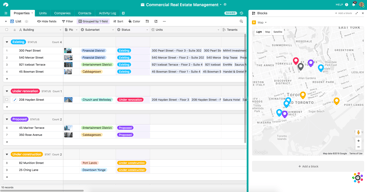
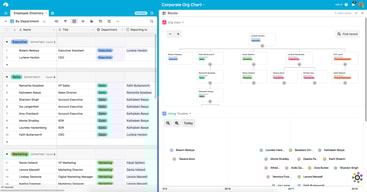
Airtable was built to be as customizable as possible, giving users the ability to display their data in a way that meets their specific needs—whether that means a simple presentation or a more complex one.
Getting started is simple.
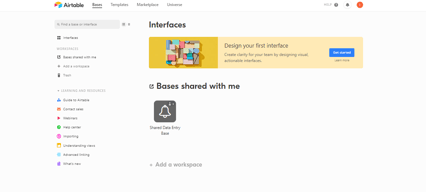
You start with an empty Airtable, which is essentially your ‘base.’ From here, you just fill it with your data. You can either use a template and bring in data from another source or construct a database from scratch. Whatever the case, you can leverage Airtable’s features to tailor the platform to meet your needs. For example, you can use the Interface Design feature to visually present data in a way that makes the most sense to you and your team.
Familiarizing and understanding all of Airtable’s features and capabilities may require some effort, but the payoff is worth it. Taking the time to learn the platform will ensure users have full control over their data and workflow management.
Features
Access to Airtable’s numerous features will depend on your subscription and, subsequently, the scalability of your projects. However, all subscription options should include:
- Unlimited bases
- Sync integrations
- The ability to add attachments
- Revision and snapshot history reporting
- Field and editing permissions
- Extension add-ons (e.g., data visualization or reporting extensions)
Airtable also provides:
Customizable Views
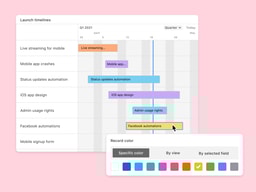
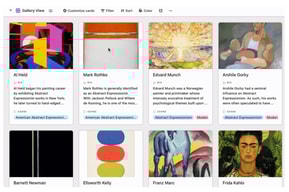
With a click of a button, this feature gives users the flexibility to switch between different data views. Users can view project timelines via the Timeline View, and easily switch to managing team tasks on the collaborative Kanban View. Other viewing options are also available ensuring that you can customize your viewing experience so you can maximize the platform.
The Timeline View

The Kanban View

Automations
Airtable Automations lets users streamline their work processes and boost team efficiency by providing customization options for notifications and creating multi-step workflows. The feature is helpful in terms of tracking project timelines and helping eliminate manual, repetitive tasks. Additionally, it can also minimize the risk of user error.
Syncing
Airtable’s ability to synchronize data means users have a central repository of information that is updated in real-time across all users and departments. It’s a useful tool that promotes seamless collaboration and data integrations, allowing everyone to enjoy a comprehensive understanding of project status or workflows at the speed of need.
Reporting
To enhance your project’s reporting capabilities, Airtable’s powerful reporting tools and extensions let users create highly customized reports that visualize your data in a simple understandable way. You can choose from a variety of charts, graphs, and tables to ensure that information is presented in a way that is easy to understand.

Integrations
Airtable offers robust integration that lets you connect the platform to a wide range of software; ensuring that all the project management tools that you use operate seamlessly. Airtable’s integrations mean multiple applications can be streamlined to automatically sync data, share information between different platforms, and automate tasks so workflows can be further improved.

Templates
Airtable’s templates can be used to effectively organize every aspect of your project’s workflows. Their pre-designed databases can be used as a great starting point for your projects. Conveniently, Airtable templates are also organized into several categories and industries, which helps you save time and effort from creating a new one from scratch. As always, these pre-populated grids are highly customizable.

Airtable Pros and Cons
Pros
- Facilitates easy collaboration between teams with company-wide visibility of plans, calendars, and workflows.
- Both Google and non-Google users can take advantage of all the features and integrations to support workflow management and collaboration
- Highly customizable bases and effective reporting features
Cons
- The platform’s user interface can be complicated for beginners
- Requires a significant learning curve
AI Features
Airtable has also introduced AI features, including an AI field type for summarization, categorization, and text generation directly within your bases.
Airtable Alternatives
A great way to decide whether Airtable is the right software for you is to compare it to other options in the workflow management space.
Eliminate the hassle of comparing options by choosing from your top choices below. With the ability to review features and relevant information in one place, you can utilize our comprehensive product reviews to gather the necessary data you need to make well-informed decisions.
ClickUp
An all-in-one project management application, Clickup is designed to be used across any industry. From solo users to larger organizations, Clickup focuses on task management to help teams streamline their workflow.
ClickUp offers numerous workflow features and data views, including a built-in Table View to ensure your team always has access to a condensed, actionable snapshot of your projects.
Notion
Designed for smaller teams or individuals, Notion is an all-in-one SaaS note-taking app and database for streamlined project management. Some features include:
- A web clipper so you can easily save images and sites
- A real-time messenger feature
- Allows for category and page hierarchy organization
Hive
With a focus on automation tools, Hive aims to simplify overly complicated work processes through email and task automation. Boasting a user-friendly dashboard, Hive aims to help teams of all sizes automate time-consuming work tasks to give time back to a project’s creation and growth.
A Final Findstack Opinion
Overall, Airtable is a highly comprehensive and customizable workflow management application.
Airtable’s app offers flexibility by allowing you to switch views and integrate reporting extensions, ensuring your data is suitable for various applications. Additionally, its extensive list of integrations enables you to consolidate all your preferred tools and their data in one convenient location.
It’s important to keep in mind, however, that these features are only useful for those willing to take the time to learn them. Airtable’s interface can be quite overwhelming for new users so our advice is to scale to higher subscription packages only after you’ve taken the time to learn the app’s features and familiarize yourself with them.

Compare Airtable with other popular tools in the same category.

The developers are constantly working to improve, there's a terrific community forum full of useful insight and suggestions, and it's easy to share a base with others. It's as easy to use as a spreadsheet, and so much more powerful. I find myself constantly making an empty base and using it just to make some simple data cleanup. On top of that, with the terrific formula support, internal automations, and tons of extensions there is almost no end to what you can accomplish with your data. They have a generous free tier that allows you to create an unlimited number of bases, invite a few friends, and have as many as 1200 records in each base. For home users, it's almost a no-brainer. I've tried some alternatives and haven't found one that's as easy to work with, or that has good formula support.
There are a few things that feel like limitations. One of my favorite database products is Filemaker, and its 'portal' feature is fantastic. I'd love to see something similar in Airtable. Yes, you can link tables, and perform lookups or rollups to pull data in from other sources (including syncing from other bases). It's just not the same.
Several. I've used it to merge data sources and clean up the results. Our company uses it to develop content. I've set up tables and bases to track and understand the permissions in cloud services, or keep track of all the cloud services we use (pricing, payment schedule, cost per user, etc). I have syncs set up to automatically show users in products. Set up a base to generate and post 'tip-of-the-day' in Slack. Another to calculate the usage in Make automation. Truly an all-around useful tool, and almost anything can be done without subscribing.

The sheer amount of data that you can compile, track, and analyze in Airtable is astounding. It has transformed just about every area of our business, from project management to production analysis to employee record-keeping and onboarding and so much more. With integrations from Zapier and Make, your source data is essentially unlimited. We would be piloting a ship sans a rudder without Airtable.
Some of the extensions are difficult to use and require some advanced knowledge. To my knowledge, it is not possible to overlay multiple sets of data on the built-in chart extension, and requires Vega-Lite to do that. I have neither the time nor desire to learn that, which is a bummer for something that is easily achievable on other platforms such as Google Sheets.
Airtable allows us to access vast amounts of company data, from a birds-eye view to granular, which helps inform our decision-making process in all departments across our company.
This is a versatile piece of software. I've used it for years: first, to track sales of household items when moving, then later for much more complex projects. A well-designed layout helps keep information clear and neat, whilst the functions for data are extremely powerful. I hardly scratch the surface of Airtable's capability, even with several complex bases on the go. Pros - Very powerful - Easy to use – with lots of information online to learn - Ability to capture information through forms which feed directly into a table - Multi-use - Pleasing design
Airtable is not a spreadsheet, so it takes some time to get your head around it. Once you’ve done this, it’s a helpful tool. A few frustrating niggles (such as not being able to have titles on two lines – this makes long titles with small data fields ridiculous on a spreadsheet) continue to persist. The next level up for Airtable is expensive (from the free version), but the free version does plenty.
Here are two scenarios we have used as a small charity. 1. Finances: expenses, claims, bank records Airtable has made life much easier for us with our summer project finances. It allows volunteers to claim expenses through a form which collects all relevant information about the expenses, bank details for repayment and allows an image to be uploaded. This feeds into a Base (document) which also tracks bank records and reimbursements. As a non-coder, this allowed us to build a financial system that fit our needs. A few clicks gave our treasurer access, and audit trails were visible – as well as easy analysis of expenditure and income. 2. Application tracking Every year we have dozens of applications for a summer project. These applicants need to be referenced, sorted, screened, and then accepted onto relevant teams and linked with host families who can cater to each applicant's needs during their time with us. A complex system which has been made simple with Airtable. Airtable links directly to our website through the API, and neatly pulls through a PDF application and any data we need for each applicant to enable us to sort. A separate table is built for hosts, and linking these tables is a doddle with Airtable. We no longer need to retrieve information from multiple courses, re-save updated information to Dropbox (for outside volunteers) and Onedrive (for staff), and keep archival records for the future. Now Airtable does all this, and each year one central Airtable document contains all we need – and all data is easily processed or deleted according to GDPR standards.

I've been using Airtable since May 2018 until I found another tool that could replace everything they offer. It's a very flexible tool, especially after they introduced extensions to write your own JS scripts, automation that takes over some of what I was doing with Zapier or Make, and now already the ability to create convenient interfaces. With interfaces, it will be much easier to transfer my whole team to Airtable.
In Airtable I don't have enough for 50,000 rows and the bigger the database the slower it works. The price per user per month is a bit high for my region. One suggestion would be to have different prices depending on the access level of each user.
I set up a complex system on Airtable where I keep my business accounts because I trust Airtable. The problem that Airtable solves for me is the clutter in which I keep my accounting records. Now I'm sure everything is safe and in order.
Airtable is like a filing cabinet full of tiny, helpful elves that look after all your business information and are ready to show it to you in whatever format you need at the drop of a hat. You can add information from all kinds of places (see a useful link, pop it in Airtable, need to save an email - pop it in Airtable)
A bit of a steep learning curve to really get the most from it but completely worth the effort. Populating data can also be a bit time consuming but this is not specific to Airtable, just getting any system set up right.
Airtable serves as the central data repository for all my business information. It makes responding to queries, knowing what's going on and finding information so much faster than it was when I was looking up information in separate systems.

The ease with which I can develop simple, fast and effective databases. In addition, the functionality of capturing data through a form. What sets Airtable apart from its competitors is the ease of use and pragmatism it allows when building databases, as well as its powerful automations.
I don't really have a strong dislike. I have not been able to fully identify the correct use of the apps, but that is a matter of me spending more time exploring their applications and uses
It has helped me spend more time on strategic issues and reduce time on operational processes that do not generate greater value.

I'm a freelance architect and have been looking for the right project management software for YEARS. Finally, a software friend recommended Airtable. I actually paid my friend to build my framework since he was so familiar with Airtable and it is AWESOME. I use it to manage my work flow, make sure I don't overbook myself, AND project my earnings. It's been a huge game changer for my business. It's saved me so much time.
It would have taken me a lonnnnnng time to build the framework myself. I'm glad I had my friend to help.
Managing my work load, project flow, and financial projections.
I've incorporated airtable into every research question I design, and it has been extremely useful for data entry and exploratory research. I like that it is customizable but at the same time very easy to use in terms of user interface. I can adapt it to the user's needs but also maintain control over the data entry process.
Some functionalities that are present in other spreadsheet systems are not present in airtable, but could be. Working with strings is particularly difficult. Downloading charts would also be highly beneficial.
Data entry, data management and exploratory data analysis. I don't have to design a separate MySQL database for every project and I don't have to do with makeshift excel solutions either.
Multiple users can work in the same field simultaneously. Very stable information platform. Great analytics with the free version. Works right out of the box. No need for an IT department.
App on Android is slow to sync to the rest of your information, on PC this has never been a problem.
Project Tracking between multiple locations with multiple people working in the data at the same time. We tried this with Microsoft products but it was clunky and difficult. Airtable worked right out of the box.

I can create almost any framework for task management, knowledge base, inventory handling, you name it. And I can make it quickly and conveniently.
One time I lost an entire database with track records of my allergy occurrences - it had a 3 or 4 years history. I still don't know how and why the database was removed. Since DB removal is irreversible, I can't restore it and see which actions led to it.
1. Prototyping. When I deal with a situation with lots of entities involved, I try to model everything in Airtable before anything else 2. Tracking things. I used to track my allergy occurrences and sickness of other kinds, spending and earnings, physical activity 3. Managing projects. I use three databases to manage products in my company.


