

Unclaimed: Are you working at Asana?
Asana Reviews: 4.3/5 — Solid Choice
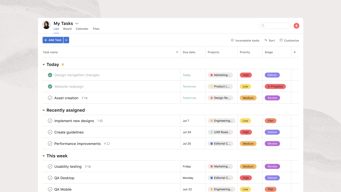
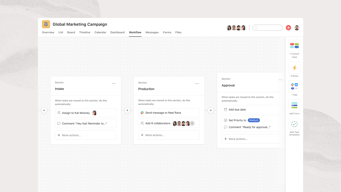
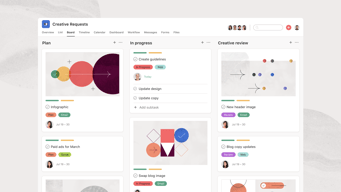
Considered one of the pioneering cloud-based project management tools, Asana offers four views for its users – List View, Timeline, Calendar, and Boards – all of which help teams get both a macro and micro view of all the moving parts of projects and tasks. It provides a comprehensive roadmap of ongoing projects from start to finish, clearly outlining dependencies, project milestones, and feedback and approval processes. For project managers, strong reporting capabilities that show completion rates, individual workloads, and potential delays just to name a few create opportunities for real-time project optimization, collaboration, stronger forecasting, and better planning for future similar projects.





| Capabilities |
API
|
|---|---|
| Segment |
Small Business
Mid Market
Enterprise
|
| Deployment | Cloud / SaaS / Web-Based, Mobile Android, Mobile iPad, Mobile iPhone |
| Support | 24/7 (Live rep), Chat, Email/Help Desk, FAQs/Forum, Knowledge Base, Phone Support |
| Training | Documentation |
| Languages | English |
Asana Pros and Cons
- Tons of great integrations
- Easy to use and clean environment
- Lots of timeline tracking tools
- Automation features built-in
- Various customization options
- No budgeting or invoicing features
- The volume of features can be overwhelming
- No time tracking feature
- The volume of features can be overwhelming
- No time tracking feature








Asana cut its free plan from 15 users to 2, and a great deal of published information has not caught up. Accounts created on or after 12 November 2025 get two seats on the Personal plan. Older accounts keep a legacy allowance of up to ten, but lose it permanently if they downgrade and re-upgrade. If you are choosing Asana because you heard the free tier supports a small team, that is no longer true.
- What it is: A project management platform for tracking work across tasks, projects, portfolios, and goals.
- Best for: Mid-size and larger teams coordinating structured work across departments, where portfolios and goals matter.
- Pricing: Personal free for 2 users. Starter €10.99, Advanced €24.99 per user per month billed annually. Enterprise is custom. Verified in July 2026.
- The honest catch: Beyond the free-plan change, AI Studio credits are allocated per billing account rather than per user, so a large team shares one pool.
What Is Asana?
Asana is one of the two or three products that defined modern work management. Its model is a hierarchy: tasks belong to projects, projects roll into portfolios, portfolios connect to goals. That structure is why larger organizations choose it. When an executive asks how a quarterly objective is progressing, Asana can answer from work people are actually doing rather than from a status document.
That focus also explains where it is weaker. Asana is less flexible than monday.com, less spreadsheet-like than Smartsheet, and less simple than Trello. It rewards organizations that want a consistent structure imposed across teams, and frustrates ones that want each team to work its own way.
The independent evidence base is very large, with more than 11,000 reviews on G2 alone, and satisfaction scores remain strong despite the free-plan controversy.
How Asana Works
- Tasks, projects, portfolios, goals. The hierarchy is the product, and portfolios and goals are what separate Advanced from Starter.
- Multiple views. List, board, and calendar on every plan, with timeline and Gantt from Starter.
- Automation. Unlimited automations from Starter, which is more generous than competitors that meter them.
- Workload and capacity. Resource management on Advanced, plus universal workload and capacity planning on Enterprise.
- AI Studio. Credit-based AI, at 50,000 on Starter, 75,000 on Advanced, and 200,000 on Enterprise, allocated per billing account per month.
- Integrations. Salesforce, Tableau, and Power BI connectivity from Advanced.
Asana Pricing
Four tiers, with the free plan now materially smaller than its reputation. Figures verified on Asana’s pricing page in July 2026, billed yearly. Asana localizes currency, and the euro figures correspond numerically to its dollar pricing.
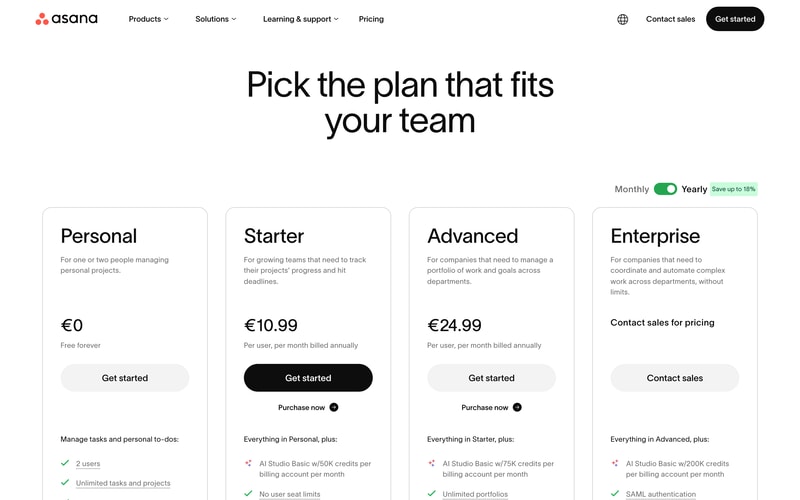
| Plan | Per user/mo (yearly) | Users | AI Studio credits | Key additions |
|---|---|---|---|---|
| Personal | €0 | 2 | — | Unlimited tasks and projects, list, board and calendar views |
| Starter | €10.99 | No seat limit | 50,000/account | Timeline and Gantt, dashboards, unlimited automations, forms, custom fields |
| Advanced | €24.99 | No seat limit | 75,000/account | Portfolios, goals, workload, approvals and proofing, time tracking, Salesforce and BI integrations |
| Enterprise | Custom | Unlimited | 200,000/account | SAML, SCIM provisioning, capacity planning, admin controls |
The details that matter most:
- The free plan is two users. Reduced from fifteen for any account created on or after 12 November 2025. This is the single most important change in Asana’s pricing in years, and much published comparison content, including some review aggregator pricing pages, still describes the old limits.
- Legacy accounts have a trap. Accounts predating the change keep up to ten users on a Legacy Personal Plan, but cannot recover that allowance if they downgrade and re-upgrade. If you are on a legacy free plan, do not experiment with plan changes.
- AI credits are per account, not per user. 50,000 credits on Starter is shared across your whole billing account, so a fifty-person team gets the same pool as a five-person one. This is unusual and worth modelling if AI features matter.
- Portfolios and goals require Advanced. At €24.99 per user, more than double Starter. Since portfolio-level visibility is the main reason larger organizations choose Asana, Advanced is the realistic tier for that use case.
- Yearly billing saves up to 18%.
- No seat minimums on paid plans, which is a genuine advantage over monday.com’s three-seat floor.
Who Should Use Asana
- Mid-size organizations coordinating across teams. The clearest case, and where the portfolio and goal hierarchy earns its price.
- Teams that outgrew a simpler tool. Asana is the common destination for teams hitting Trello’s dependency limits, and it handles dependencies properly.
- Companies that run on OKRs or similar. Goals connected to actual work is genuinely useful rather than decorative.
- Teams wanting structure. If consistency across departments matters more than per-team flexibility, Asana suits better than monday.com.
It fits poorly for individuals and pairs on the free plan, which is now extremely limited, for very small teams on a budget, since €10.99 per user adds up quickly, and for teams wanting to shape the tool around an unusual process, where monday.com’s flexibility is better.
Honest Pros and Cons
Strengths
- Excellent structural model. Tasks to projects to portfolios to goals is coherent and genuinely useful at scale.
- Proper dependency handling. Unlike Trello, Asana models work that waits on other work.
- Unlimited automations from Starter. More generous than competitors that meter automation runs.
- No seat minimums. You can buy exactly the seats you need.
- A very large evidence base. More than 11,000 G2 reviews with consistently strong satisfaction.
- Mature integrations. Salesforce, Tableau, and Power BI on Advanced for organizations that need reporting elsewhere.
Limitations
- The free plan is now two users. Cut from fifteen, and the change is poorly reflected in third-party documentation.
- The legacy grandfathering is fragile. Downgrade and re-upgrade and you lose the higher allowance permanently.
- AI credits are pooled per account. A large team shares the same allocation as a small one.
- Portfolios and goals need Advanced. More than double the Starter price for the capability larger buyers actually want.
- Less flexible than monday.com. Asana imposes structure, which some teams experience as rigidity.
- Cost at scale. €24.99 per user across a large organization is a serious line item.
Asana Alternatives and How It Compares
- monday.com is more flexible and more visual, with a three-seat minimum and less rigorous portfolio structure.
- ClickUp offers more features per dollar and a genuinely usable free tier, at the cost of a busier interface.
- Trello is simpler and cheaper, and lacks dependencies entirely, which is the usual reason teams move to Asana.
- Smartsheet suits organizations whose work already lives in spreadsheets.
- Teamwork is better for agencies that need billable time and project profitability.
For a broader survey see our guide to the best project management software.
The Verdict
Asana remains one of the strongest work management platforms for organizations that want structure rather than flexibility. The hierarchy from tasks through portfolios to goals is coherent, dependencies work properly, and unlimited automations from the entry paid tier is more generous than most competitors. For a mid-size company coordinating work across departments, it is a sound default.
The free plan is no longer part of the argument. Cutting it from fifteen users to two for accounts created after 12 November 2025 changes what Asana is for small teams, and the change is badly reflected in third-party sources, including some review-site pricing pages that still quote the old figures. If you are evaluating Asana for a small team on the strength of its free tier, check the current limit rather than the guide you are reading.
Two specifics worth acting on. If you hold a legacy free account with up to ten users, do not downgrade and re-upgrade, because the allowance does not come back. And if AI features factor into your decision, note that AI Studio credits are pooled per billing account rather than per user, which makes them meaningfully less generous for large teams than the headline numbers suggest. Price Asana at Advanced if portfolios and goals are why you want it, because that is where they live.
FAQ
How many users does Asana’s free plan support?
Two, for any account created on or after 12 November 2025. It was previously fifteen. Accounts created before that date are grandfathered onto a Legacy Personal Plan supporting up to ten users. Much published comparison content, including some review aggregator pricing pages, still describes the older, larger limits.
I have an older Asana free account. Should I change plans?
Be careful. Legacy accounts keep up to ten users, but Asana does not restore that allowance if you downgrade and subsequently re-upgrade. If you are on a legacy free plan and value the extra seats, avoid experimenting with plan changes, since the higher limit cannot be recovered once lost.
How much does Asana cost in 2026?
Billed yearly, Starter is €10.99 per user per month and Advanced €24.99, with Enterprise custom priced and Personal free for two users. Yearly billing saves up to 18%. There are no seat minimums on paid plans, and Asana localizes currency so its dollar pricing corresponds numerically.
Are Asana’s AI credits per user or per team?
Per billing account, which is the less generous interpretation. Starter includes 50,000 AI Studio credits per month for the whole account, Advanced 75,000, and Enterprise 200,000, regardless of how many users you have. A fifty-person team receives the same allocation as a five-person team, so model your expected usage before assuming the allowance is sufficient.
Is Asana better than monday.com?
They optimize differently. Asana imposes a consistent structure across teams and handles portfolios and goals more rigorously, which suits larger organizations. monday.com is more flexible and visual, letting each team shape the tool around its own process, and has a three-seat minimum. Choose Asana for structure and monday.com for adaptability.

Compare Asana with other popular tools in the same category.

Easy to assign tasks to individuals and teams. Easy sorting. Effective in managing repeating tasks.
No fear in using Asana.it is easy to manage tasks without being overwhelmed.
Plan, execute and track projects easily. Best tool manage teams worldwide. We use it to share files with team members.
I like the clean layout asana provides when organizing our team's process steps.
This may be how my team has automations set up, but I get a lot of email updates on projects I don't touch, so if I could keep access to unrelated projects without getting constant updates, that would be nice.
Asana helps my team keep up with the status of a project and allows us to detail what exactly is the pain point of every project.

An intuitive app to use. Easy to add to do's. A great tracker of goals. A guru in workflow management.
No scorn. The best tool so far to manage people and tasks.
We use Asana to plan for the future in terms of work and time. We use Asana to measure progress. Realtime communications with clients.
It's easy to use, tasks can be broken down, great for collaboration and clear goals/deadlines and communicate on them. Good for future planning.
that ownership can't be assigned to more than one person. navigation to subtasks is fiddly.
Much better team communication

Helps us to make decisions faster. Enables building a culture of actions. Empowers employers to get things done faster.
No scorn whatsever. Helps to eliminate friction by getting everyone on the same page without confusion.
Great planner of the day. Add tasks and manage shared projects. Prioritize tasks on your checklist with daily planner.
There is so much flexibility in how you can set up projects. I love that you can create tags. I also love the completion celebrations.
I was an early adopter of Asana and they have made incredible strides. There is nothing I can point out that they haven't already improved.
Collaboration! It so easy to collaborate and know what other team members are working on.

Great organizer of teams. Helps to manage work in one place. It is very flexible.
No contempt.asana lets the team know who's doing what and when to enable work balancing.
Asana helps teams communicate about work easily. Best goal tracker. It is more action-oriented to ensure better results.

Asana is the simplest, user-friendly, and most interactive task management tool. We can manage our team task and project collaboration to be more organized and quickly tracking the project progress percentage.
There is no easy options to delete people from teams and projects
Asana is an excellent collaboration tool for helping teams manage all kind of tasks. Asana is a perfect tool to have and utilize if you are a team of developers, marketers etc., that need their tasks and goals being tracked in real time and in one place.

.Tasks and project organization is very easy . It is very simple and user friendly tool It helps you to keep the track of your work and sends reminders . Discussion with the team members is very easy
The only thing I don't like is private chat option whatever message you send it is visible to everyone.
I am using Asana to manage my tasks.
Asana makes intra-team and inter-team communication very easy and the commenting system provides a clear record of work on any given task or project.
When you start getting into tasks and subtasks, it can be hard to keep track of "where" you are in a project hierarchy. There is no visualization to show you where you are at the moment - you can only see the name of the previous hierarchical level.
Asana makes it easy to keep track of projects currently in progress as well as future ideas we want to try, all in the same place. This is better than having a ton of different spreadsheets or documents all spread out in a drive.
Helps our team stay on time with project management items
There is a bit of a learning curve. While there are a ton of capabilities, it takes time to optimize your use of them.
Our team has visibility into the status of all projects and milestones. Overall we are coordinating things better.
The way you can add in people to complete exactly the tasks you want done;the built in templates and the fact that they are so customizable and can be used repeatedly with just small tweaks. As my virtual assistant said she credits the organization and collaboration and accountability we were able to create using Asana with crossing the 6-figure mark.
Sometimes the design is a little boring. I know that's minor but it's the one thing that comes to mind.
Organization across multiple remote team members and clients. As well as the need to systematize processes and our ways of doing things and handing projects. Might sound cliche but asana has helped us save so much time and hold ourselves accountable in a way that helps tremendously.

Asana is every organizational tool you need for business in one platform. Task manager, calendar, file-sharing, collaboration. When it comes to planning projects, the software easily allows me to organize tasks, assign tasks to team members, and upload related media for review. In this age of remote working, I can't imagine a better way to streamline my team's workflow. The interface is easy to navigate and I've been using Asana for several years now.
Absolutely nothing to dislike here so I'll share a snazzy secret. Sometimes when you complete a task in Asana, a rainbow unicorn flies across the screen. Talk about productive satisfaction!
Asana declutters my Slack email, consolidating all relevant files and updates in one free app.
I love how collaborative it is. You can invite team members, comment, and update everyone, all in one place. It's great to be able to have different projects, too. There are different ways to layout tasks as well: for example, lists, visually (similar to a Trello layout), or calendar views. The free version is robust.
It would be great if you could sync it to your calendar and set reminders, as some team members prefer to work with their calendar for task and time management. I would also love a desktop app.
I started off as the only person on my team, so I knew all of the jobs on the go. As the team grew with interns, part-time and contract workers, as well as full-time employees, it became increasingly important to have a place with all tasks and for me to be able to not only keep track of them, but ensure deadlines are being met, too. It has been critical to have a tool like this.

Unlimited nestled tasks! Considering we have cognitive biases that make us underestimate the time it takes things, the level of detail asana affords helps me and my team combat this for better project planning and time estimating.
Literally nothing. I've used asana for 6 years in three different organizations. In the first two we thoroughly evaluated all competitors and asana was the best tool for managing research and design work. Third team I told them Asana or nothing!
We have better time estimates and we are able to show senior leadership our workload. Having our work mapped out enables us manage and Re-prioritize when work shifts, as often does in government.

Teamwork enhanced with organized projects. Calender integration helps in keeping schedule and time. Great tracker with timely reporting and easy document uploading.
I'm just amused that I have no set backs.
Making it our daily task management tool and involving all team members to work towards a similar target.
Excellent for task-heavy teams like us with guests that need to see only specific tasks on specific projects.
The webhooks that are available via Zapier, Integromat, and Automate.io lack some key data. This makes our workflows significantly complex. Asana offers some automation features in the app called Rules but they are quite basic and they don't cover our needs.
Task management with great project management features. It helps stay organized are all times.
I've used various systems to organize my task list and keep projects in order: Salesforce, Google Calendar, and more. But Asana is the best I've used at managing my work to increase my productivity and my team's productivity. A large part of this is the ability to make task and project templates which I can repeatedly use instead of recreating a project with 20 tasks that each have five subtasks.
I want Asana to give me alerts and reminders. I can look at my task list and calendar, but I'm not in Asana all day, so it would be nice to have the option to have it pop up when I have time-sensitive events that need to begin. A lack of reminders doesn't stop me from working, but it would be preferable.
My team used to assign tasks using Excel Spreadsheets. That is not an ideal way to track progress and assign tasks. Asana helps us save hours each week by helping us see what we need to do and when in a friendly and comfortable user interface. I can view my tasks in each project differently, from a list to a calendar or a kanban priority board, and each of these is useful for different reasons in different projects.
Asana is a solid software that enables you to easily manage your daily tasks and projects from anywhere anytime. Allows you and your team members to easily collaborate on work assignments. Enables you to track time spent on projects. It has a clean UI.
I use Asana every day and it is a great and recommendable application for tasks and projects management. I don't have anything to dislike about it.
With Asana, managing daily activities is very easy and simple. It is simple, easy and fast to install and set up. Getting started with Asana is simple. Integrates with other softwares like Google Calendar, Gmail and Microsoft outlook.

Asana is relatively easy to understand and mostly gets many features in the free version, I have used asana for the last few years, and I'm feeling good having such a tool for my internal project management.
Privacy is not that good with a free plan, so I need to upgrade from a free to a paid plan for some projects. add more security-based feature in free plan as well
I found that with asana, many project-related issues like assigned tasks give deadlines flow, and status for each job easily managed.

Asana is a beneficial software to have, particularly when your staff has gone entirely remote recently. Asana is my favorite project management tool since it allows me to organize work and tasks over several teams or departments. Asana tracks who is accountable for every job and clearly defines the phases of an assignment and the deadlines for each step. Collaboration on several tasks is made possible by using just one platform, and it interacts with a lot of additional items to make it even more helpful. Products such as Discord, Hub, and Firefox are examples. Working with others is very simple, which is my second favorite feature in Asana. Asana was clearly designed to be used by groups of individuals.
This could become stressful while working on a relatively simple application that does not require these capabilities. Even when I'm using it alone or for a short job, I tend to become overwhelmed by the number of options available, and I don't always take advantage of all of its features.
With the help of Asana, my organization and staff have been able to address a variety of challenges. For the monitoring duties for the actions required to accomplish them, we have already been employing this software. It is beneficial to have everything organized to allow me to understand who's really focusing on what and then when it is ready. In addition, we all can make suggestions in a single location that may be referred to in the later if necessary. This feature is essential because my firm has transitioned to a remote environment for the time being. It allows all of our departments to keep in touch. They are constantly introducing new things and updating their software, which would be a real advantage.
One of my favorite things about Asana is how easy it is to join and collaborate with other companies, agencies, and teams. It's so intuitive and functional, it's hard to imagine working without it.
Asana has so much under the hood that it can be overwhelming at times. However, that can be said about most premium project management platforms. The mobile app is not my favorite either. The desktop / browser experience is great.
We manage all of our different project with all the different layers. Asana runs our day to day.
Asana is the real deal software for project and task management. Allows you to create multiple new tasks and easily assign them to your teams. Asana integrates with other great softwares like Gmail, Google Calendar and Microsoft outlook thus making it a very strong application for project and task management. Allows you to track time spent on projects.
I have been using Asana for a couple of years and it has been of great help to me and my colleagues. It is a great and reliable product for team collaboration. It is simple to install and set up. Provides top security. Has a friendly and responsive customer support team.
With Asana, managing daily tasks and projects is easy and simple. It's a great platform for online proofing. Allows you to easily monitor the progress of your projects from anywhere anytime. Has a friendly interface that makes it easy to learn and use.

Asana impresses from the very beginning. Compared with Jira, it shows itself more user-friendly and less complicated, when the goal remains the same: to manage collaborative work in flexible methodologies. Workspace organization and its opportunities to switch between List, Board, Timeline and so on allows you to keep the hand of the pulse of all the working process and makes team processes handy and easy.
Compared to Jira again, in my humble opinion, Asana needs its own "Confluence", a cross-linkable workspace to keep documentation and other valuable and essential data with opportunities to track someone, to link with tasks pages, etc.
Anyone in the team contributes their best into work on a product

Hosts real-time communication and collaboration. proficiency to comment on a task for instant communication. Users receive notifications in their inbox about the statutes of their work and upcoming deadlines.
No Negative comment.it is suitable for both long-term and short-term projects.
Planning and tracking work. Generates reports that are used for comparison and helps to improve the team's workflows. Integrates with many applications to help us manage projects and products from end to end. Breaking down projects into tasks and milestones for easy management.
My experience with Asana is over 3 years, since it was easily deployed in our organisation. We use it to manage a few aspects within our small business. We use it to manage few tasks,that allows our business collaborate and organise task and projects in our program.
So far so good,i have no dislike at all.
Asana is a cloud-based taks management solution that allows businesses to manage, collaborate and communicate organise tasks and projects. Tasks collaboration with wide range of features to keep all kinds of tasks information centralized.
I love to use Asana! It turns my life so much better and accessible - and it's a great way to manage the team's activities. I recommend it to all of my friends.
I would like to add the initial time to my project and track the progress and how long to finish. But, in summary, it's good.
Organize and manage activities.

Asana manages to be both robust and flexible at the same time, offering myriad ways to organize projects and teams. 10/10
The learning curve for new user adoption can be a bit steep, though most pick it up quickly.
Asana helps to unify projects across different teams and bring together the organization as a whole. Having transparency and access to other teams' work that may affect your own is invaluable.
The user interface is impeccable, it is what I liked the most about the software, organizing the daily tasks was very simple, the best thing is that it was beneficial both for our company and for my personal life, it is delicious for keeping the team working and generate responsibility in each member, it is easy to follow the project and the progress of each task, due dates, and it has options such as adding additional notes or creating subtasks, it allows me to see all the tasks at the same time, that makes everything more comfortable, loved the filter to review completed and not yet completed tasks.
The cost to use the pro version is a bit high, I could not mention any other complaints.
It generated a decisive organization for our company, it is perfect for carrying out and manage personal and professional projects, I love that this tool allows me to monitor my team members, I was able to better lead my team by assigning tasks and subtasks to each member, I can even assign tasks in a group way, I can configure the notification system which helped me a lot at all times, it has a mobile version and a desktop version this is an excellent plus.
Asana is an excellent tool for managing your work, keeping track of upcoming events, and assessing your team members' capabilities. Everything you're working on now and in the future is shown on the dashboard, and you may sort by the due date, project, or completion. In addition, if you wish to be informed about a coworker's activities, you may register yourself as the following person and get alerts whenever the task is changed or updated.
The one disadvantage I found with Asana was the regularity with which I got emails and alerts in the beginning. However, after I figured out how to customize my notification settings, the experience became more delightful.
Organizing my tasks into projects and categorizing them according to their due dates is an excellent method to keep track of my capacity and my colleagues'/teamamtes'. Using Asana, we have removed uncertainty about what someone's job is. Harvest's time tracking integration is advantageous for monitoring the amount of time spent on each job, and it all connects back to the particular task through Harvest.